























































In an age full of rapid technological progress in various industries, probably the most significant achievement of the 20th century was the journey of humanity through the atmosphere and its first trip into space.
In the last years, the aerospace industry has experienced huge metamorphosis and development that has to lead it to become one of the most profitable industries to work in. Every year, a dozen new startups appear in this sector and many of them turn out to be really prosperous. Even though the competition inside this field is huge and the market cap is massive, it is a fascinating market.
Aerospace Startups conquer the investors’ assets. New startups provide new ideas, innovations, and perspectives. Mostly these are led by the younger specialists which makes startups even more successful. If you are interested to discover different aerospace then you need to take a look at this post.
While some of the next startups reinvent new technologies, products, or services, others have improved existing services in new ways. And to present themselves is much easier with the PRNEWS.IO service. It’s a company that already has a significant list of media contacts to create, publish and distribute press releases and other content, so important to introduce all tech startups’ plans and draw the attention of investors and publicity.
The sectors of aerospace companies
There are many different sectors for aerospace projects which are highly dynamic for all types of startups currently:
- Aircraft Connectivity and Entertainment
- Hybrid and Electric regional aircrafts
- Electric VTOL aircrafts
- Trafic control management
- Autonomous Vehicles and UAV
- New space (communication, research space exploration)
Top aerospace startups
Heavyweights & Launch Services
These companies are the backbone of space access, focusing on reusability and cost-reduction.
Anduril has redefined itself in 2025 as a software-first defense titan, moving beyond simple drones into complex autonomous ecosystems.
In May 2025, Anduril closed a massive $2.5 billion Series G round. This capital is being used to scale “hyperscale” manufacturing, allowing them to produce thousands of autonomous systems at a fraction of traditional costs.
Anduril is a lead contractor for the U.S. Space Force’s Golden Dome program. This is a proliferated, space-based missile defense architecture. Anduril provides the Lattice software—the “brain” that coordinates thousands of sensors and interceptors to detect and destroy hypersonic and ballistic threats.
Their flagship “interceptor” drone is now fully operational. It is the world’s first reusable, high-explosive VTOL interceptor. If it launches and doesn’t find a target, it simply returns to base and lands vertically to be refueled—saving millions compared to traditional one-time-use missiles.
2025 has been the “Year of the Moon” for Firefly, proving they can handle complex, end-to-end space missions.
On March 2, 2025, Firefly’s Blue Ghost lander successfully touched down in the Mare Crisium region of the Moon. It operated for over 14 days, completing 100% of its NASA mission objectives, including the first-ever tracking of GPS signals from the lunar surface.
Firefly is unique because they control the entire stack: the Alpha rocket for launch, the Elytra orbital vehicle for moving satellites in space, and Blue Ghost for landing.
Following the 2025 success, NASA awarded Firefly additional task orders, bringing their total to four planned lunar missions through 2029.
Stoke Space is currently the “darling” of aerospace investors because they are solving the hardest problem in rocketry: making the entire vehicle—including the upper stage—reusable.
In late 2025, they raised $510 million in a round led by the US Innovative Technology Fund, supplemented by a $100M debt facility. This brought their total valuation to nearly $1 billion.
The funding is focused on Nova, their fully reusable medium-lift rocket. Unlike SpaceX’s Falcon 9 (which only reuses the booster), Nova’s second stage uses a unique regeneratively cooled heat shield that allows it to land and fly again within 24 hours.
They are currently refurbishing Launch Complex 14 at Cape Canaveral (the historic site of John Glenn’s flight), with a goal of activating it for high-cadence flights by early 2026.
Isar represents Europe’s best hope for “sovereign” space access—ensuring the EU doesn’t have to rely solely on American rockets.
Their flagship 28-meter rocket, Spectrum, is designed for the small-to-medium satellite market. After a setback in early 2025 during their inaugural flight, the company demonstrated incredible “Silicon Valley speed” by implementing corrective actions and returning to the pad for a second flight attempt in late 2025/early 2026.
Isar’s competitive edge is their automated production. They opened a 40,000-square-meter facility near Munich capable of producing over 30 rockets per year, using robotics to keep costs significantly lower than traditional European aerospace firms.
In late 2025, they signed major contracts with the European Space Agency (ESA) and private aggregators like SEOPS, solidifying their role as Europe’s primary commercial launch provider.

Space Logistics & Manufacturing
The “Industrial Revolution” in space is officially underway.
Varda has successfully transitioned from “experimental” to “operational” in 2025, proving they can regularly return products made in space to Earth.
2025 was a breakout year with four launches (W-2 through W-5). In November 2025, they launched W-5 on a SpaceX Transporter mission, their first vehicle built entirely in-house.
Their W-2 mission, which landed in the Australian outback in February 2025, successfully returned crystals of the drug Ritonavir. This proved that microgravity can create more stable and effective pharmaceutical formulations than is possible on Earth.
Varda secured a $48M contract with the U.S. Air Force to use their reentry capsules as hypersonic testbeds. Because their capsules hit the atmosphere at Mach 25, they provide invaluable data for defense research while simultaneously carrying commercial cargo.
Founded by Tom Mueller (the engine mastermind behind SpaceX), Impulse is now the leader in high-energy orbital transfers.
In May 2025, Impulse closed a $300M Series C round, bringing their total funding to over $500M. In November 2025, they launched the LEO Express 3 mission using an upgraded Mira spacecraft. This vehicle features a 25% increase in fuel capacity and new gimbaled solar arrays, allowing it to move heavy payloads between orbits with extreme precision.
In late 2025, Impulse unveiled a mission architecture to deliver 3 tons of cargo to the Moon using their upcoming Helios kick stage. They aim to fill the gap between small scientific sensors and massive human-scale landers.
D-Orbit remains the “postal service” of space, maintaining the highest mission cadence in the logistics sector.
In November 2025, D-Orbit successfully launched two separate ION Satellite Carriers (SCV Stellar Stephanus and SCV Galactic Georgius) on a single SpaceX flight.
Beyond just “dropping off” satellites, D-Orbit is now testing hosted payloads where customers can run cloud computing or sensors directly on the ION carrier rather than building their own satellite.
They are the primary advocate for “End-of-Life” services, ensuring every ION carrier is safely de-orbited at the end of its life to prevent the growth of the space debris cloud.
AstroForge represents the high-risk, high-reward frontier of the industry. 2025 was a year of “failing forward” for the asteroid mining startup.
Launched in February 2025, the Odin probe was intended to fly by a metallic asteroid (2022 OB5) to scout for platinum-group metals.
Approximately 20 hours after launch, the company lost contact with Odin due to ground station and communication failures. While the mission did not reach the asteroid, it provided critical flight data on their deep-space propulsion system.
Despite the Odin loss, AstroForge’s investors “doubled down,” allowing the company to proceed with the Vestri mission (scheduled for 2026). Vestri aims to not just fly by, but actually land on an asteroid to test ore-refining technology in deep space.

Earth Observation & Climate Tech
These startups use satellite data to solve terrestrial problems like wildfires and climate change.
Muon Space has become the definitive leader in fire-tech this year, largely due to their role as the hardware architect for the FireSat constellation. Following the successful launch of the FireSat Protoflight in March 2025 (on SpaceX’s Transporter-13), the satellite released its first high-fidelity wildfire images in July. It successfully detected a small, cool fire in Oregon that other traditional satellites missed.
Their multispectral infrared sensors are the first to bridge the gap between “detecting a fire” and “characterizing it.” It can see through thick smoke and clouds to map the perimeter and intensity of small 5-meter blazes.
Muon is currently building the next three operational satellites for the Earth Fire Alliance (EFA), scheduled for a mid-2026 launch. They also secured a partnership with CAL FIRE in 2025 to install ground-based soil moisture sensors that integrate with their satellite data for better predictive modeling.
Albedo has disrupted the market by proving that Very Low Earth Orbit (VLEO) is the future of high-res surveillance.
Launched on March 17, 2025, Clarity-1 operates at an altitude of roughly 320 km—nearly half the height of standard imaging satellites. This proximity allows for a record-breaking 10cm visible resolution, a level previously only achievable by low-flying aircraft or drones.
Their “Vis-Sharp Thermal” product is their 2025 standout. It fuses the 10cm optical image with 2-meter thermal data, allowing users to see not just a building, but which parts of the building are currently consuming power or radiating heat.
In August 2025, Albedo was awarded a Stage II contract from the National Reconnaissance Office (NRO). This marks a major pivot where the U.S. government is now looking to Albedo to provide tactical-grade imagery that was once reserved for classified spy satellites.
Pixxel is functioning as a “Planetary Health Monitor,” providing a depth of data that standard RGB images cannot match.
On January 14, 2025, Pixxel launched the first three satellites of its Firefly constellation. These satellites provide 5-meter resolution hyperspectral imagery, capturing over 250 spectral bands.
In 2025, Pixxel’s data began being used for “fingerprinting” Earth. Their sensors can detect:
- Agriculture: Specific nitrogen and phosphorus levels in soil without ground testing.
- Water Quality: Chlorophyll content and heavy metal pollutants in lakes (notably Utah Lake in 2025).
- Energy: Minute methane leaks from aging pipelines that are invisible to the naked eye.
In December 2025, Pixxel announced a partnership with UP42, making their hyperspectral data accessible to a global community of developers for the first time.

Sustainable & Next-Gen Aviation
Innovating how we fly within the atmosphere.
As of late 2025, Joby is widely considered the “frontrunner” in the eVTOL race, shifting its focus from testing to global commercial readiness.
In late 2025, Joby entered the Type Inspection Authorization (TIA) phase—the final stage of FAA certification where federal pilots begin flying the aircraft to validate safety. They are targeting a full commercial launch in 2026.
2025 was a record year for flight operations. Joby logged over 9,000 miles and 850+ flights across the U.S., UAE, and Japan. They completed the first-ever piloted point-to-point air taxi flight in the UAE (from Margham to Al Maktoum International Airport) and are on track to launch the world’s first commercial air taxi service in Dubai by early 2026.
Backed by nearly $1 billion in total investment from Toyota, Joby expanded its Marina facility and began producing propeller blades at a new plant in Dayton, Ohio. They are currently aiming for a production rate of four aircraft per month by 2027.
2025 was the year Boom proved that “quiet” supersonic flight isn’t just a theory; it’s a reality.
On January 28, 2025, Boom’s demonstrator aircraft, XB-1, made history as the first independently developed civil jet to break the sound barrier, reaching Mach 1.12. After completing its test program in February, the aircraft was retired to make way for the full-scale Overture.
Boom demonstrated that through a phenomenon called “Mach cutoff,” their aircraft can fly at supersonic speeds (approx. Mach 1.15) without a sonic boom reaching the ground. This led to a landmark U.S. Executive Order in June 2025 that directed the FAA to begin lifting the 50-year ban on supersonic flight over land.
Boom is currently scaling the technology from XB-1 to its flagship Overture airliner. Construction of the “Symphony” engine test facility in Colorado is underway, with the first full Overture rollout expected by the end of 2025 or early 2026.
The Swedish startup has become the face of “Regional Air Mobility” (RAM), focusing on the difficult task of electrifying larger, 30-passenger planes.
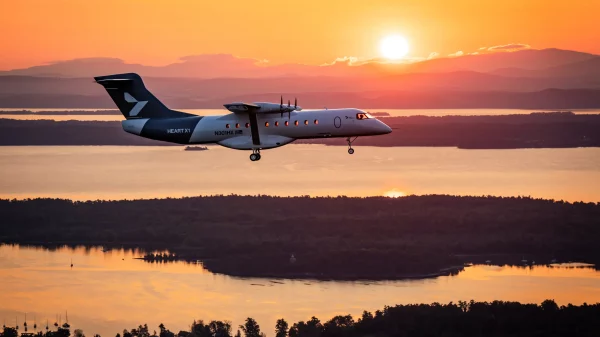
In mid-2025, Heart Aerospace successfully conducted the first fully electric experimental flight of its Heart X1 demonstrator at Plattsburgh International Airport, New York. The X1 is currently the largest fully electric aircraft ever to fly.
While the X1 is fully electric, the commercial ES-30 uses a “reserve-hybrid” system. It can fly 200 km on pure battery power for zero-emission short hops, but carries a hybrid generator to extend its range to 400 km or provide emergency reserves.
In 2025, Heart officially moved its corporate headquarters to Los Angeles, citing the U.S. as its largest market. They are currently building the Heart X2—a pre-production prototype designed to test the hybrid-electric propulsion system in flight by 2026.
Conclusion
With the above companies, these aerospace startups are not on the final list. Many other aerospace startups are also making an outstanding job in terms of innovation and technology. The aerospace industry is not interesting for everyone, they need lots of funds for development, discovering technologies, producing satellites and rockets- and the list goes on.
In addition, the failure ratio of aerospace startups is considerably less. Their work culture differs very much from other businesses. It will be interesting to watch out for the future aerospace projects and development of these eleven aerospace startups in the coming years. Let’s follow them and explore the galaxy with them.