




































































The global race to build scalable autonomous driving technology just intensified.
London-based AI startup Wayve has raised €1 billion ($1.2B) in a Series D round, pushing its valuation to €7.2 billion ($8.6B) and positioning the company as one of Europe’s most valuable AI scaleups focused on mobility.
The round was led by Eclipse Ventures, Balderton Capital, and SoftBank Vision Fund 2, with participation from major institutional investors including Ontario Teachers’ Pension Plan, Baillie Gifford, British Business Bank, Icehouse Ventures, and Schroders Capital.
Strategic investors Microsoft, NVIDIA, and Uber also joined the round, alongside automotive partners Mercedes-Benz, Nissan, and Stellantis.
The funding signals growing confidence that end-to-end AI could finally unlock scalable autonomous driving — something the industry has pursued for over a decade.
From Research Lab to Global Autonomy Platform
Founded in 2017, Wayve focuses on embodied AI, training neural networks to drive vehicles using real-world sensor data rather than relying heavily on pre-built maps or rule-based systems.
According to co-founder and CEO Alex Kendall, the company is building a platform designed to scale across the entire global vehicle ecosystem.
“Autonomy will not scale through city-by-city robotaxi deployments alone,” Kendall said. “It will scale through a trusted platform that automakers and fleets can deploy globally and improve continuously.”
Instead of building its own vehicles or fleets, Wayve licenses its AI Driver platform to automakers, allowing manufacturers to integrate autonomous capabilities into existing models.
The company’s software supports multiple autonomy levels — from L2+ hands-off driver assistance to L3 and L4 “eyes-off” automation.
Uber Robotaxis and Consumer Cars by 2027
Wayve’s commercial rollout is already taking shape.
The company plans to launch robotaxi trials on the Uber platform in London starting in 2026, with expansion to more than 10 global markets over time.
Under the partnership:
- Wayve provides the AI Driver autonomy software
- Automakers provide production vehicles
- Uber owns and operates the robotaxi fleets
This model avoids the capital intensity that has plagued many autonomous vehicle startups attempting to build vertically integrated fleets.
By 2027, consumers may also be able to buy vehicles equipped with Wayve’s AI Driver, beginning with advanced L2+ driver assistance capabilities.
A Different Approach to Autonomous Driving
Unlike many competitors, Wayve’s system does not depend on high-definition maps or location-specific engineering.
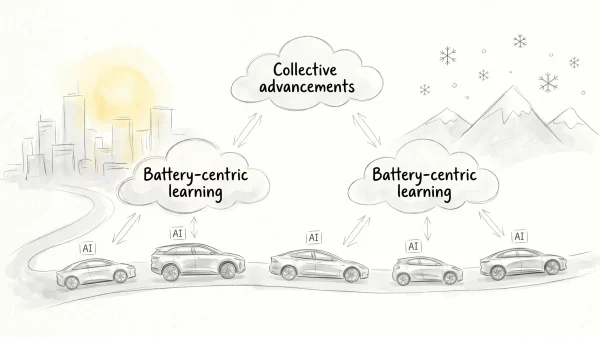
Instead, its AI models are trained on massive datasets from real-world driving environments across more than 70 countries.
This allows the system to generalize to new environments — a concept known as “zero-shot driving.”
Over the past year, Wayve says it successfully demonstrated autonomous driving in over 500 cities across Europe, North America, and Japan without city-specific fine-tuning.
If this approach proves scalable, it could dramatically reduce the cost and complexity of deploying autonomy globally.
The Largest AI Mobility Bet in Europe
The scale of Wayve’s new round also highlights how heavily investors are betting on AI for physical systems, often called embodied AI.
Compared with other recent European AI startups:
- Overmind raised €2.3M
- Toyo raised €3.6M
- happyhotel raised €6.5M
- Equixly raised €10M
Combined, those rounds total roughly €22.4 million — just a fraction of Wayve’s €1 billion funding.
The disparity illustrates a broader shift: while generative AI software startups dominate headlines, autonomous mobility remains one of the few sectors capable of absorbing billion-euro capital rounds.
Europe’s AI Champion for Mobility
The investment also reinforces the UK’s ambition to lead Europe’s AI scale-up ecosystem.
With partnerships spanning cloud providers, automotive giants, and global ride-hailing platforms, Wayve is positioning itself as the autonomy layer for the global vehicle industry.
If the company can successfully move from research breakthroughs to reliable real-world deployment, it could become one of the defining AI infrastructure companies of the mobility era.