

























































As artificial intelligence expands beyond software into real-world machines, one challenge is becoming increasingly clear: AI systems need better physical data to interact with the real world.
German DeepTech startup FLEXOO believes it has the answer. The Heidelberg-based company has raised €11 million in a Series A funding round to scale its physical AI sensor technology, a platform designed to bridge the gap between hardware systems and machine-learning algorithms.
The round was led by eCAPITAL Entrepreneurial Partners and AUMOVIO, with funds aimed at accelerating FLEXOO’s global expansion and scaling its sensor platform across battery storage and automotive industries.
The Missing Layer in AI: Real-World Data
While billions of euros are flowing into AI models, many industrial systems still lack the high-quality sensor data needed to power intelligent automation.
According to Michael Kröger, FLEXOO’s technology aims to solve this gap.
“Only ultra-thin, free-form sensor technology bridges the gap between physical hardware and learning algorithms,” Kröger said. “With the right data layer, physical AI systems can finally reach their full potential.”
Founded in 2023 as a spin-off from InnovationLab GmbH, FLEXOO builds ultra-thin, flexible sensors that can be embedded directly into surfaces, devices, and industrial systems.
These sensors collect real-time operational data and process it using AI at the edge, allowing machines to respond dynamically to physical conditions.
From Industrial Systems to Space Exploration
One of FLEXOO’s most notable applications already lies far beyond Earth.
The company says its printed heater and battery monitoring technologies are being used in a lunar rover developed by NASA, demonstrating the robustness of its hardware in extreme environments.
Beyond space applications, FLEXOO’s sensor platform is being evaluated across several industries, particularly electric mobility and battery storage.
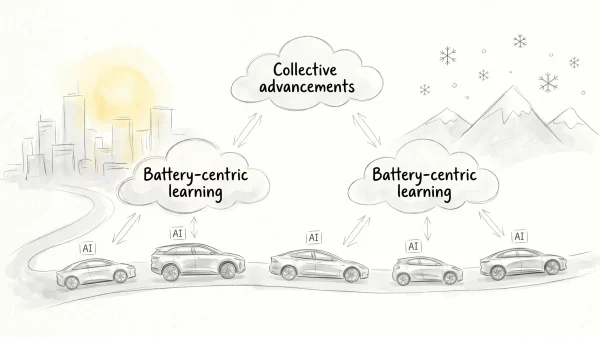
Battery manufacturers using the system have reportedly seen capacity improvements of up to 5% without redesigning battery chemistry, thanks to precise real-time monitoring at the cell level.
This type of insight enables:
- AI-driven battery management systems
- early failure detection and safety monitoring
- improved battery lifespan and performance
Printed Electronics and Scalable Manufacturing
FLEXOO’s technology is built around printed electronics, allowing sensors to be manufactured as thin, flexible layers that integrate into almost any surface.
The company’s portfolio includes:
- printed sensors
- battery monitoring systems
- foil heaters
- printed antennas
- flexible printed circuit boards (Flex PCBs)
These components form the hardware data layer for physical AI systems, enabling AI models to interact with real-world environments more accurately.
Why Investors Are Betting on Physical AI
Investors increasingly see physical AI — AI applied to robotics, vehicles, infrastructure, and industrial systems — as the next major frontier beyond generative AI.
For Hannes Schill, FLEXOO’s combination of proprietary sensors and AI-driven analytics makes it particularly compelling.
“The world is pouring billions into AI models, yet starving them of the physical data they need,” Schill said. “FLEXOO closes that gap with a scalable platform that delivers reliable real-time sensor intelligence.”
Scaling Globally in 2026
With fresh funding secured, FLEXOO plans to focus on international sales expansion and customer support while strengthening its intellectual property portfolio.
Key priorities for 2026 include:
- expanding global partnerships
- securing large-scale supply contracts
- delivering prototypes of its advanced physical AI platform
- building foundational IP around dexterous sensing technologies
If successful, FLEXOO could become a key infrastructure layer for the next generation of AI-powered machines, electric vehicles, and smart industrial systems.
And with technology already operating in space, the startup may be proving that Europe’s DeepTech ecosystem can deliver innovations that scale from Earth to the Moon. 🚀