





































































For more than a decade, the global conversation around energy innovation was framed through ClimateTech — an investment narrative built around emissions reduction, regulatory pressure, and long-term environmental impact.
Today that narrative is shifting.
Energy innovation is increasingly attracting capital not because it reduces carbon, but because it reduces costs, stabilises revenues, and strengthens control over critical infrastructure. What once sat inside the broader ClimateTech category is rapidly evolving into something more economically explicit: EnergyTech.
The distinction matters because capital follows incentives. And right now, energy systems that generate predictable financial returns are becoming one of the most attractive infrastructure investments in the global economy.
The Shift From ClimateTech to EnergyTech
The transition from ClimateTech to EnergyTech does not reflect a change in ambition. It reflects a shift in capital discipline.
Earlier waves of ClimateTech investment were often justified by environmental impact and long-term emissions narratives. Profitability and scalability were sometimes secondary considerations, expected to materialise as policy support and market adoption increased.
EnergyTech reverses that logic.
Investors now prioritise solutions that immediately improve operational economics:
- lowering total cost of energy
- stabilising electricity prices
- increasing asset utilisation
- reducing exposure to volatility
In this model, emissions reduction becomes a consequence of efficiency, not the primary justification for investment.
Market data illustrates this reprioritisation. Global ClimateTech investment declined by roughly 29% in 2024, falling from €73.5 billion to €52.1 billion according to PwC. At the same time, capital continues to flow into technologies that directly optimise energy infrastructure and energy markets.
The reason is simple: energy costs have become a strategic economic variable.
Energy Is Now a Margin Driver
For decades, energy functioned primarily as an operating expense. It rarely shaped competitive advantage.
That dynamic has changed.
Rising electricity prices, supply disruptions, and infrastructure constraints have transformed energy into a core determinant of industrial margins, asset value, and national competitiveness.
Companies that control their energy infrastructure gain:
- lower exposure to price volatility
- greater operational predictability
- stronger cost structures
In this context, technologies that optimise energy systems are no longer niche sustainability tools. They are financial infrastructure.
Solutions such as:
- AI-driven grid optimisation
- battery storage orchestration
- demand-response systems
- decentralised energy platforms
are attracting capital because they generate measurable economic outcomes today.
Energy Infrastructure Is Becoming Digital
The energy transition is often framed around generation capacity: building more solar farms, wind parks, and renewable infrastructure.
But generation alone does not solve the system-level challenge.
Without advanced digital infrastructure to coordinate supply and demand, large volumes of renewable energy can create bottlenecks in electricity distribution networks.
EnergyTech addresses this coordination layer.
Through software platforms, control systems, and data-driven optimisation, modern energy infrastructure can:
- balance supply and demand in real time
- integrate distributed generation
- coordinate battery storage
- optimise electricity trading across markets
This digital layer effectively transforms energy from a commodity into a managed infrastructure system.
The scale of investment required is enormous. According to the International Energy Agency, global investment in electricity grids will need to reach around €690 billion per year by 2030 to support electrification and renewable integration.
The Sovereignty Premium
Energy is no longer only an economic variable. It has become a strategic one.
Geopolitical disruptions over the past decade have exposed the vulnerability created by energy import dependence.
According to Eurostat, Germany relied on imports for roughly 67% of its total energy consumption in 2024. Across the European Union, the average import dependence stood at 57%.
Some countries are even more exposed:
- Spain: 69% energy import dependence
- Italy: 74%
When energy supply becomes vulnerable to external shocks, the economic consequences ripple through entire industrial systems.
EnergyTech offers mechanisms to reduce that exposure.
Technologies such as microgrids, intelligent load management, and distributed energy platforms enable companies and regions to generate, store, and manage energy locally. The result is a form of economic resilience often described as a sovereignty premium: the financial value of reduced dependence on external energy sources.
Europe’s Strategic Opportunity
Europe enters this transformation with a significant advantage: a deep industrial base combined with a strong innovation ecosystem.
According to the GreenTech Monitor 2025, Germany alone hosts around 3,000 active GreenTech startups, with roughly one quarter operating in energy-related technologies.
This ecosystem spans areas such as:
- grid intelligence
- distributed storage systems
- energy trading platforms
- industrial electrification technologies
At the same time, Europe faces urgent pressure to reduce external energy dependence while meeting climate targets. That combination of technical capability and political urgency creates a rare strategic window for EnergyTech innovation.
AI Is Accelerating the EnergyTech Shift
Artificial intelligence is emerging as a critical accelerator in this transformation.
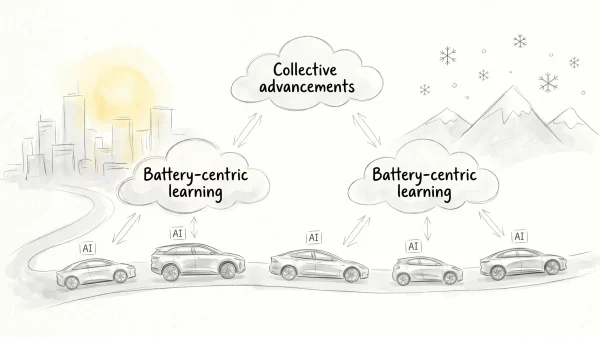
AI systems increase electricity demand — particularly through data centres — but they also dramatically improve the efficiency of renewable energy systems.
By analysing large volumes of energy data in real time, AI can:
- forecast renewable generation
- optimise battery charging cycles
- predict peak demand
- coordinate distributed energy resources
Nearly 50% of Europe’s electricity already came from renewable sources in 2024, and global renewable generation is expected to grow by around 60% by 2030, according to projections referenced by CNBC and the International Energy Agency.
Managing this increasingly complex energy system requires precisely the kind of algorithmic coordination that AI provides.
In practice, AI strengthens the operational backbone of decentralised energy systems — making them more reliable, flexible, and economically viable.
EnergyTech Is Becoming a Core Infrastructure Asset Class
The implications for investors are clear.
EnergyTech is no longer a niche sustainability category. It is becoming a core infrastructure allocation, comparable to telecommunications networks or transportation systems.
Control over energy infrastructure now translates directly into:
- economic stability
- industrial competitiveness
- geopolitical resilience
Startups building the digital operating systems of energy — platforms that coordinate generation, storage, and consumption — are effectively shaping the architecture of future energy markets.
And as capital increasingly moves toward infrastructure that generates predictable returns, the logic of EnergyTech becomes difficult to ignore.
The energy transition, it turns out, may not be driven primarily by climate ambition.
It may be driven by something far simpler:
energy that is cheaper, smarter, and economically unavoidable.