
























































Berlin-based climate startup VARM has raised €17.5 million in Series A funding to expand its home insulation platform across Germany and prepare for broader European rollout. The round was led by the ABN AMRO Sustainable Impact Fund, with participation from GET Fund, Aurum Impact, and existing investors including Emerge Partners, Pale Blue Dot, Emerge VC, and noa.
The company is tackling one of Europe’s largest but often overlooked climate challenges: the millions of homes that remain poorly insulated despite available technology and policy incentives.
Addressing a Massive Retrofit Gap
Germany alone has an estimated 14 million poorly insulated homes, representing a significant barrier to achieving national and EU climate targets.
While insulation technology is widely available, VARM argues that the real bottleneck is not materials—but workforce capacity and installation speed.
The company is building a scalable execution layer for home insulation, focusing on how to deploy trained workers efficiently across fragmented residential markets.
The “Cloud Installer” Model
At the core of VARM’s approach is its proprietary Cloud Installer model, which rethinks how insulation services are delivered.
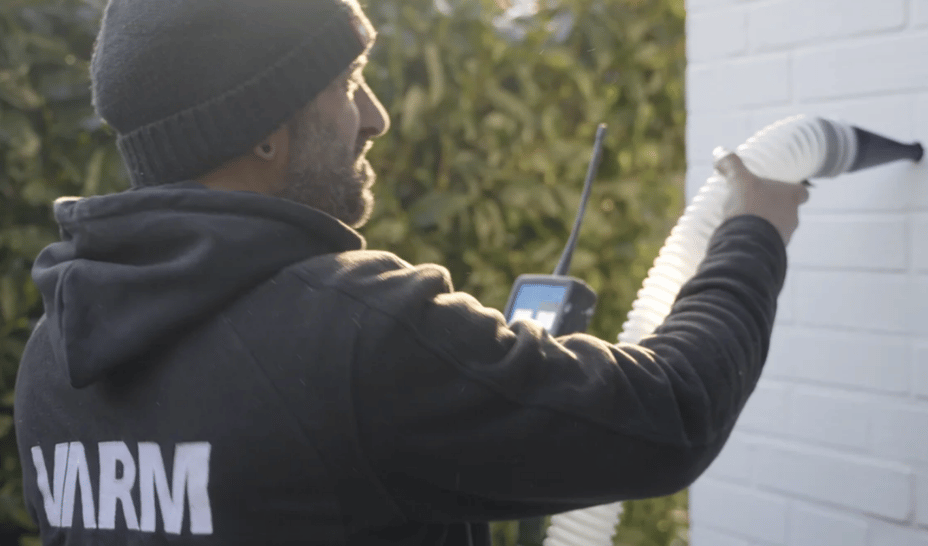
Instead of relying solely on traditional trade apprenticeships, VARM recruits career changers from sectors such as logistics and retail, training them as certified insulation specialists within weeks.
These installers are then organized into regional teams and supported by standardized workflows, quality control systems, and fixed-price offers.
According to the company, a typical single-family home can be insulated in around six hours, significantly reducing project time compared to conventional methods.
From Fragmented Trades to Scalable Infrastructure
VARM is positioning itself not just as a service provider, but as a deployment infrastructure layer for building retrofits.
Its end-to-end platform includes:
- Installer recruitment and training
- Project planning and scheduling
- Grant and subsidy support
- Fixed-price customer quotes
- Quality assurance and post-installation support
This vertically integrated model is designed to reduce friction for homeowners while increasing throughput across installation teams.
Early Traction Across Germany
Since launching in 2023, VARM has completed more than 1,000 insulation projects and expanded operations from a single city to seven locations across Germany.
The company offers insulation services for façades, roofs, ceilings, and basements, with a focus on predictable pricing and faster delivery times.
A Workforce Solution to the Energy Transition
VARM’s strategy highlights a growing recognition in Europe’s climate transition: technology alone is not enough without skilled labor to implement it at scale.
By opening insulation work to non-traditional workers, the company aims to expand the labor pool while accelerating building retrofits across Europe.
This approach also positions VARM within a broader trend of climate-focused workforce platforms, where software, logistics, and training systems combine to solve physical deployment constraints.
A Competitive European Retrofit Market
The company operates in a rapidly growing sector of building efficiency and energy renovation, alongside other German startups focused on decarbonizing the built environment.
Similar companies are addressing adjacent layers of the value chain, including:
- serial renovation technologies
- heat pump deployment
- smart metering and energy data systems
VARM’s differentiation lies in focusing on the installer network itself as the core scalability problem.
Scaling Toward a Million Homes
VARM’s long-term ambition is to insulate 1 million homes within 10 years, building a distributed European network of local insulation hubs.
The company envisions a model where trained installers can operate as part of a standardized system while still functioning as local businesses within their communities.
Building for Europe’s Climate Deadline
As Europe moves toward stricter 2030 energy efficiency and emissions targets, building renovation has become a critical priority—but also a logistical challenge.
VARM’s Series A funding positions the company to scale its operations and infrastructure at a time when demand for retrofitting solutions is accelerating.
By combining workforce training, standardized operations, and a platform-based approach to service delivery, VARM is attempting to turn home insulation into a scalable industrial system rather than a fragmented manual trade.
The success of that model will determine whether VARM can help close Europe’s insulation gap at the speed required for the energy transition.