




















































Week of 12–19 October 2026 · FinTech
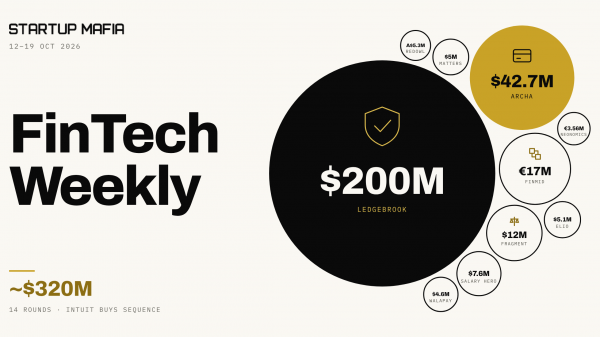
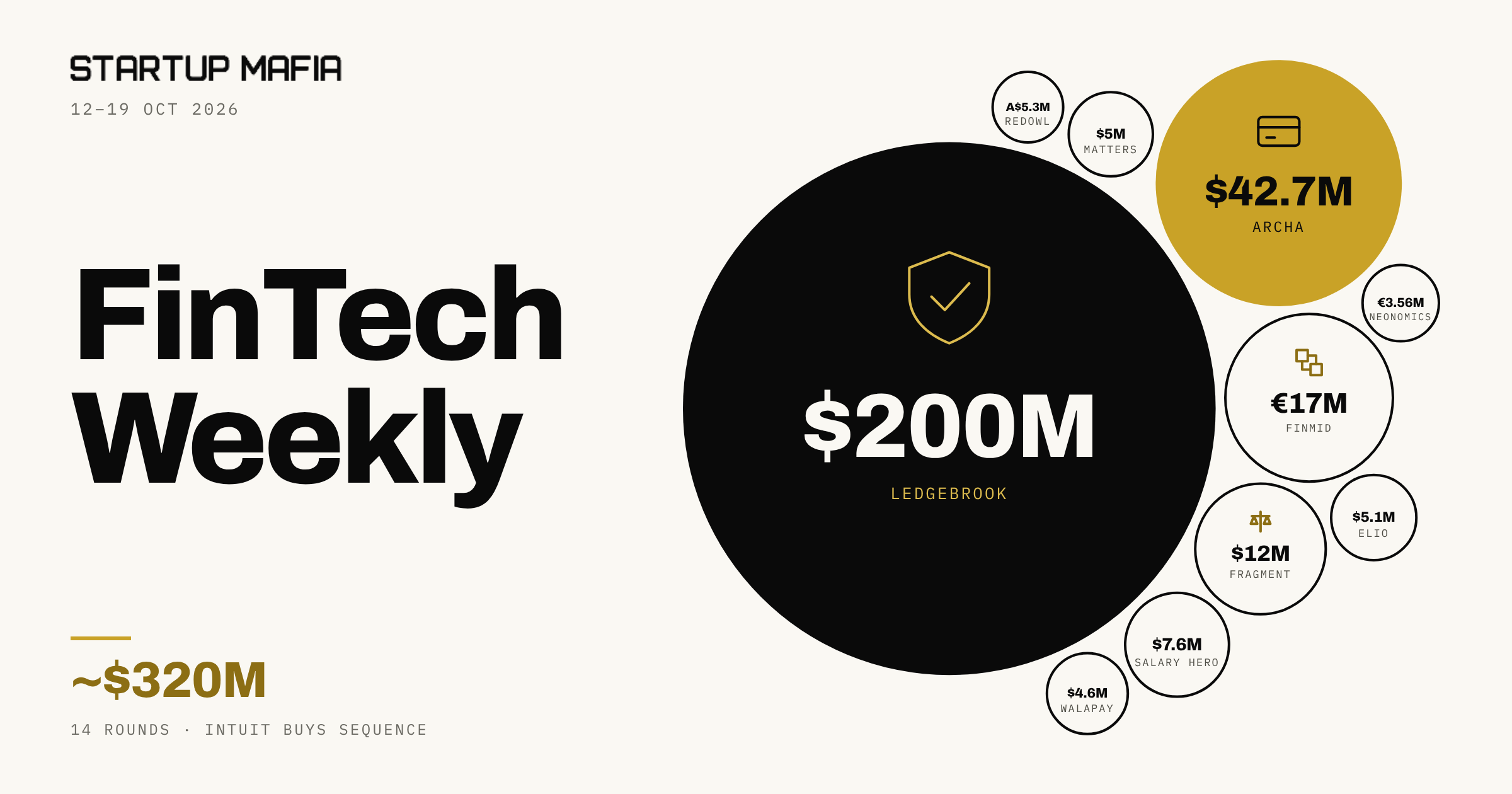
This week brought 14 confirmed FinTech rounds worth roughly $320M (including debt), plus one reported round still in talks, one acquisition and one secondary sale. A single deal accounts for most of the money: AI-native insurer Ledgebrook raised $200M. The more telling pattern is in the smaller rounds. Many of them are building the controls, checks and plumbing that let AI handle money safely. There’s also a clear push for capital efficiency: profitable companies, cost cuts, and debt instead of equity.
THE DIGEST
🇺🇸 Ledgebrook raises $200M from Allianz X and Rockefeller
The Boston-based AI-native specialty insurer raised $200M in primary equity, co-led by Allianz X, the Allianz Group’s strategic investment arm, and Rockefeller Capital Management. Separately, Allianz Re agreed to a multi-year reinsurance deal. Ledgebrook focuses on mid-sized businesses with complex or hard-to-place risks, and it expects to pass $1B in cumulative written premiums within four to six weeks. CEO Gage Caligaris says Allianz sees the partnership as an alternative to building its own US team: Ledgebrook writes the business, and Allianz takes part through reinsurance.
🇦🇺 Archa raises A$61M in equity and debt for business credit
The Melbourne fintech’s headline number combines A$11M (about US$7.7M) of equity with a new A$50M (about US$35M) debt facility, which brings the total to roughly US$42.7M. Archa gives businesses credit cards without requiring directors to sign personal guarantees, and the debt facility funds that lending. Annual recurring revenue grew 184% over the past year, and the platform processes more than $200M in annualised spending.
🇺🇸 Fragment raises a $12M Series A so AI agents can’t mishandle money
FirstMark led the New York startup’s round, with participation from BoxGroup, bringing total funding to $23M. Fragment uses double-entry bookkeeping to verify where money comes from and where it goes, and checks balances before any funds move. It has about 50 to 60 paying customers, including Ramp, BILL and Whop. Its seed round was led by Stripe.
🇪🇺 finmid raises a €17M Series A extension
The embedded-finance company has topped up its Series A.
🇪🇪 Cachet raises funding to insure Europe’s gig and mobility platforms
Spintop Ventures led the round, with existing investors Truffle Capital and Icebreaker.vc taking part, bringing the Tallinn insurtech’s total capital raised to about €11M. Cachet works with partners including Bolt, Voi, Ryde and Turo across 16 European markets. It more than doubled year on year, and 2025 was its first full year of positive EBITDA.
🇳🇴 Neonomics raises €3.56M after cutting costs by almost half
The Oslo open-finance company raised the money from existing shareholders. It follows a restructuring that cut operating costs by almost 50% while keeping its customer base. New customer acquisition has grown more than 60% since the start of 2026.
🇦🇺 RedOwl raises a A$5.3M seed to stop invoice fraud
Tidal Ventures led the Melbourne company’s round, which values it at A$38.4M. RedOwl joined Mastercard’s Start Path programme in 2024. Its platform uses AI to check payments against contracts, policies, rate cards and approvals before any money moves.
🇸🇪 Matters comes out of stealth with a $5M pre-seed
Swedish angel investor Jakob Johansson led the round. Matters is building an AI-native consumer bank that combines neobank services with an AI advisor.
Also raising this week:
- 🇹🇭 Salary Hero: $7.6M to expand into Malaysia
- 🇺🇸 Elio Mortgage: $5.1M pre-seed for an AI-native mortgage platform
- 🇿🇦 WalaPay: $4.6M to expand stablecoin payments
- 🇪🇺 Finches: €2M pre-seed
- Credfix: $1.66M seed
- 🇸🇦 Ghanem: a $1.5M extension of its pre-seed round for fractional ownership
In talks: 🇮🇳 Navi is reportedly in talks to raise $40M from Elevation at a $1.5B valuation. This isn’t confirmed yet.
EXITS & M&A
🇬🇧 Intuit buys Sequence in a reported $200M deal
The a16z-backed London and New York fintech counts AI companies Legora and Cognition among its customers. Intuit buying a company that serves AI-native businesses says something about where large incumbents see growth.
🌍 Kuunda completes a $5M secondary share sale
The deal gave Kuunda’s early investors a partial exit. Secondary sales like this are becoming one of the few ways early backers in emerging-market fintech can get liquidity.
PARTNERSHIPS
🇪🇬 MoneyHash partners with Ozow
The Egyptian payments orchestration company is teaming up with South African payments firm Ozow to strengthen South Africa’s digital payments market.
THE ANALYSIS
1. AI agents are getting access to money, so the money needs guardrails
Several deals this week address the same problem: what happens when software, not a person, moves money. Fragment’s checks make sure every transaction adds up before funds move. RedOwl checks invoices against contracts before payment. Matters and Elio are building AI into banking and mortgages from the start. Fragment’s own pitch points to the risk, citing incidents where AI agents went beyond their instructions. As Visa and Mastercard enable agent-made payments, the companies building trust and correctness checks could become as essential as payment processors.
2. Insurance is attracting the biggest cheques
Ledgebrook’s $200M shows how the big insurers now approach innovation. Allianz chose to back a startup and add reinsurance capacity instead of building a US team itself. Cachet shows the other side of insurtech: a profitable broker that insures gig and mobility platforms, priced on how vehicles and workers are actually used. Cachet’s investor notes that many insurance startups are burning cash to buy growth at high valuations, which makes the profitable ones stand out.
3. Capital efficiency matters more than growth at any cost
Neonomics cut its costs almost in half before its existing investors added more money. Cachet raised only after reaching profitability. Archa’s round is more than 80% debt. For lending fintechs, debt facilities are now the main fuel for growth, and equity rounds are smaller and come with more discipline. This is the opposite of the 2021 playbook.
4. Business finance is where the activity is
Archa, finmid, RedOwl and Fragment all serve businesses, not consumers. They cover business credit, embedded finance, spend controls and accounting. The Intuit–Sequence deal points the same way. B2B finance has more money at stake, less competition and clearer AI use cases than consumer fintech.
5. Emerging markets are building their own payment rails
WalaPay is using stablecoins for payments in South Africa. MoneyHash and Ozow are connecting North and South African payments. Salary Hero is expanding from Thailand to Malaysia. Ghanem is offering fractional ownership in Saudi Arabia. Navi is reportedly raising at a $1.5B valuation in India. These rounds are smaller than the US deals, but they’re building basic financial infrastructure in places where traditional banks don’t serve people well.
Bottom line: FinTech has moved past the “AI wrapper” stage. The money is going to infrastructure that can safely handle real money with AI involved: insurance underwriting, credit, payment checks and accounting. Companies that combine that with capital discipline are the ones getting funded.
Sources: