


































Week of 26 October – 2 November 2026 · AITech
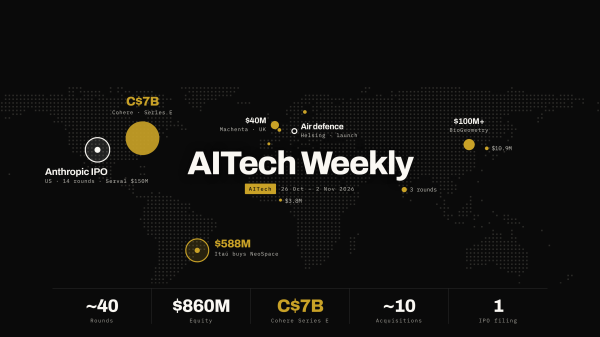
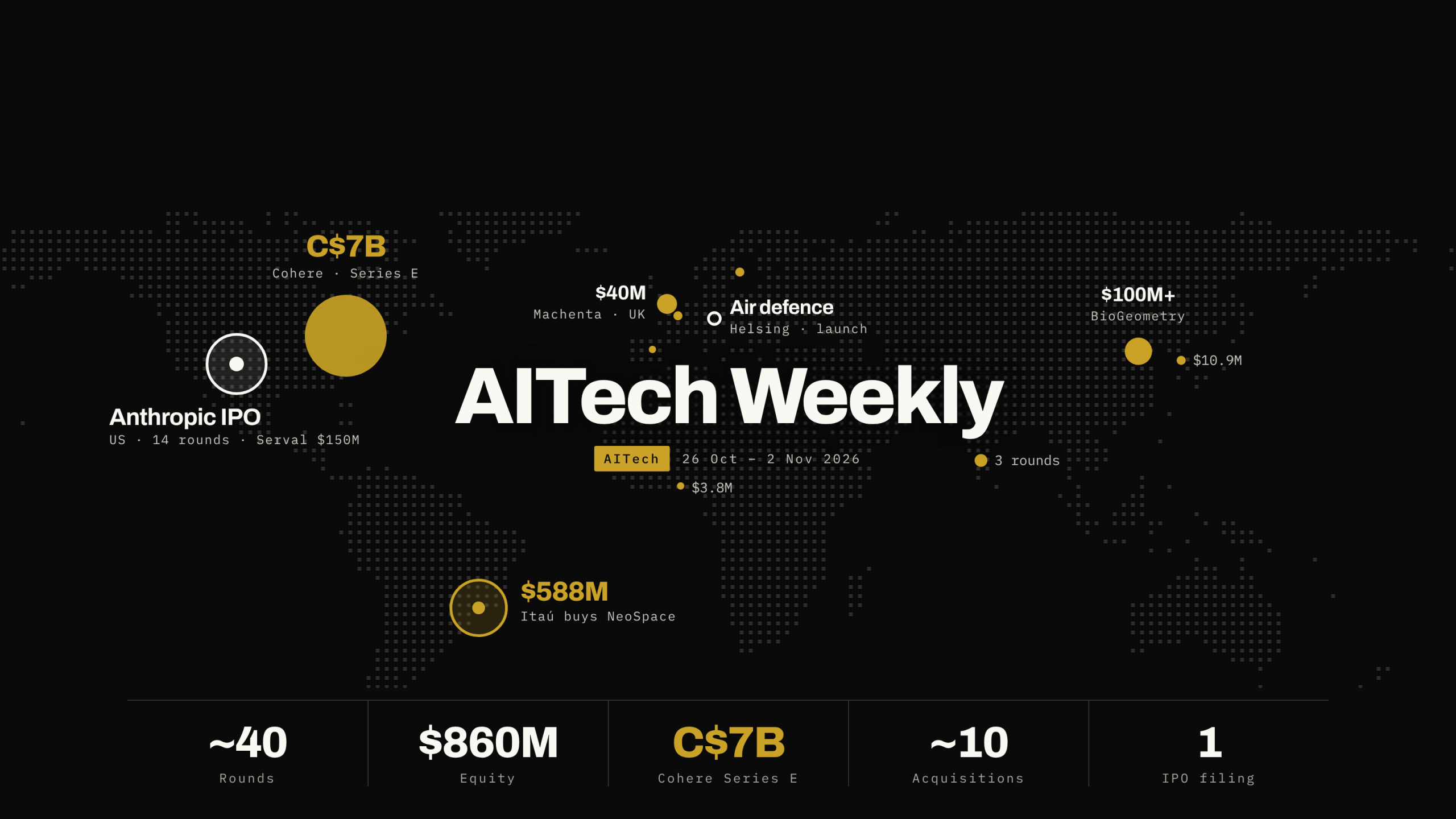
This week brought about 40 rounds worth roughly $860M in disclosed equity, plus Cohere’s planned C$7B Series E and around 10 acquisitions. The biggest story wasn’t a funding round: Anthropic filed to go public, which for the first time put a leading AI lab’s finances on public record. Governments also became direct shareholders in AI companies, startups raised money to replace established enterprise software, and European money went to robotics, policing and defence.
THE DIGEST
🇺🇸 Anthropic files for a Nasdaq IPO under the ticker “ANT”
The filing reports $16.3B in revenue for the first half of 2026, up from $1.16B a year earlier. Anthropic posted its first operating profit in the second quarter, $974M on $11.6B of revenue. Its net loss for the half was $80.7B, mostly because of accounting charges on convertible notes whose value rose with Anthropic’s valuation. More than 1,900 customers each pay over $1M a year. Seven co-founders will hold 50.1% of the voting power through a special share. Goldman Sachs and Morgan Stanley are leading the offering. The filing doesn’t give a price range; Reuters reports a likely market value of about $1.5T.
🇨🇦 Cohere announces the first close of a Series E targeting up to C$7B (about US$5B) at a C$35.7B valuation
Germany’s Schwarz Group leads the round, with Bell Ventures and Bullhound Capital. Canada’s government will invest up to C$1.6B for an equity stake, announced by Prime Minister Mark Carney. In return, Cohere has committed to staying headquartered in Canada and to investing at least C$1.7B in Canadian computing infrastructure by 2030. It is the largest private funding round ever for a Canadian company, though Cohere hasn’t said how much has been committed so far.
🇺🇸 Serval raises a $150M Series C at a $3B valuation to replace ServiceNow
Sequoia led the round, as it led the previous two, with Conviction and Headline joining. That’s three times the valuation from December, and the company has grown from about 20 to nearly 200 employees in a year. Its AI agents handle IT support and are expanding into HR, finance and legal requests. Customer Lucid Motors moved off ServiceNow entirely in 45 days.
🇺🇸 Wabi raises $55M at a $1.25B valuation
IVP led the round, with a16z, Forerunner and the Amazon Alexa Fund, plus angels including Tobi Lütke and Marc Benioff. Founded by Eugenia Kuyda, who previously created the AI companion app Replika, Wabi has moved from letting users build mini-apps from prompts to an AI assistant designed for group chats.
🇨🇳 BioGeometry passes $100M in Series A funding for AI that designs drugs from scratch
China Life Capital led the latest extension. The Beijing company’s GeoFlow model designs new molecules, and its GeoCell model predicts how cells respond to genetic changes and drugs. Several of its antibody drugs should be ready to file for clinical trials in 2027.
🇬🇧 Machenta raises a $40M seed, the largest ever for a UK robotics startup
Creandum and Union Square Ventures co-led the round. The 11-person Imperial College London spin-out trains robots entirely in computer simulation, with no real-world data, and says its model can learn a new task from a single demonstration. Its research showed a robot learning 1,000 everyday tasks in under 24 hours.
🇬🇧 22one valued at about $400M before launching a product
Sequoia, General Catalyst, Lux Capital and Creandum invested; the amount raised wasn’t disclosed. The London company builds AI tools for police investigations and is still in stealth. Founder Steven Richardson is a former Merseyside Police detective chief superintendent who later co-founded Riven, an AI redaction tool used by UK police forces, which has since been sold.
Also raising:
- 🇨🇦 Solink: more than $100M led by Vertu Capital for AI that analyses security camera video
- 🇺🇸 Fragment: $56M Series A (8VC, General Catalyst, A*) for AI agents that handle procurement problems
- 🇺🇸 Casap: $56M for AI that helps banks tackle customer fraud
- 🇺🇸 Hyperbolic: $30M Series A-1 led by Walden Catalyst for a marketplace for AI computing power
- 🇺🇸 SuperMe: $20M for a network of AI versions of experts
- 🇺🇸 Alta: $20M Series A for AI fashion services
- 🇺🇸 Dream: $17M from a16z for AI that models construction sites, founded by former Palantir executives (not the same company as Dream Labs)
- 🇬🇧 Nous: $17M (Heartcore, Mosaic) for an AI agent that switches household providers and cancels subscriptions for you
- 🇺🇸 ClarityCare: $16.5M for healthcare admin AI
- 🇺🇸 Plato: $16M Series A led by Nava Ventures for AI training simulations
- 🇮🇳 Live2.ai: ₹130 crore pre-Series B led by IvyCap
- 🇮🇳 Simplismart: $14M Series B led by Dallas Venture Capital
- 🇺🇸 Reflex: $14M for building custom business apps to replace off-the-shelf software
- 🇬🇧 Ravical: £12M for AI serving accounting firms bought by private equity
- 🇺🇸 Paradev: $11.5M seed to run hundreds of coding agents at once
- 🇰🇷 NanoForge AI: $10.9M seed to automate materials discovery
- Omnichat: $10M Series A led by Openspace
- 🇺🇸 Mintive: $7M seed for identity verification for AI agents, backed by Jeff Dean and Andrej Karpathy
- 🇺🇸 Dalet Labs: $7M pre-seed from Lightspeed for an AI shopping app
- 🇫🇷 Bleu Robotics: €5M pre-seed (Contrarian, OVNI) to set up humanoid robots for new tasks in under an hour
- 🇬🇧 Querio: €4.48M led by BMW i Ventures
- 🇮🇳 Hunar.AI: ₹40 crore Series A led by Blume Ventures
- 🇳🇬🇺🇸 Minicor: $3.8M seed to connect AI to older business software, raised after seven rejections
- 🇪🇸 Artiso: €3M+ pre-seed (Criteria Venture Tech) for fashion teams
- 🇸🇪 Pixel Systems: €2.7M seed for detecting AI-generated content
- 🇬🇧 Ares Intelligence: €2.6M (Creandum, Lakestar)
- 🇸🇪 oaiz: SEK 23M pre-seed for AI workflow automation
- 🇩🇪 VUSE XR: €1.2M pre-seed for mixed-reality training
- Smaller rounds: EchoTwin, MARC, Mostest, Assembler AI, QwikBuild and Tensrai. China’s Hypersphere, Jixian and Prophetlab each raised undisclosed yuan rounds.
REPORTED, NOT CLOSED
- OpenAI: reports say it raised about $11B instead of the $30B it was seeking at a $1.25T valuation. Investors had until 30 October to commit. Not confirmed by the company.
- Physical Intelligence: reportedly in talks at about $20B, double its last valuation
- Lovable 🇸🇪: offering employees an $80M share sale at a $13.3B valuation (Sifted)
- Sarvam 🇮🇳: Cognizant reportedly in talks to invest at $3.5–4B
- Humain 🇸🇦: the feed reports Aramco buying 49% for $2.6B. The only confirmed deal is a non-binding agreement from October 2025.
EXITS & M&A
- 🇧🇷 Itaú buys NeoSpace for R$2.93B (about $588M). NeoSpace builds AI models trained on Itaú’s own data for credit, fraud and customer service, and the bank already owned 15% of it. NeoSpace was founded in 2023, and its roughly 80 researchers will keep working independently.
- 🇺🇸 Salesforce buys Rune Technologies, reportedly for $375M. Rune’s software helps the US military plan supply logistics even without a reliable connection. It’s Salesforce’s largest national-security acquisition, a week after it bought Braze.
- 🇺🇸 Deepgram buys Daily, maker of Pipecat, a popular open-source framework for building voice agents. Pipecat will stay open source under a new independent foundation.
- 🇺🇸 Apple hires much of Ascend.io’s team and licenses its technology. Ascend.io built AI agents for data engineering. The deal closed 30 June and was only disclosed this week through the EU’s acquisitions register.
- Smaller deals: Freshworks bought Israel’s Robusta Dev, Coveo bought a Silicon Valley startup that helps retailers sell to AI agents, and Equiti bought Lexi, a year after Lexi’s $1.4M pre-seed.
SHUTDOWNS
- Swish.ai was sold for $150,000 in insolvency after raising $20M.
LAUNCHES & POLICY
- 🇩🇪 Helsing unveils Contra, an AI-controlled air defence system designed to counter large drone and missile attacks. It comes with two interceptors, AD-1 Inferno and AD-2 Ambush, which Helsing says will cost under €100,000 each, against $4–5M for a Patriot missile. Neither has finished flight testing, and Helsing expects them to be ready in the second half of 2027.
- 🇬🇧 The UK adds £120M to its Sovereign AI Fund to invest in and buy from startups.
- 🇸🇪 Strawberry releases its AI browser with built-in assistants, pitched as a business alternative to ChatGPT and Claude.
THE ANALYSIS
1. Investors are about to see a frontier AI lab’s real finances
Anthropic’s filing puts revenue, losses and computing costs on public record for the first time. That matters beyond one company: once there’s a public benchmark, every private AI valuation can be compared against it. The reported pullback in OpenAI’s round shows private investors are also starting to push back on price.
2. Governments are buying stakes in AI companies
Canada is buying into Cohere, the UK is adding to its Sovereign AI Fund, and Aramco is reportedly deepening its stake in Humain. “Sovereign AI” now means governments owning equity in AI companies, not just signing contracts with them. The trade-off is that conditions come attached, such as Cohere’s commitment to stay in Canada.
3. AI startups are going after established enterprise software
Serval is targeting ServiceNow, Reflex wants to replace off-the-shelf software with custom apps, and Fragment and Paradev automate whole workflows. Investors are betting AI can take over the job that established software does, not just add features to it.
4. Big companies are buying AI teams and owning their AI models
Itaú paid $588M to own the AI models it already relied on. Apple licensed Ascend.io’s technology and hired much of its team rather than buying the company outright. Salesforce bought Rune for defence. Meanwhile Swish.ai sold for $150,000 after raising $20M, showing that funding doesn’t guarantee an exit.
5. AI assistants are a crowded and expensive bet
Wabi, SuperMe, Nous and Dalet Labs all raised for personal AI assistants, following Instinct’s $10B round last month. Valuations are high for products that are mostly still early, so investors are making several bets in the hope one wins.
6. Europe is backing robotics, policing and defence
Machenta raised the UK’s largest robotics seed, 22one was valued at $400M before launching a product, Helsing unveiled a full air defence system, and Bleu Robotics raised for humanoid robots. Europe’s AI money is going into robots, public safety and defence rather than chatbots.
Bottom line: Anthropic’s filing means AI valuations will soon have a public benchmark, and governments are now direct shareholders in the AI race. Startups targeting established enterprise software and personal assistants drew the most money, while Europe put its bets on robots and defence.