

































Week of 26 October – 2 November 2026 · BioTech
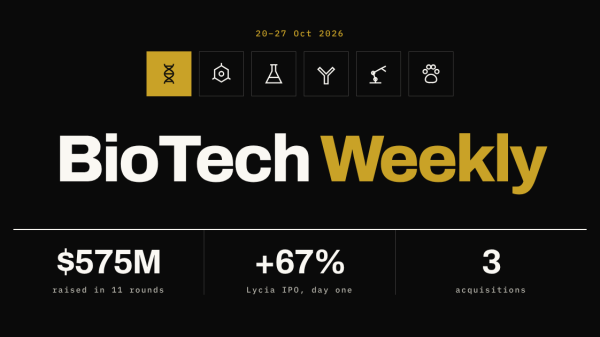
This week brought nine verified rounds worth about $590M, a $600M drug-development fund, one IPO and two acquisitions. The biggest commitment wasn’t a funding round: Formation Bio raised a $600M fund to buy promising drugs that have stalled in other companies’ pipelines and take them through trials. Dren Bio raised $350M ahead of a possible 2027 launch, and Aspen’s Parkinson’s IPO priced at the bottom of its range. Anthropic disclosed that it had bought Mithril Medicine, a biotech with one employee who coordinated 11 labs using Claude.
THE DIGEST
🇺🇸 Formation Bio raises a $600M fund to buy and develop stalled drugs
Formation Bio isn’t a venture firm. It manages the fund, and the money comes mostly from university endowments, foundations and hospitals. The fund will buy or license 10 to 15 drugs that have stalled in other companies’ pipelines over three to five years, and use Formation’s AI tools to move them through clinical trials faster. It has already licensed two. CEO Ben Liu argues the real bottleneck is development, not discovery, and that AI is making it worse by producing more promising drugs than companies can test.
🇺🇸 Dren Bio raises $350M for a possible 2027 launch of its blood cancer drug
Juvia Group and Lightspeed co-led the round, with General Catalyst, OrbiMed, Cormorant and Mirae Asset joining. Dren Bio’s lead drug, dibotatug, is an antibody that removes the faulty immune cells driving two rare blood cancers, cytotoxic T-cell lymphoma and large granular lymphocytic leukemia. Neither cancer has an approved treatment. The money funds late-stage trials, the application for approval and launch preparations. Dren Bio has previously signed deals with Sanofi, Novartis and Pfizer.
🇺🇸 Setara Biosciences launches with a $90M Series A
Jazz Pharmaceuticals paid $820M upfront in August to buy Actio Biosciences for its epilepsy drug. Setara is the new company formed to take on the rest of Actio’s pipeline, and Jazz took a minority stake. Actio’s investors Deerfield, Canaan, Droia, EcoR1, Euclidean and Regeneron Ventures returned. Setara’s lead drug, STAR-0871, is a pill for Charcot-Marie-Tooth disease type 2C, a rare inherited nerve disorder, and for the much more common overactive bladder.
🇺🇸 Opentrons raises a $40M Series E for lab robots
Healthcare investor Avego led the round, with BroadOak. Opentrons has installed more than 11,000 lab robots in over 80 countries. Its Flex platform lets AI systems design, run and refine experiments in a continuous loop. The round is much smaller than its $200M Series C in 2021.
🇨🇦 Specific Biologics raises a $35M Series A to bring an ALS gene-editing treatment to patients
Hatteras Venture Partners led the round, with Lumira, adMare, BDC and Genesys. ALS is a fatal disease that destroys the nerves controlling muscles. The Toronto company’s Dualase technology cuts out the stretch of repeated DNA in the C9ORF72 gene that is the most common genetic cause of ALS, while leaving the healthy part of the gene intact.
Also raising:
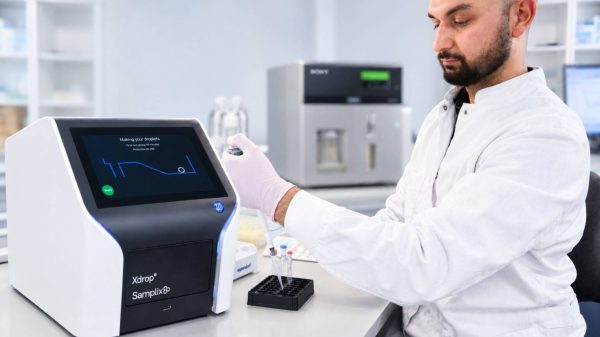
- 🇩🇰 Samplix: €25M first close, led by WLanholding. Only €3M is new money; €22M comes from existing shareholders’ convertible bonds. The target is €30M.
- 🇺🇸 Libo Bio: $15M Series A for small-molecule drugs that target RNA
- 🇨🇭 Atlas Bio: $12.5M to test drugs on virtual patients
- 🇪🇸 ALLOX: $10.5M seed led by Asabys, through its Sabadell Asabys II fund, for drug discovery
- 🇬🇧 Resurrect Bio: $10.3M for AI that restores crops’ natural disease resistance using only the plant’s own DNA
- 🇺🇸 Caravel Bio: $1.2M grant from the National Science Foundation for AI that makes protein research faster and cheaper; it also hired a CTO
- Two unnamed $50M rounds: a drug developer in Wayne, Pennsylvania, and an AI biotech in Cary, North Carolina. I couldn’t identify either company.
IPO
🇺🇸 Aspen Neuroscience raises $140.6M on Nasdaq (ticker ASPE)
It sold 9.4M shares at $15, the bottom of its $15–17 range, valuing the company at about $462M. Aspen makes a Parkinson’s treatment from each patient’s own skin cells, which are turned into the brain cells Parkinson’s destroys. Fifteen patients have been dosed in its early trial, and it plans to start a Phase 3 trial in the second half of 2027.
EXITS & M&A
- 🇺🇸 Anthropic disclosed that it bought Mithril Medicine. The deal closed in July. Mithril’s only employee, founder Cody Tranbarger, used Claude to manage contracts and experiments across 11 outside labs. In under 18 months he took a treatment for rare muscular dystrophies from idea to promising results in mice. It could reach human trials by late 2028. Tranbarger now works at Anthropic, and Mithril’s programs are the first drugs in Anthropic’s own pipeline.
- 🇺🇸 Ferring is buying Gameto for $1.4B (covered in this week’s HealthTech digest).
THE ANALYSIS
1. The bottleneck has moved from discovering drugs to testing them
Formation Bio raised $600M on the argument that AI is creating more promising drugs than anyone can test. Atlas Bio simulates trials on virtual patients, and Opentrons automates lab work. The money is shifting from finding molecules to proving they work.
2. Biotech is finding new ways to fund drugs
Formation’s fund invests in individual drugs rather than whole companies. Setara was formed to take on the drugs Jazz didn’t buy. Samplix raised mostly from its existing shareholders. All three are ways to fund drugs without a traditional venture round.
3. Investors want drugs that are close to approval
Dren Bio raised $350M for a drug approaching launch, while Aspen’s IPO priced at the bottom of its range despite FDA designations that speed up review. Investors are paying for drugs near approval and are more cautious about earlier-stage science.
4. Small teams can now run drug programs with AI
Mithril took a treatment to promising results in mice with one employee and Claude coordinating 11 labs. It’s a single case, and the results are early, but it suggests the minimum team needed to run a drug program is shrinking.
5. Gene editing is going after harder targets
Specific Biologics’ technology can cut out repeated DNA, which conventional gene editing struggles with. ALS caused by the C9ORF72 gene is one of the hardest problems in genetic medicine, and an oversubscribed round shows investors are willing to back the attempt.
Bottom line: The money this week went to the slow, expensive stage of proving drugs work, not to discovering more of them. New funding models for individual drugs are emerging, and Mithril showed how small a drug-development team can now be.