









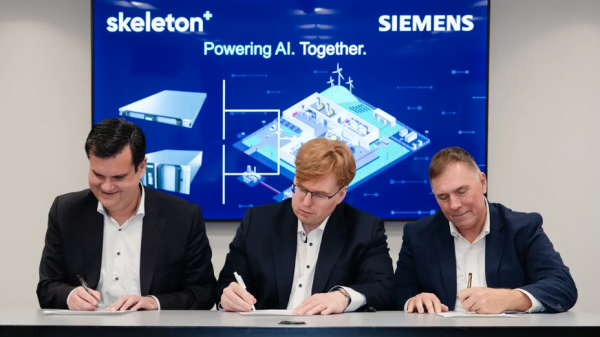






















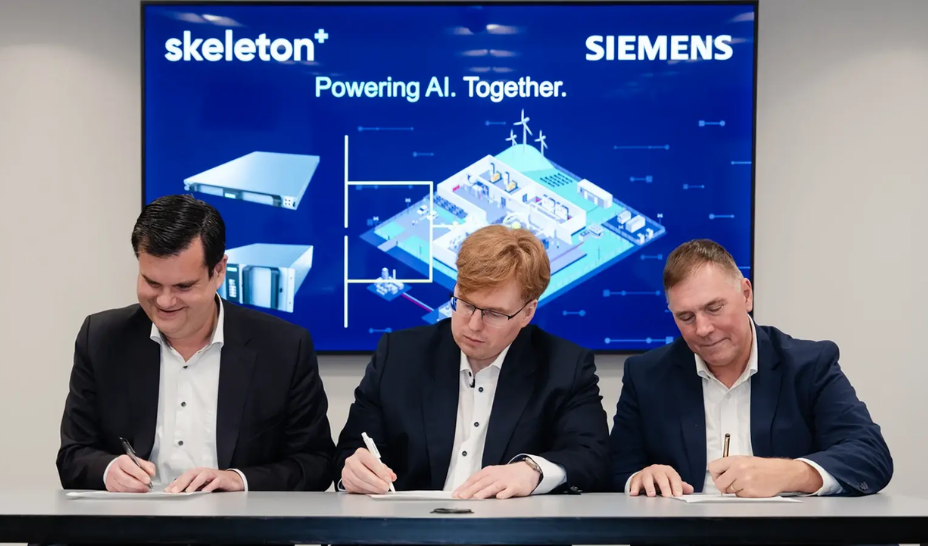
Tallinn-based Skeleton Technologies, a developer of high-power systems for AI infrastructure, has announced a “9-digit investment” led by Siemens, lifting its valuation to more than €899 million ($1 billion). The exact amount was not disclosed.
The Investment
The money will mainly accelerate the expansion of Skeleton’s US manufacturing footprint and its R&D in Silicon Valley, to meet growing demand from hyperscalers for AI data-centre power systems. Skeleton plans to invest more than €179 million ($200 million) in operational scale-up and R&D in Silicon Valley, working directly with hyperscalers. The US expansion includes plans for domestic cell manufacturing, creating a fully integrated US value chain from cells to complete systems.
In May 2026, EU-Startups reported a €33 million first close for Skeleton, bringing its cumulative venture funding at the time to €392 million, ahead of a planned US IPO in 2027.
Taavi Madiberk, CEO of Skeleton Technologies, said: “AI is scaling faster than the power infrastructure behind it. The constraint is not how many GPUs you can buy, but how much compute you can extract from every GPU and every megawatt available.”
He added: “In AI infrastructure, supercapacitors are becoming the new semiconductors. They will determine how much performance hyperscalers can deliver from their GPUs. Our systems remove power fluctuations as a constraint, enabling more compute faster while delivering up to 40% energy savings and double-digit improvements in GPU performance. This 9-digit investment round led by Siemens gives us the industrial scale to expand manufacturing in the United States and become the only player in our segment with a full US value chain, from cells to complete systems.”
The Siemens Partnership
The investment deepens a long-standing relationship. Siemens supported Skeleton’s expansion in 2023, and Siemens Digital Industries designed and automated the company’s Leipzig SuperFactory in Germany. The new partnership focuses on AI data-centre infrastructure and rising hyperscaler demand in the US.
The companies will combine Siemens’ industrial electrical infrastructure with Skeleton’s fast-response power systems to develop and commercialise products for next-generation AI data centres, addressing hyperscaler demand “from the grid to the rack” and bringing Skeleton’s manufacturing closer to its largest AI infrastructure customers.
Markus Grabmeier, President of Electrical Products at Siemens AG, said: “Skeleton’s portfolio perfectly complements Siemens’ comprehensive data centre offering. Our combined innovation roadmap will deliver benchmark solutions for the white space of next-generation data centres, delivered by a strong manufacturing network across Europe and the USA.”
The Technology
Founded in 2009, Skeleton equips AI data centres, electrical grids, defence systems and critical infrastructure to withstand surges, instability and failure. Its power systems protect GPU clusters from millisecond-level spikes and let hyperscalers run at higher rack densities without grid compromise. The company reportedly makes AI data centres up to 40% more energy efficient.
At the core is its proprietary Curved Graphene material, engineered for fast power delivery, high efficiency and long cell life. Skeleton combines its cells with power electronics and system-level controls to manage the rapidly changing power demands of AI clusters.
Why Power Is the Bottleneck
According to the International Energy Agency, global data-centre electricity consumption is expected to nearly double from around 485 TWh in 2025 to 950 TWh by 2030, while electricity use by AI-focused data centres is expected to triple. In the US, data centres are projected to account for around half of electricity-demand growth through 2030.
The round comes amid a series of European rounds targeting the physical infrastructure and energy demands of AI data centres in 2026, including Valencia-based iPronics (€107.6 million for energy-efficient optical networking), London’s Orbital Industries (€43 million for AI-designed data-centre infrastructure, including cooling) and UK-based Gaussion (€24.5 million for battery technologies, including for data centres). Together with comparable or adjacent rounds in the Netherlands, Germany and the UK, these represent approximately €261.1 million in active funding.