









































Week of 12–20 October 2026 · AgriTech
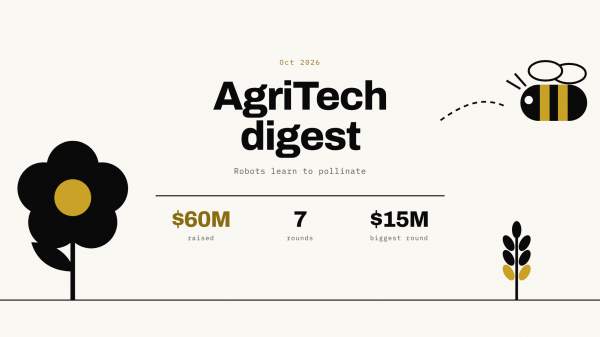
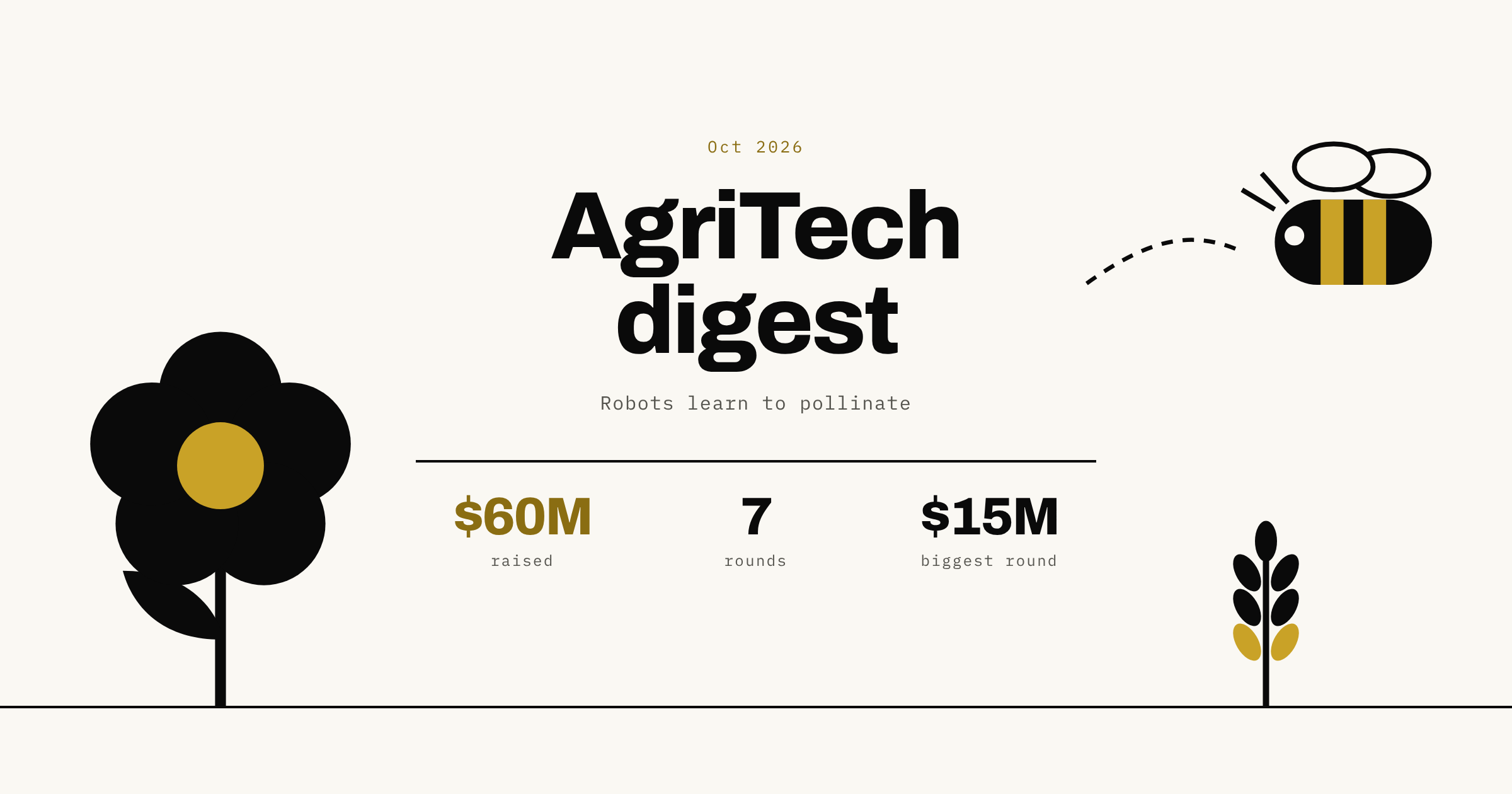
This week brought seven AgriTech rounds worth roughly $60M, one asset acquisition and one shutdown. More than half the money went to biologicals: microbe-based products that aim to replace synthetic fertiliser and pesticides. Growers and food companies also invested directly, and climate pressure is reshaping what farms buy, from salt-tolerant wheat to robotic pollination.
THE DIGEST
🇺🇸 BioConsortia raises $15M to scale nitrogen-fixing seed treatment
The money came from an entity linked to John Pasquesi, managing member of existing investor Otter Capital. Its main product, Always N, is a seed coating with microbes that let crops take nitrogen from the air, so farmers need less synthetic fertiliser. In New Zealand, where it sells through partner H&T, adoption rose from about 5% in 2024 to about 50% in 2025, and is projected to reach about 80% in 2026. In the Americas it sells through a partnership with Mosaic.
🇮🇱 BloomX raises a $13M Series A for robotic pollination
Elah Fund led the round, with the Rothschild Fund, OurCrowd, BioBee, several Israeli farming cooperatives and the Israel Innovation Authority, bringing total funding to $20M. BloomX’s robots pollinate avocados and blueberries alongside bees, and growers pay for pollination as a service instead of buying the machines. The company says farms using it have seen average yield increases of about 20%. Next it plans to expand in Peru, Mexico, South Africa and Israel, and to enter the US.
🇺🇸 IMIO raises $12M from Sofinnova and Chipotle’s Cultivate Next
Sofinnova Partners led the round, with Chipotle’s venture fund Cultivate Next and others participating. IMIO grows each microbe strain separately, mixes them in exact ratios, and freeze-dries the result so it stays alive on the shelf. Its products break down crop residue left after harvest and release nutrients back into the soil. In trials across more than 10,000 acres, IMIO reports corn yields up 11.9 bushels per acre on average. The money will build a lab and manufacturing headquarters in Chicago.
🇺🇸 Kodama raises $7M for “physical AI” in forestry
Konvoy Ventures and Breakwater Ventures co-led the round, with Breakthrough Energy Ventures and Congruent Ventures among the participants. Kodama fits existing logging machines with systems that let one operator run them remotely, with a human always in control, and it sells this as a service. The company works with logging contractors in the southeastern US.
🇸🇪 OlsAro raises a €5M seed for climate-resilient wheat
Industrifonden led the round, with Nordic Foodtech VC as co-lead. In trials in Bangladesh, OlsAro’s salt-tolerant wheat yielded up to 41% more than a variety already considered moderately salt-tolerant. In India, seed company DCM Shriram has been testing its wheat lines. OlsAro plans to launch commercially in 2027 and is adding drought tolerance and nitrogen-use efficiency to its research.
Also raising this week:
- 🇨🇦 Molagri: $5.2M seed led by Convective Capital, with Y Combinator and Paul Graham. Molagri makes pesticides that target only specific pests and can be updated as pests develop resistance, instead of being reinvented each time.
- 🇮🇹 Active Label: €2.1M from Eureka! Venture, CDP Venture Capital (through its Farming Future programme) and Banco di Sardegna. Active Label is a University of Cagliari spin-off making smart labels that record whether food stayed at the right temperature during transport.
ACQUISITIONS
🇦🇺 Fremantle Seaweed buys FutureFeed’s cultivation assets
The Western Australian startup bought the nursery, production technology and equipment of FutureFeed, which was set up by Australia’s national science agency CSIRO. FutureFeed holds the global rights to use Asparagopsis seaweed as cattle feed, which can cut methane emissions from cattle by more than 80%. Fremantle Seaweed aims to start selling its seaweed feed in 2027.
SHUTDOWNS
🇲🇦 YoLa Fresh closes after failing to raise new funding
The Moroccan startup linked fruit and vegetable growers directly with retailers, with next-morning delivery. Its co-founders confirmed the closure on 8 October. YoLa Fresh had raised $9M in disclosed funding, worked with more than 1,000 retailers and handled about $1M in monthly sales. Investor Al Mada Ventures had taken a controlling stake in 2024.
THE ANALYSIS
1. Biologicals are getting the money
IMIO, BioConsortia and Molagri together raised $32M of this week’s roughly $60M. All three pitch the same thing: biological products that work as reliably as the chemicals they replace. Freeze-drying, two-year shelf life and pesticides that can be updated are each answers to farmers’ main complaint, which is that biologicals perform inconsistently.
2. Farms are buying protection against climate change
OlsAro’s salt-tolerant wheat, BloomX’s pollination as bees decline, and Fremantle Seaweed’s methane-cutting feed all sell resilience. Farmers aren’t paying for “sustainability” as an idea; they’re paying to protect yields from weather, soil and pollinator problems.
3. Robotics is sold as a service
BloomX sells pollination as a service and Kodama sells remote operation as a service. Farmers and loggers don’t buy the robots, which removes the biggest barrier to adoption: upfront cost. The pitch is filling a labour shortage, not replacing workers.
4. Growers and food companies are investing directly
Israeli kibbutzim and farming cooperatives backed BloomX, Chipotle backed IMIO, and Mosaic distributes BioConsortia’s products. When the end customer is also an investor, it’s a strong sign of demand, and it gives the startup a ready way to get its product onto farms.
5. European public money is backing agrifood
Sweden’s state-owned Industrifonden led OlsAro, Italy’s CDP Venture Capital backed Active Label, and the Israel Innovation Authority joined BloomX. France’s Sofinnova led a US round. Europe’s agrifood deals this week are small, but state-backed funds are writing the cheques.
6. Owning the product beats running the logistics
YoLa Fresh’s closure shows how hard it is to raise money for a marketplace that has to handle the produce itself. This week’s funded companies own patents, genetics or manufacturing processes. Investors want defensible technology, not thin margins on moving produce.
Bottom line: AgriTech money this week went to biology and climate resilience, sold in ways farmers can adopt easily. Investors want proof that products work reliably in the field, and they are steering away from asset-heavy marketplaces.
Sources: