






















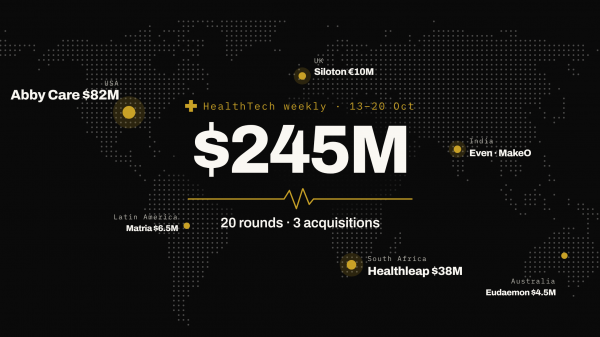



























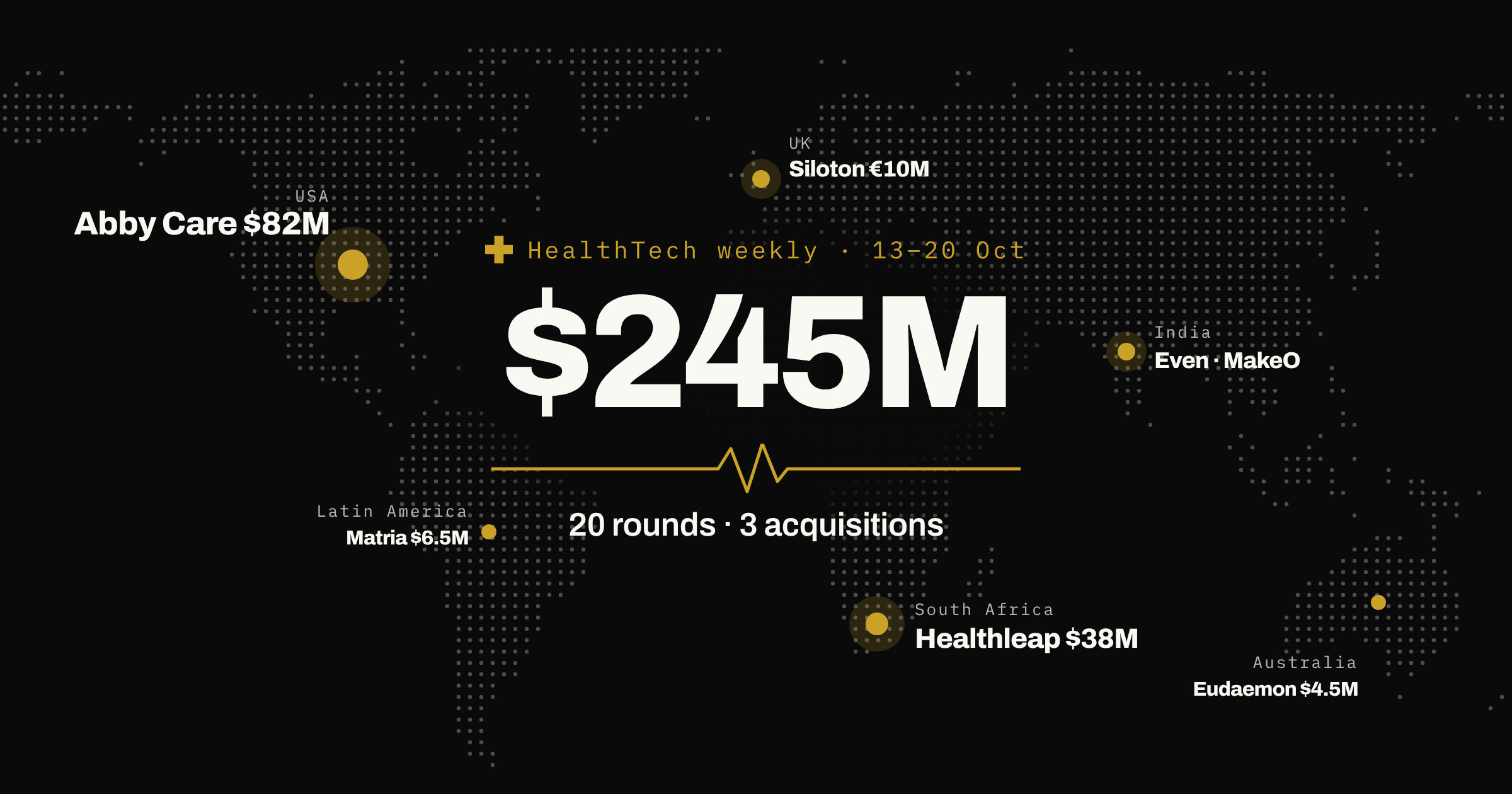
This week brought 20 HealthTech rounds with disclosed amounts, worth roughly $245M. There were also two rounds with undisclosed amounts, one €9.98M government contract and three acquisitions. Two deals account for nearly half the money: Abby Care’s $82M and Healthleap’s $38M. The rest is early stage. Twelve of the rounds are seed or pre-seed. The clearest pattern is where the money goes. It’s going less to new ways of treating patients and more to the paperwork, billing and admin that surround care. The buyers are moving in the same direction.
THE DIGEST
🇺🇸 Abby Care raises $82M to pay family caregivers
The company pays family members who care for relatives, a model that relies on Medicaid funding home care. Its founder grew up on Medicaid in Baytown, Texas. This is the largest round of the week. It is a sign that investors now see family caregiving as a real way to deliver care, not just a gap in the system.
🇿🇦 Healthleap secures $38M to scale clinical AI
The South African startup’s total combines its seed and Series A rounds. It is one of the largest African HealthTech raises this year. It also shows that clinical AI built outside the US and Europe can attract serious capital.
🇮🇳 Khosla Ventures doubles down on Even Healthcare at a $300M valuation
Khosla led the round, its second bet on the company. Even combines insurance-style memberships with its own hospitals, and it will use the money to grow its hospital network. The model takes on Indian hospital economics directly by controlling both the payment and the care.
Sunbound raises a $24M Series A and buys Richter Healthcare Consultants
TTV Capital led the round. Sunbound bought Richter, a senior-care billing firm, at the same time. Raising and acquiring together is becoming the standard way to scale revenue-cycle businesses: buy the customers and the expertise, then automate the work.
🇺🇸 Confido Health raises $12.5M led by Z47
The US startup’s round was led by Z47, formerly Matrix Partners India.
🇮🇳 MakeO raises ₹90 crore (about $10M) for dental technology
The parent company of clear-aligner brand Toothsi will use the money to expand its dental technology operations.
🇬🇧 Siloton wins a €9.98M Innovate UK contract
The Bristol startup will use the non-dilutive funding to develop a handheld eye imaging system. It is the largest European deal in this week’s HealthTech flow.
🇬🇧 Stride raises a £4.6M seed for preventative health
The UK startup will develop its platform and expand internationally.
🇬🇧 Flo reportedly draws investment from Google
The women’s health unicorn, founded by Belarusian founders, has reportedly attracted investment from Google. The amount was not disclosed.
Also raising this week:
- Sunlight AI: $10M seed to automate medical practice admin
- XRlabs: $8.4M seed led by Playground for a surgical intelligence platform
- Otter Health: $8M seed to speed up prior authorisations
- Onyx: $8M seed to build a “virtual immune system”
- Allswell: $7M seed led by Rethink Impact for LGBTQ+ behavioural health
- Matria: $6.5M seed to connect fragmented hospital data across Latin America
- 🇦🇺 Eudaemon: $4.5M seed for a hydrogel condom
- TechNovaTime: $3.4M pre-seed to reduce healthcare’s admin burden
- 🇬🇧 Unravel Health: €2.96M for a palm-sized at-home hormone lab
- Metabolize: $3.2M seed for Stanford-backed metabolic health technology
- Collective X Health: $3.2M pre-seed to close the women’s health data gap
- Nabta Health: PVP joins its $3M pre-Series A as it expands into employer healthcare
- Bia Health: $2.15M for AI that reduces unnecessary medical interventions
- HapWare: $1.5M oversubscribed pre-seed ahead of launching ALEYE, a wristband that turns facial expressions into touch
EXITS & M&A
🇺🇸 Zocdoc buys Sohar Health
This is Zocdoc’s first acquisition in nearly 20 years. Sohar, a New York startup, verifies patients’ insurance. With the deal, Zocdoc moves from helping patients book appointments into the administrative work that comes before an appointment.
Carenet Health acquires Invene
Carenet will use Invene to build and scale agentic AI for Fortune 100 health insurers.
Context: Cal AI’s influencer playbook
MyFitnessPal bought calorie-tracking app Cal AI in March. A new TechCrunch report shows how the app earned more than $30M in revenue in two years, mostly through paid influencers. That marketing model is now an acquisition model in consumer health.
PARTNERSHIPS
🇺🇸 Commure partners with Compassus
The two companies will use AI to automate home care referrals.
THE ANALYSIS
1. Admin is where AI money is going
Sunlight AI, Otter Health, TechNovaTime and Sunbound all target healthcare’s administrative work, including scheduling, prior authorisations, billing and paperwork. On the M&A side, Zocdoc bought an insurance-verification company and Carenet bought an agentic-AI developer for insurers. Commure is automating referrals. Admin AI has an advantage over clinical AI: the return on investment is easy to measure, there is less regulatory risk, and the buyer, whether a practice, a payer or a care operator, feels the cost every day.
2. Care is moving home, and so is the money
Abby Care pays family caregivers. Sunbound bought a senior-care billing firm. Commure and Compassus are automating home care referrals. The largest round of the week and two of the week’s other deals all point to the same shift: care is moving out of facilities and into homes, and the companies that handle the payment side of that move are getting funded.
3. Women’s and underserved health is now a mainstream category
Flo, Unravel Health, Collective X Health, Eudaemon, Allswell and Nabta together make up almost a quarter of this week’s deals. Investors no longer treat this as a niche. Data gaps, like the one Collective X Health is addressing, have become a market opportunity in themselves.
4. The biggest bets are outside the US–Europe corridor
Healthleap in South Africa, Even and MakeO in India, and Matria in Latin America show where models built for healthcare systems with fewer resources are getting funded. Even is the clearest example. Instead of selling software to hospitals, it owns the hospitals.
5. Europe is thin, and mostly British
All of this week’s European activity came from the UK: Siloton, Stride, Unravel Health and Flo. The single largest European cheque was a government contract, not a VC round. For European HealthTech founders, grants and other non-dilutive funding still fill the gap that venture capital leaves at the early stage.
Bottom line: HealthTech capital is moving toward unglamorous, measurable problems: admin, billing, insurance verification and home care. Clinical breakthroughs make the headlines. The money is going to companies that make the existing system cheaper to run, and acquirers are paying for the same thing.