
































Paris-based solar manufacturing startup HoloSolis has closed a Series A of more than €15 million to build what it describes as Europe’s next solar gigafactory.
The Round
Four new investors joined: Crédit Agricole Group (through four of its regional banks), investment firm Algebris, solar manufacturer Trina Solar and EV charging company StarCharge. They join existing backers Calès Technologies, Forming and Ecolab, who had already committed to the round.
In November 2025 HoloSolis secured over €220 million in public and private funding. With this Series A, the total financial support identified for the planned gigafactory is now past €400 million. The company has also been shortlisted for a grant from the European Commission’s Innovation Fund, which is not yet a confirmed award.
Series A proceeds will go toward pre-construction work: detailed engineering studies, technical specifications, selecting production line suppliers and qualifying panel prototypes.
Henri Poupart-Lafarge, CEO of HoloSolis, said: “We are particularly pleased to welcome leading industrial and financial shareholders, whose diverse expertise and strong commitment reflect our industrial ambition and its potential. Their confidence, combined with the support of the French and European public authorities, enables us to move forward with confidence into the next stages of developing and financing our factory.” He added that the Series A and the Innovation Fund shortlisting “represent two major milestones in the development of our project.”
The Factory
Founded in 2022 by InnoEnergy, HoloSolis is one of five industrial champions the European CleanTech investor launched, alongside battery maker Verkor, hydrogen producer FertigHy, green-steel startup GravitHy and energy-storage company Repono.
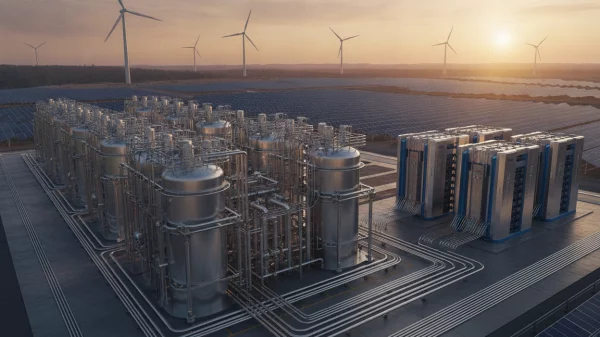
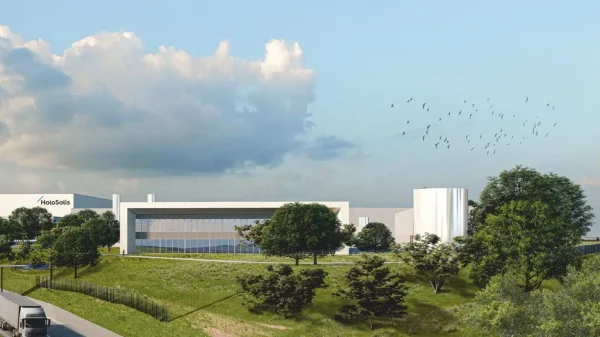
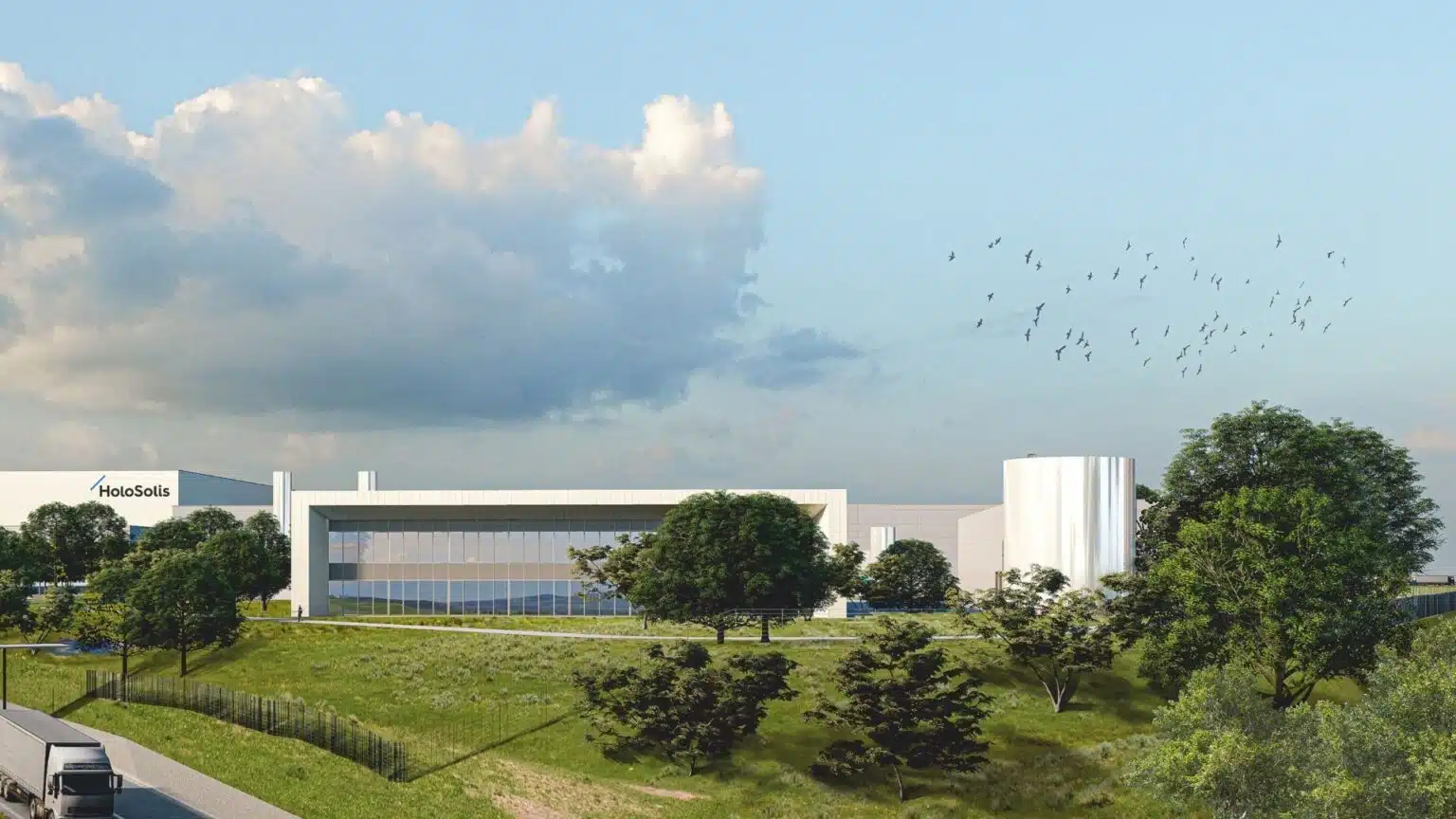
The company is building what it calls Europe’s most advanced photovoltaic production site in Hambach, in France’s Moselle department. It will make photovoltaic cells and assemble them into modules, two distinct processes automated on one 50-hectare site. Its products use n-type TOPCon (Tunnel Oxide Passivated Contact) technology, one of the highest-performing solar cell architectures currently available.
The total investment needed is estimated at €1 billion. At full capacity, HoloSolis says the plant will produce 5 GW of solar panels a year, roughly 10 million panels, and create 2,000 direct jobs. Construction is planned to begin in 2028, with production starting in 2029.
Why It Matters
If built at that scale, the factory would substantially reduce Europe’s dependence on imported solar panels, most of which come from outside the continent. The EU has designated this a vulnerability for its energy security. France has formally designated the project as one of major public interest, and the European Commission has recognised it as a strategic “Net Zero” project.
What’s Next
Before construction or any panel production, HoloSolis has secured letters of intent covering more than 30 GW from prospective customers. Letters of intent are not binding contracts. With new EU rules under the Industrial Accelerator Act, which aims to lift EU industrial manufacturing to 20% of GDP by 2035, the company’s focus is on converting these into binding agreements and on completing its next fundraising round, expected to open in the coming months.