







































Week of 12–20 October 2026 · CleanTech
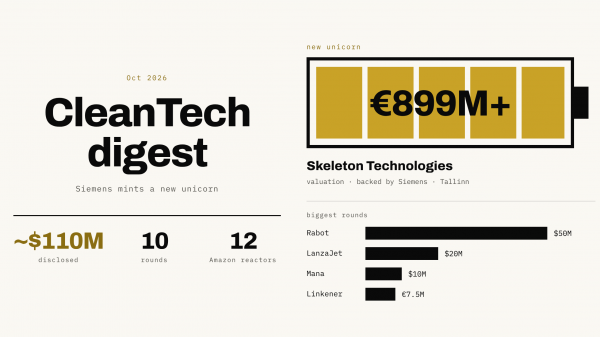
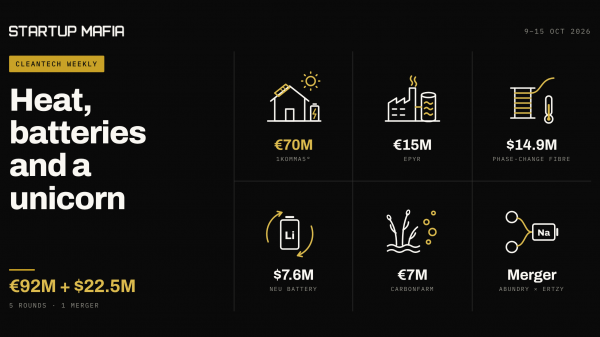
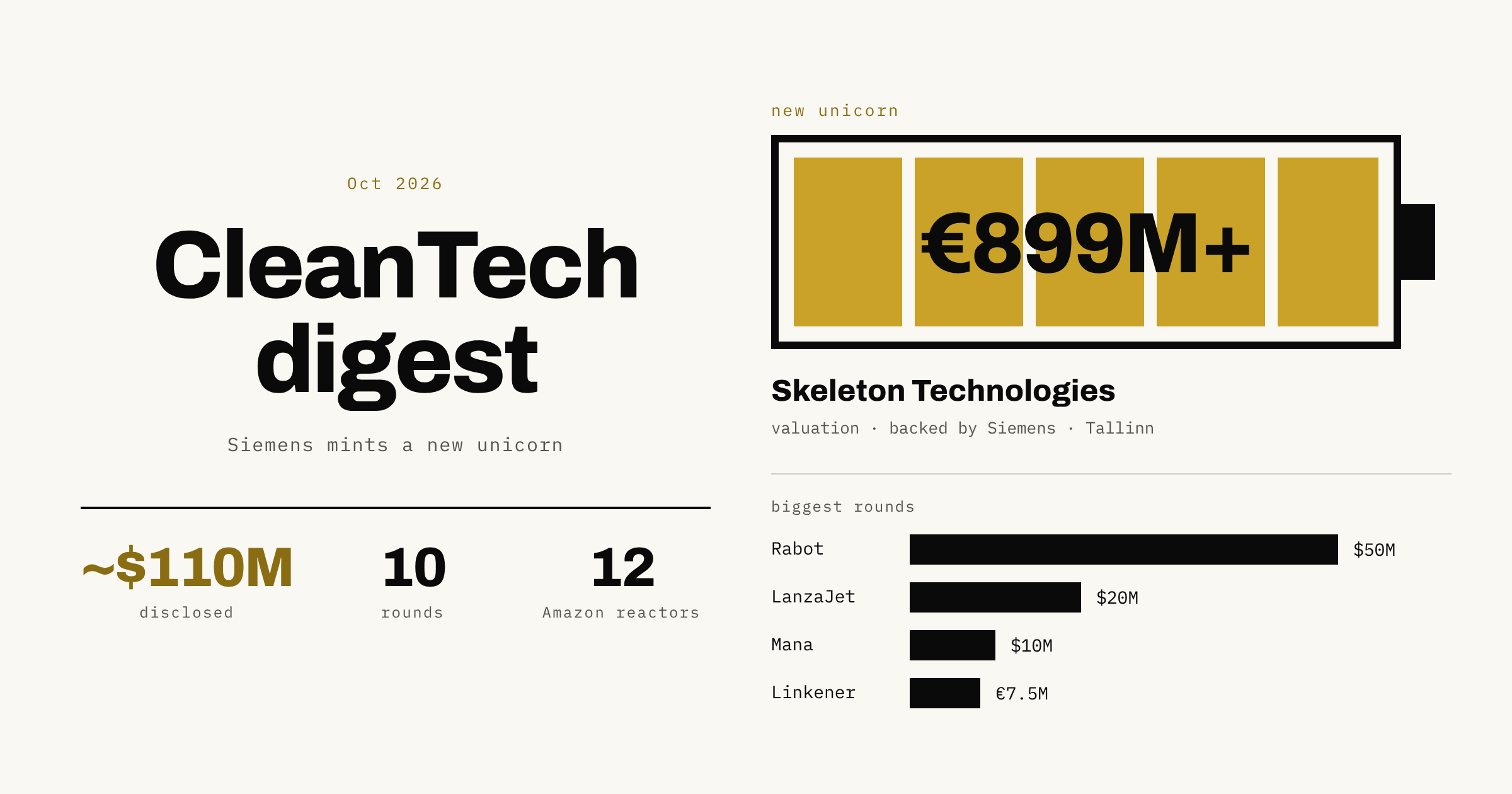
This week brought eight CleanTech rounds with disclosed amounts, worth roughly $90M. On top of that, Skeleton Technologies took a nine-figure investment of undisclosed size from Siemens, and LanzaJet raised at least $20M as part of a refinancing. The theme running through most of the week is power for AI: data centres need more electricity, delivered more reliably, than grids were built for. Skeleton is building hardware for that, Amazon is funding nuclear for it, and Rabot and Linkener are building software to manage demand. Europe led the week: five of the eight rounds went to European companies.
THE DIGEST
🇪🇪 Skeleton Technologies becomes a unicorn with a Siemens investment
The Tallinn company announced a nine-figure investment from Siemens that values it at more than €899M ($1B). The money will mainly fund US manufacturing and R&D in Silicon Valley, to meet demand from hyperscalers for AI data-centre power systems. Skeleton plans to invest more than €179M ($200M) in the US, including domestic cell manufacturing. Its supercapacitors absorb the sudden power spikes that GPU clusters create, and the company says they make AI data centres up to 40% more energy efficient. CEO Taavi Madiberk argues the limit on AI is no longer how many GPUs you can buy, but how much compute you can get from each megawatt. Skeleton is preparing for a US IPO in 2027.
🇩🇪 Rabot Energy raises a $50M Series B to turn homes into a virtual power plant
Endeit led the round, alongside the DeepTech & Climate Fonds (DTCF); existing investors including HV Capital and Bosch Ventures also took part. Rabot sells electricity tariffs that change with market prices and automatically shifts customers’ usage to cheaper, greener hours. It is now linking home batteries together into a “virtual power plant” that the grid can draw on. In three and a half years it has grown to more than 200,000 customers and €200M in revenue. Its aim is one million customers, with EV chargers and heat pumps connected to the network next.
🇺🇸 Mana Battery raises a $10.5M seed for sodium batteries
Voyager Ventures led the round in the Broomfield, Colorado startup, with USV and Buff Gold Ventures participating. Sodium batteries avoid lithium and the supply chain that comes with it.
🇪🇸 Linkener raises €7.5M for business energy management
Klima Energy Transition Fund, Alantra’s energy transition fund, led the round in the Barcelona company. Linkener’s platform measures businesses’ energy use, checks their bills, and flags savings. It serves more than 2,000 customers and manages 1.7 TWh of energy a year. It plans to grow partly by acquiring other companies.
🇫🇮 Ambio raises a €5.1M seed for recycled-plastics procurement
b2venture led the round in the Helsinki company, with Montis and existing investor Lifeline Ventures taking part. The quality of recycled plastic varies a lot from batch to batch, which makes manufacturers wary of buying it. Ambio uses AI to match buyers with suppliers and verifies the material’s quality, acting as the single accountable supplier from first sample to long-term deliveries.
Also raising this week:
- 🇺🇸 Stellios Technologies: an oversubscribed $5M pre-seed for high-power microwave systems, starting with counter-drone defence and later compact fusion. It had $2M in signed purchase orders before it raised any money.
- 🇬🇧 Centre for Energy Equality: a reported £3.48M investment from BGF to tackle energy poverty and grid flexibility
- 🇺🇸 Subeca: about $3M (Series A-2) led by Burnt Island Ventures, with SUEZ and Cycle H2O, for low-cost smart water meters. It is now live in 23 communities.
- 🇬🇧 Spine Energy Technology: a $3M seed for software that helps owners manage grid-scale battery assets
REFINANCING
🇺🇸 LanzaJet raises at least $20M as its CEO steps down
LanzaJet makes sustainable aviation fuel from ethanol. The money came from parent company LanzaTech, Vinod Khosla and LanzaJet’s board, as part of a wider effort to restructure the company and reduce its debt. LanzaTech CEO Jennifer Holmgren becomes interim CEO.
PARTNERSHIPS & PROJECTS
🇺🇸 Amazon funds a 960 MW nuclear plant on a former Indiana coal site
The plant would use 12 small modular reactors from X-energy, with utility AEP operating it. It is three times larger than the first Amazon–X-energy deal, announced two years ago. The plan still depends on X-energy delivering its first plant, in Texas, where it hasn’t broken ground yet. X-energy’s shares have fallen nearly two-thirds since its April IPO.
🇳🇬 EBRD lends up to $10M to Beacon Power Services
The money supports a $20.9M project to roll out smart meters and grid software at six of Nigeria’s eleven electricity distribution companies. More than 80 million Nigerians lack reliable grid power. Founder Bimbola Adisa says Beacon’s systems have cut electricity losses from 35% to 20% on past projects in Nigeria and Ghana.
🇪🇪🇮🇹 PowerUP and H2Boat team up on hydrogen power for yachts
The Estonian fuel-cell generator maker and the Italian marine hydrogen startup will combine their technology into one system. It makes hydrogen from renewable electricity, stores it on board and converts it back into silent, emission-free power.
THE ANALYSIS
1. AI’s electricity problem is now a CleanTech opportunity
Skeleton’s unicorn round, Amazon’s nuclear bet and Stellios’ high-power systems all come from the same pressure: compute is growing faster than power infrastructure. Investors are funding whatever helps get more out of each megawatt, whether that’s smoothing power spikes inside data centres or building new reactors. Big companies like Siemens and Amazon are now the ones writing the largest cheques.
2. Software that manages demand is beating new generation
Rabot, Linkener, Spine, Subeca and Beacon are all software or metering businesses that make existing grids work harder, rather than building new power plants. This kind of business is cheaper to start and earns revenue sooner, and it fixes a problem grid operators face right now.
3. Smart meters are the new battleground
Subeca brings smart meters to small water utilities, Beacon to Nigerian power distributors, and Linkener to Spanish businesses. Rabot’s newest product comes with a smart meter included. Whoever controls the meter controls the data, and the data is what lets these companies sell savings, flexibility and new services.
4. Europe led the week
Estonia, Germany, Spain, Finland and the UK supplied the bulk of the deals, and Skeleton and PowerUP make Estonia the standout. European companies are increasingly building in the US to be close to their biggest AI customers, as Skeleton shows.
5. First-of-a-kind plants are still hard
LanzaJet’s refinancing and leadership change show how hard it is to scale the first commercial sustainable aviation fuel plant. Amazon’s nuclear plan likewise depends on X-energy’s still-unbuilt first plant. Big announcements aren’t the same as working plants.
6. Defence money is funding long-term energy research
Stellios is selling counter-drone systems to pay for its fusion research. PowerUP’s generators are built for both civilian and military use. For deep-tech energy startups, defence customers are becoming a practical way to fund long, expensive R&D.
Bottom line: CleanTech money this week went where power is scarce: AI data centres, flexible home energy and grid software. Big strategic investors like Siemens and Amazon are now writing the largest cheques. Europe was the source of most of the deals.
Sources:
- EU-Startups – Skeleton Technologies becomes a unicorn
- Tech.eu – Rabot Energy $50M Series B
- Axios Pro Rata – Mana Battery
- EU-Startups – Linkener €7.5M
- Tech.eu – Ambio €5.1M seed
- DroneLife – Stellios Technologies
- Browne Jacobson – BGF invests in Centre for Energy Equality
- Pulse 2.0 – Subeca Series A-2
- ESG Today – LanzaJet financing
- TechCrunch – Amazon and X-energy’s Indiana nuclear plant
- Ecofin Agency – EBRD and Beacon Power Services
- Tech.eu – PowerUP and H2Boat