





















































Week of 15–21 October 2026 · Crypto / Blockchain / Web3
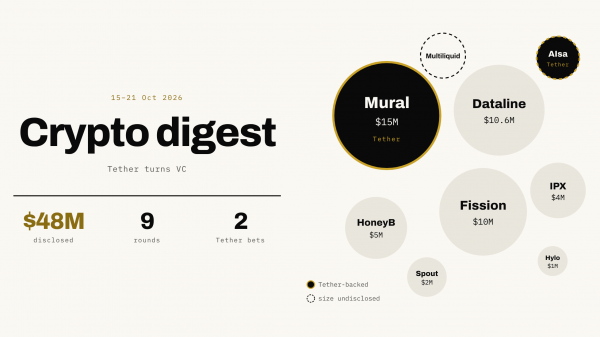
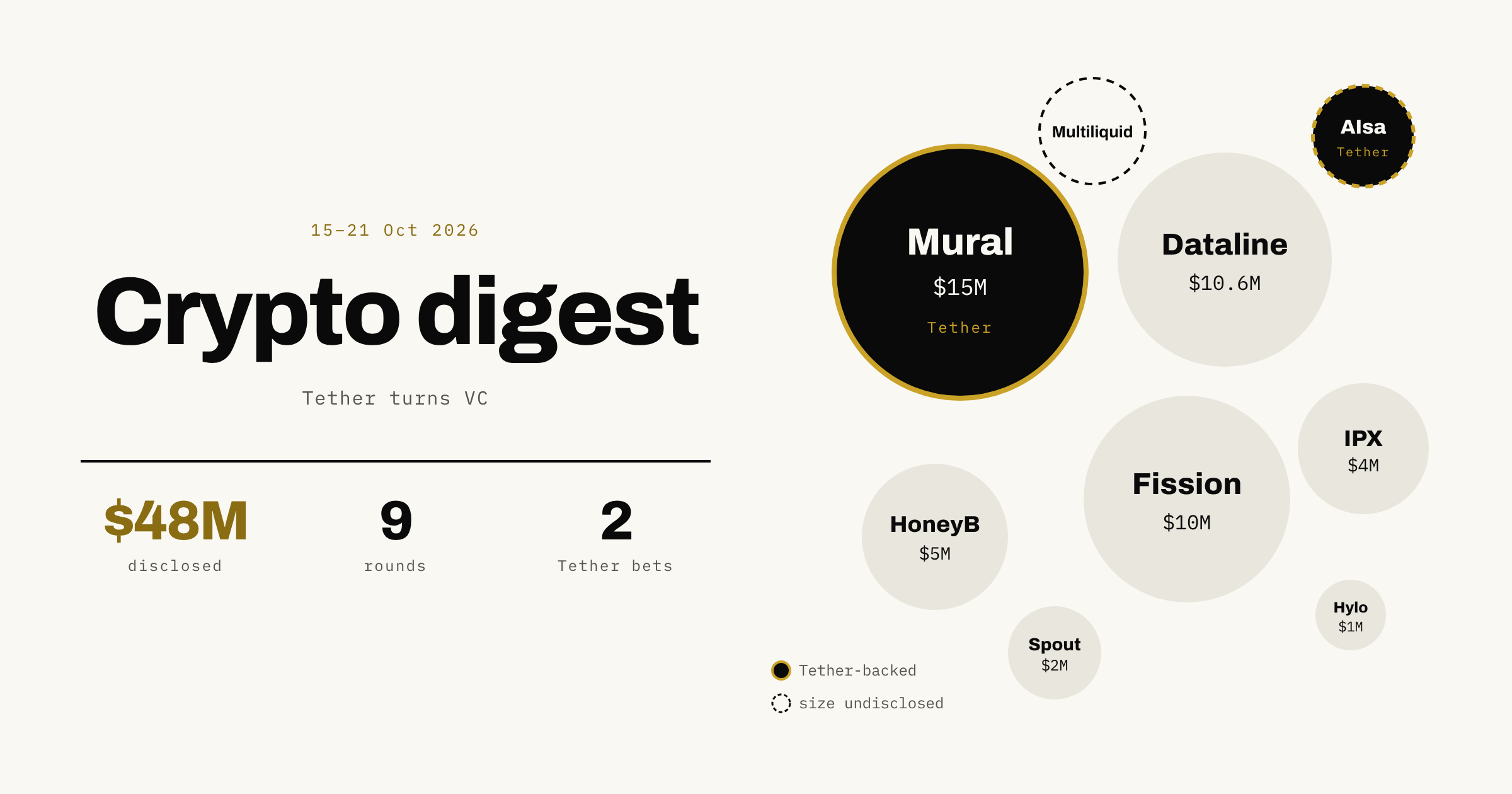
This week brought nine crypto rounds. Seven disclosed their size, worth roughly $48M combined, and two more (Multiliquid and AIsa) disclosed only their total funding. There was also one acquisition. Cheques were small: the largest was $15M, and five of the nine were seed or strategic rounds. Three patterns stand out. Tether, the company behind the largest stablecoin, is now one of the most active investors in the space. A cluster of startups is working on the same problem: tokenized funds and stocks exist, but they are hard to sell quickly or borrow against. And AI agents keep showing up in crypto pitches as a new kind of customer.
THE DIGEST
🇺🇸 Tether leads Mural’s $15M Series A
North Island Ventures and existing investors also took part, bringing the New York startup’s total funding to $28M. Mural was founded by former Palantir engineers. It gives businesses one place to manage payments, accounts, identity checks and compliance across both bank networks and blockchains. Customers include payroll providers, software companies and fintechs. Mural says it has processed $2.1B in payments across 128 countries. Its controls let companies set spending limits and require extra approval for large payments, which is why Tether framed the deal partly as a bet on AI agents that move money.
🌐 Dataline raises a $10.6M seed for an AI-agent data network
Lattice and Dispersion Capital co-led the round, with Symbolic Capital, Coinbase Ventures, Anagram and Robinhood CEO Vlad Tenev participating. Dataline, previously called Tearline, gives AI agents data they can pay for on demand. It scores each source for reliability, recency and consistency so agents can decide whether to trust it. The company plans a public token sale through Uniswap’s auction platform, with the token launch targeted for the end of 2026.
🇺🇸 Fission raises a $10M Series A led by Pantera Capital
Circle Ventures and Borderless Capital also took part. Tokenized fund shares can take around 200 days to sell, because funds only redeem at fixed intervals. Fission pays holders out within about 90 seconds and charges a fee for that speed. Its customers are hedge funds, crypto firms and stablecoin issuers holding tokenized private credit or equity.
🇺🇸 Multiliquid closes a Polychain-led seed, bringing total funding to $8M
Circle Ventures, CMT Digital and Strobe Ventures also participated; the split between this seed and an earlier pre-seed wasn’t disclosed. Multiliquid lets holders swap tokenized money market fund or Treasury shares into USDC at net asset value in a single transaction, instead of waiting for the usual redemption cycle. Its founders previously held leadership roles at Standard Chartered’s tokenization platform and UniCredit’s digital bank. Unusually for this sector, Multiliquid says it has no plans to issue a token.
🇺🇸 Tether and HIVEN join AIsa’s seed extension, taking total funding past $9M
AIsa is a San Francisco startup building infrastructure that lets enterprise AI agents find tools and data, and pay for them. The size of the extension and the valuation were not disclosed. Its earlier seed round was co-led by Alibaba and Tribe Capital.
Also raising this week:
- Nectar Group (HoneyB): a $5M seed led by Portal Ventures, at a $30M valuation, for a platform that lets institutions earn 2–4% a year on their bitcoin
- 🇺🇸 IPX: a $4M seed at a $125M valuation for a platform where celebrities and creators tokenize their IP and fans trade it, built on Base
- Spout: a $2M strategic round from Draper Dragon, Anchorage Digital and Flow Traders for 0%-interest loans against tokenized US stocks on Solana. The product isn’t live yet.
- Hylo: a $1M strategic round led by Solana Ventures for leveraged tokens on Solana that can’t be liquidated. It reports more than $700M in cumulative trading volume.
EXITS & M&A
🌐 Network School acquires Farcaster from Neynar
Network School, the community project led by former Coinbase CTO Balaji Srinivasan, bought the decentralized social network’s app and protocol code. Terms were not disclosed. Farcaster will be renamed the Network State Protocol. It is the platform’s third owner in 2026: Neynar bought it from its original developer, Merkle Manufactory, in January. By October, Farcaster’s monthly revenue had dropped 96% from its February peak.
THE ANALYSIS
1. Tether is becoming crypto’s biggest strategic investor
In one week, Tether led Mural’s round and joined AIsa’s. Both are payment businesses that could route more money through USDT. Tether earns billions from the interest on the US Treasuries backing USDT, and it is using that money to pay for distribution. For payment startups, Tether is now a realistic lead investor.
2. AI agents are the new pitch
Mural sells controls for payments made by AI agents. AIsa builds a network where agents can buy tools and data. Dataline sells data to agents. IPX calls itself an “agentic OS.” The idea that AI agents will need crypto rails to pay each other is now standard in fundraising decks, but there is little independent evidence of how much agents actually transact today.
3. Tokenization has a liquidity problem, and startups are racing to fix it
Fission speeds up exits from tokenized funds. Multiliquid converts tokenized Treasuries into stablecoins instantly. Spout lets people borrow against tokenized stocks. Putting assets on-chain is solved; making them easy to sell or borrow against isn’t. Circle Ventures backed both Fission and Multiliquid, and both route their payouts into USDC.
4. Seed valuations and token sales are back
IPX raised $4M at a $125M valuation before launching. Dataline is planning a public token sale. HoneyB’s round was a SAFE that comes with a token warrant. Valuations are rising again, and so is the expectation of a token. Multiliquid’s decision not to issue one stands out.
5. Decentralized social is still looking for a business model
Farcaster is on its third owner this year, and its revenue has collapsed. Network School is betting on a narrower, community-first version of the platform. Building a decentralized social network is technically possible; making it pay for itself is not yet proven.
6. No European deals this week
Every round with a known location was US-based. For a European audience, this is a gap worth noting. Payments and tokenization rules (like the EU’s MiCA regulation) are clearer in Europe than in many other places, but the capital this week went elsewhere.
Bottom line: Crypto money this week went into practical infrastructure: payments, liquidity for tokenized assets, and data and payment rails for AI agents. Stablecoin issuers are increasingly the ones writing the cheques. Rounds are small but valuations are climbing, and tokens are coming back.
Sources:
- CoinDesk – Tether leads Mural’s $15M Series A
- Crypto Briefing – Mural raises $28M in total funding
- The Block – Dataline raises $10.6M
- Pulse 2.0 – Fission Series A
- Crowdfund Insider – Multiliquid seed
- Cointelegraph – Tether backs AIsa
- The Block – HoneyB / Nectar Group
- The Defiant – IPX seed
- CryptoRank – Spout strategic round
- Crypto Briefing – Hylo strategic round
- CryptoRank – Network School acquires Farcaster
- ForkLog – Farcaster revenue and ownership history