




























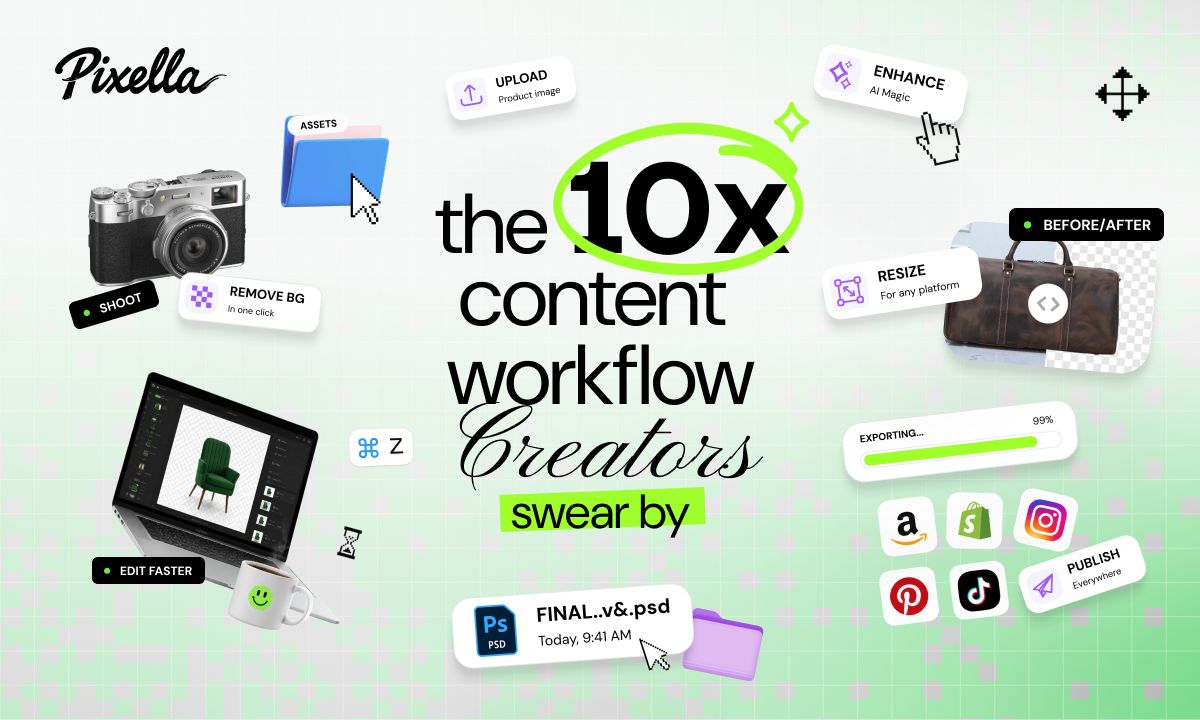
Here is the arithmetic that should not work. Most creators have somewhere around ten hours a week to actually make things, and the ones who are pulling ahead are shipping ten times the visuals they did two years ago. 70% of creators spend ten hours or less a week on content, according to DemandSage’s 2026 creator economy report, which means the extra output is not coming from extra hours. Spend any time reading a Pixella review from that crowd and the explanation turns out to be duller than magic and far more useful: the unit of work changed.
The unit used to be one image
Two years ago, a single graphic was a project. You started it, you finished it, and somewhere in the middle you usually waited on someone with design skills you did not have. The output ceiling was set by how many of those projects you could push through in a week, which was never many. What changed is not that creators got faster at the old job. It is that the old job stopped being the job.
Laid out next to each other, the difference is less about any single tool being clever and more about where the waiting went.
| Producing one visual | The old way | Inside Pixella |
| Getting a base image | Brief a designer or dig through stock, then wait | Generate it from a prompt in seconds |
| Isolating the subject | Hand-cut in an editor, pixel by pixel | Background removed automatically |
| Fixing colour and exposure | A separate app, another export | Adjusted in the same tab |
| Sizing for every platform | Rebuild the canvas one format at a time | One pass across many presets |
| Rescuing a soft file | Reshoot or live with the blur | Upscaled to something crisp |
This is the shift a Pixella review from a daily poster keeps circling. You stop finishing one image at a time and start producing one source you can spin into a dozen finished things.
What a Pixella review of a creator’s week shows
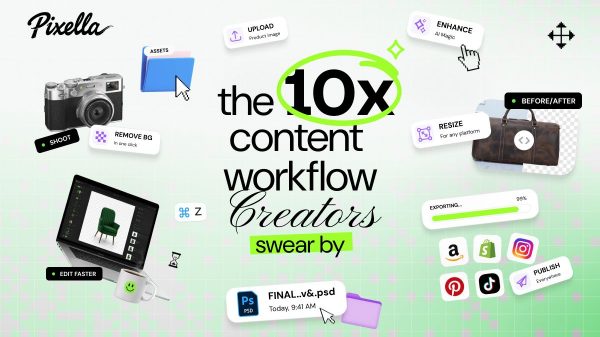
Picture the Monday of someone running a channel alone. A concept becomes an image through the AI Image Generator, which can switch between models like Flux 2.0 Pro or Ideogram v3 depending on the look the post needs. The Background Remover lifts the subject out. The Image Editor takes the small corrections. None of it means opening a second program or pinging a designer. Then the same asset fans out. The Image Resizer, the one tool here that does not run on AI, reformats it for a feed post, a vertical story, a thumbnail, and a banner in a single pass across many presets. If the starting file is soft, the Upscaler sharpens it enough to hold up at full size. By lunch there are nine usable visuals where the old workflow would have produced one.
The reviews that ring true
The accounts worth trusting come from people who clearly put the thing to work, not the ones who clicked around for five minutes. A Pixella review in that category skips the adjectives and points at a specific result, usually after a specific frustration. Two recent ones do.
Bruno Finotti, posting in June 2026, did not arrive at Pixella first. He had already run an image through several other tools without landing the look he wanted. That is worth more than a clean rating with no story, because a verdict from someone who just compared three or four options beats praise from someone with nothing to measure against. Pixella gave him the cleanest result of the lot.
Roberto, updating his review in June 2026, pointed at the question that decides things for a creator: whether the output can go straight onto a feed without looking machine-made. He called the results professional, realistic, and creative, three words doing real work. Realistic, in particular, means none of the plastic, over-smoothed look that gives cheap AI editing away.
When everyone can run the same play
When the production floor opens to everyone, what sets a creator apart shifts from raw output to the choices behind it. 48% of creators now run the whole operation themselves, from content to monetisation, with no team behind them, per Circle’s 2026 Community Trends Report, and most of them reach for the same tools. A careful Pixella review lands right here. The platform will gladly help anyone make ten times more images, which puts the spotlight on the same place it has always belonged: the taste and judgment the person brings to them. The parts that generate and clean and resize are dependable, and they free the creator to spend their attention on exactly the decisions that make a feed feel like theirs.
What the multiplier is really for
So the ten times figure is real, but it points at the wrong thing if you read it as ten times the work done. What it actually buys is room. Room to try five versions of an idea instead of committing to the first one. Room to keep posting through a slow week without going dark. Room to test a format, watch it flop, and move on by the afternoon rather than the end of the month. That’s exactly what the Pixella review is about. The platform does not make a creator more creative. It clears away the production tax that used to make experimenting expensive.