












































































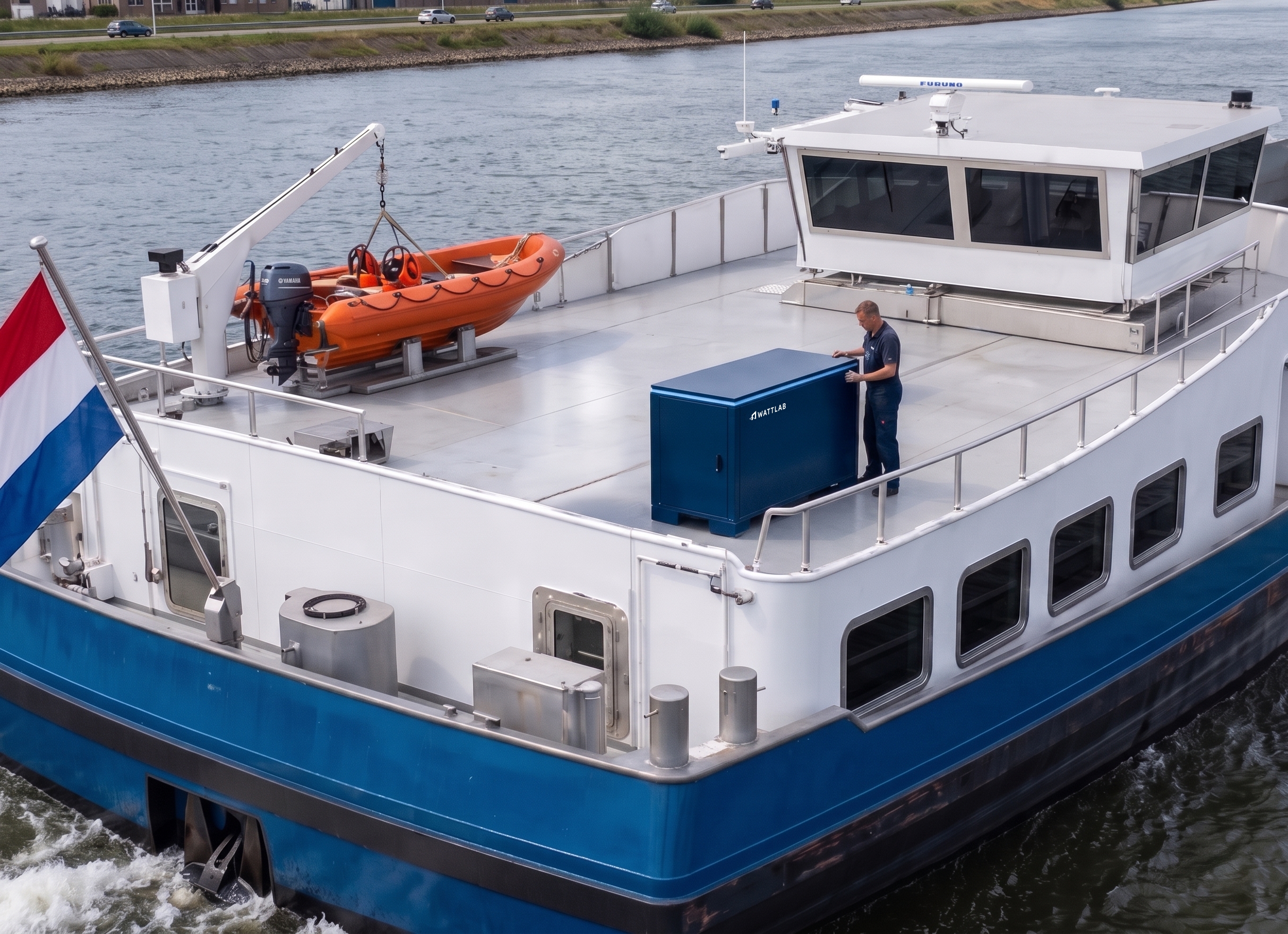
Dutch maritime technology company Wattlab has introduced WEstack, a standardized battery system designed to significantly simplify and accelerate the electrification of inland shipping. The system can be installed on vessels within a single working day, marking a major shift away from traditionally complex, custom-built marine battery integrations.
A plug-and-play approach to maritime electrification
Inland shipping has long faced a practical barrier to electrification: installation complexity. Conventional battery systems are typically custom-engineered for each vessel, requiring weeks of onboard work and costly downtime.
WEstack takes a different approach. Each system is fully assembled and tested in Wattlab’s workshop before delivery. Onboard, it only needs to be connected, reducing installation time to approximately one day.
The system is available in standardized capacities of 100, 200, 300, and 400 kWh, enabling faster production, predictable integration, and lower costs compared to bespoke solutions.
Cutting generator use by up to 90%
A core feature of WEstack is its ability to optimize onboard energy use. According to Wattlab, vessel generators often operate at only 10–15% capacity, an inefficient range that leads to unnecessary fuel consumption.
By introducing battery storage, generators can run at optimal load levels to charge the system, while the battery handles power distribution onboard. This can reduce generator operating hours by 80–90%, leading to:
- Lower fuel consumption
- Reduced CO₂ emissions
- Decreased maintenance costs
- Improved onboard comfort (less noise and vibration)
Designed for both retrofit and newbuild vessels
WEstack is installed on the aft deck and is suitable for both existing inland vessels and newbuild projects. The system can be applied across a wide range of ship types, including dry cargo vessels, tankers, and smaller coastal ships.
Beyond efficiency gains, Wattlab also positions the system as a compliance and operational advantage as European ports and regulators increasingly push for lower emissions and quieter operations.
Efficiency as a near-term decarbonisation strategy
While alternative fuels remain part of the long-term maritime transition, Wattlab emphasizes energy efficiency as the fastest path to emissions reduction.
The company argues that optimizing existing diesel-based systems with hybrid electrification delivers immediate impact without requiring full fuel infrastructure replacement.
From solar pioneer to integrated energy systems
Founded in 2017 in Rotterdam, Wattlab initially gained recognition for its solar energy installations on inland vessels. The company later expanded into modular solar solutions for seagoing ships, including its Solar Flatrack system.
With deployments on more than 30 vessels worldwide, Wattlab has established itself as a key innovator in practical maritime decarbonisation technologies.
Notably, the company contributed to a record-breaking solar installation on the inland vessel MS Helios, recognized by Guinness World Records, and received the Environmental Protection Award from International Bulk Journal in 2025.
Conclusion
With WEstack, Wattlab is pushing inland shipping toward a more modular, scalable, and cost-efficient electrification model. By drastically reducing installation time and improving operational efficiency, the system addresses one of the key barriers slowing maritime decarbonisation.
As the sector faces increasing regulatory pressure and rising fuel costs, standardized hybrid solutions like WEstack may become a defining step in the transition to low-emission inland shipping.