
























































AI tools let a founder with no engineering background ship a working product in weeks. Getting that product safely into production is a different job — and most vibe-coded startups find that out the expensive way. Fedir Kompaniiets, CEO and co-founder of Gart Solutions, on what solo, AI-built startups need from a technical partner.
A few months ago a founder came to us with what looked like a routine request: move the app onto production-ready infrastructure, sort out compliance, and draw up a go-live plan. The idea was strong, the market was real, and early users had already confirmed demand.
Then came the detail that changed the whole conversation. One person had built the product — no technical co-founder, no CTO, no engineering team. The entire app had been assembled in a few weeks on an AI app-building platform. The founder isn’t a programmer. The founder isn’t from tech at all.
When a technical founder or CTO walks in, we share a vocabulary: infrastructure, BAA, managed Postgres, encryption at rest. When the person across the table genuinely doesn’t see why an app that demos beautifully to its first users is not the same as a system ready to handle real people’s payment or medical data, the whole consulting process has to be rebuilt.
If you are a vibe-coding founder, this article is for you. There will be many more of you — and the gap between “it works” and “it’s ready” is where most of your risk now lives.
How deep the hole is
The numbers on vibe-coded products are sobering, even for people who have been in the industry for years.
- Most AI-built apps need rescuing. By several independent industry estimates, of roughly 10,000 startups that shipped mostly AI-generated apps to production by the end of 2025, more than 8,000 needed partial or full rebuilds by mid-2026. “Rescue engineering” is becoming a service category of its own, at $50,000–$500,000 per project (Vexlint, Why Vibe Coded Startups Are Failing; methodology in Getcreatr, Vibe Coding Technical Debt).
- Basic security fails often. Veracode tested more than 100 language models on 80 coding tasks: 45% of generated code failed basic OWASP Top-10 checks — not exotic exploits, but unvalidated input and missing authorisation.
- More vulnerabilities per line. A CodeRabbit and CSA Labs analysis of around 470 real pull requests found roughly 2.7x more vulnerabilities in AI-generated code than in equivalent human-written code.
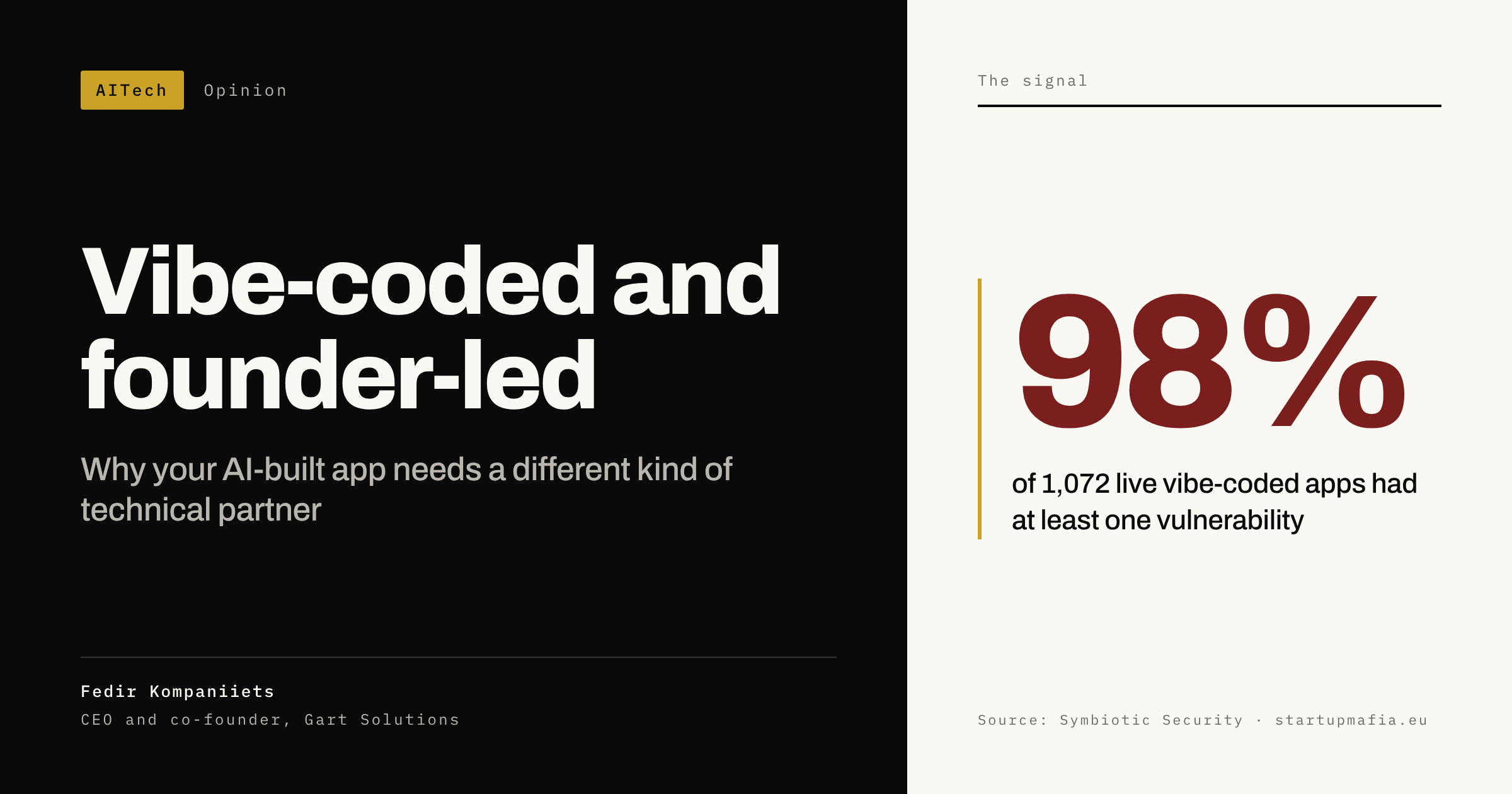
- Almost every vibe-coded app leaks something. Symbiotic Security scanned 1,072 live vibe-coded apps and found at least one vulnerability in 98% of them — mostly Supabase access keys exposed in client-side code and misconfigured CORS.
The problem isn’t that AI writes bad code by itself. It’s the pattern Google Chrome engineer Addy Osmani described back in late 2024: a non-technical person with an AI tool gets to about 70% of a working solution very quickly. The last 30% becomes a loop where every fix creates a new bug.
Practitioners now call it the month-three wall: the point where features built in isolation from each other start to structurally diverge. If your app suddenly breaks somewhere else every time you ask the AI to fix something, you’ve hit it.
The speed illusion
Vibe coding feels fast. That feeling is the most dangerous number in your plan.
In a randomised controlled trial by METR, 16 experienced developers worked on large codebases (over 1 million lines of code on average, 5+ years on the project) with AI assistants. They were actually 19% slower — yet afterwards estimated that AI had made them 20% faster. That’s a gap of almost 40 percentage points between perception and reality. It’s where unrealistic deadlines come from, and they end up on a consultant’s desk.
The broader picture is similar. Research firm DX tracked more than 400 companies over 15 months and summed it up in its report title: AI productivity gains are 10%, not 10x. A systematic review of 116 studies puts gains at 10–30% in release output — useful, but not a multiplier.
Meanwhile the debt piles up. Forrester forecasts that by the end of 2026 more than 75% of technology leaders will face moderate or severe technical debt, up from just over 50% in 2025, and names accelerated AI development as one of the drivers. McKinsey estimates tech debt can make up to 40% of a mid-sized organisation’s technology estate, with companies paying an extra 10–20% on top of every project just to service it.
For a startup, that 10–20% isn’t an abstraction. It’s the runway you lose when the investor’s due diligence turns up an app that has to be rebuilt before it can scale.
Agents changed the nature of the debt
In 2025, AI tools mostly helped individual developers: autocomplete, suggestions, quick fixes inside a single function. In 2026, agents increasingly plan, generate, test and prepare releases with minimal human involvement — across the whole development cycle, not one fragment of code.
Gartner forecasts that 40% of enterprise applications will embed task-specific AI agents by the end of 2026, up from under 5% at the start of 2025. For a vibe-coding founder, that means the app builder isn’t just writing your code anymore. It’s making architecture decisions you never see.
The bottleneck has moved accordingly. Sonar’s 2026 survey of over 1,100 professional developers found that 96% don’t fully trust AI-generated code — yet only 48% always review it before committing. Distrust is near-universal; review discipline exists in only half of teams. And those are professionals.
The hardest part of software in 2026 isn’t generating code. It’s governance: knowing what the AI produced, why it did it that way, and whether it’s safe to ship. A non-technical founder can’t assess that alone — not through any fault of their own, but because governance is exactly the layer they never saw, even back when humans wrote all the code.
Demo-ready is not production-ready
An app built on an AI platform creates an illusion of completeness. It runs, it looks finished, it has a polished interface. So it’s genuinely confusing when “just finishing it off” costs as much as the whole first version did. The statistics above explain why: the first 70% and the last 30% are fundamentally different kinds of work, even though from the outside the difference is almost invisible.
The second trap is that your requirements live in business terms — and those move. In our case, the go-to-market strategy shifted mid-conversation. The founder first planned to sell to medical institutions (B2B). In the US that immediately means full HIPAA compliance, because hospitals and clinics are covered entities handling protected health data. Then the focus moved to selling directly to consumers (B2C), and the legal context around the exact same technical decisions changed completely.
A technical partner sees the link between sales model and regulatory requirements instantly. A non-technical founder usually doesn’t — and that’s normal; it isn’t their field.
For European founders, the same logic applies with different acronyms. Selling to hospitals, banks or public bodies pulls in GDPR obligations around health and financial data, data-processing agreements, EU data residency, and — depending on what your product does — sector rules and the EU AI Act. None of that is visible in a demo. All of it decides what your infrastructure has to look like.
A playbook for vibe-coded startups
Here’s what we’ve learned — partly from experience, partly from a few painful bruises — about getting an AI-built product safely to market without a technical co-founder.
- Run a security sweep before your next user signs up. Check that no API keys or database credentials (Supabase keys are the classic case) sit in your front-end code, that every endpoint requires authorisation, and that CORS isn’t open to the world. This is where 98% of vibe-coded apps fail.
- Decide your sales model before your architecture. B2B to regulated buyers and B2C to consumers need different infrastructure. Write down who pays you in the next 12 months — that answer drives compliance, hosting and cost.
- Ask for decisions in business terms. “AWS or Supabase?” is a question you can’t judge. “Launch fast without full compliance now, or launch later ready for hospital contracts?” is a question about your strategy — and you can.
- Phase compliance instead of avoiding it. In our case, the B2B-to-B2C shift led to a two-phase plan: launch without full HIPAA now, and switch it on when the company starts signing contracts with medical institutions. Design the first phase so the second doesn’t require a rebuild.
- Get every architecture decision in writing. Non-technical people forget the nuances of a technical conversation fast. Insist on a document or diagram you can reopen in a week — or show to an investor in six months — and still follow the logic.
- Budget for the last 30%. Assume production-readiness costs about as much as your first version. If it comes in cheaper, you’ve gained runway; if you assumed it was free, you’ve lost it.
- Expect requirements to drift — and plan for it. Early-stage strategy changes almost always. A good process absorbs a pivot without the feeling that “everything is broken”.
Choosing the right kind of help
You won’t be the first founder in this position, and the market has started to answer — though still in fragments.
| Option | What you get | Best when |
|---|---|---|
| Fractional CTO | A person or small team translating tech into risk, cost and timelines | You need ongoing decisions, investor-ready answers and someone to own the roadmap |
| Vibe-code cleanup / rescue engineering | Audit of generated code, architecture, security and CI/CD readiness, then a stabilisation plan | Your app works but is hitting the month-three wall or heading into regulated sales |
| Cloud and compliance consultancy | Production infrastructure, compliance setup and a go-live plan | You know your market and need the platform to carry real users and real data |
Rescue engineering is no longer niche: estimates put the market at $400 million to $4 billion. Good providers usually offer a free first assessment, precisely because at this stage a founder can’t define the technical scope alone — and selling a paid audit blind wouldn’t be fair.
Whoever you hire, a good partner working with a non-technical founder should:
- Run structured discovery, not a free-form chat. Expect a prepared list covering compliance posture, data volume and type, current environment, target architecture, access and audit, migration, integrations, post-launch operations, budget, timelines and success criteria. Improvising is fine between engineers; with you, it’s how critical questions get skipped.
- Translate options into business consequences you can weigh, not technical alternatives you can’t.
- Leave written artefacts — decisions, diagrams, trade-offs — that outlive the call.
- Build drift into the process so a pivot means replanning, not starting over.
If a partner can’t explain a recommendation in terms of your revenue, risk or timeline, that’s your signal to keep looking.
The bottom line
Vibe coding didn’t remove the need for engineering discipline. It raised the price of not having it. It’s now far easier to generate far more code, far faster, before anyone notices the discipline is missing.
A founder without a technical co-founder is not a less serious founder. You simply need a different way of working: structured discovery, decisions framed as business consequences, and written records instead of verbal agreements. The number of one-person, AI-built startups is growing faster than the industry can agree on how to support them — and within a year or two this will be a question every investor, accelerator and service provider in Europe has to answer.
If your team has found a different approach, I’d be glad to compare notes.
Fedir Kompaniiets is CEO and co-founder of Gart Solutions, a cloud solutions architect and digital transformation consultant.