

















Week of 20–27 October 2026 · BioTech + FoodTech
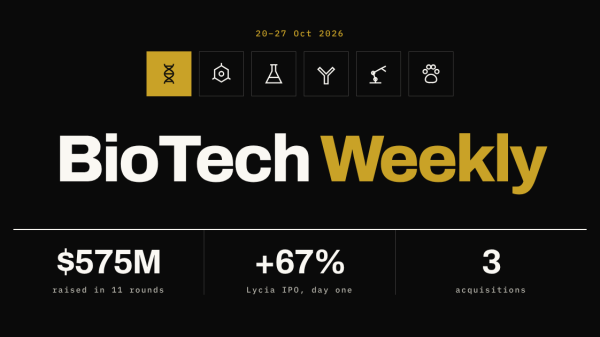
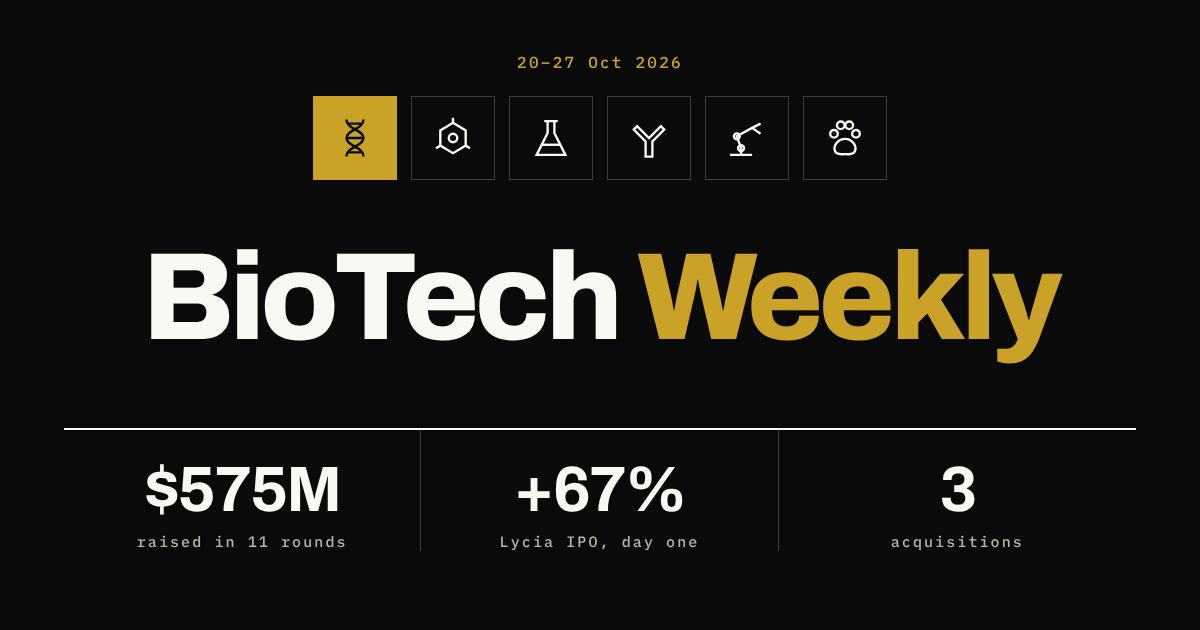
This week brought 11 BioTech private rounds worth roughly $575M, one IPO raising $317.5M, and three acquisitions. Two deals over $200M account for more than 70% of the private money, and both were started by founders from tech, not biotech. Warhound wants to breed gene-edited military working dogs, and Warp Sciences wants to bring drug-chemistry work back to the US from China. Lycia’s 67% first-day jump showed the IPO window is still open. In FoodTech, Finland’s Volare opened one of the world’s largest insect protein factories.
THE DIGEST
🇺🇸 Warhound launches with a $200M seed to breed military working dogs
The Dallas company was conceived by Colossal Biosciences’ Ben Lamm and Anduril’s Palmer Luckey. Investors include Sequoia, 8VC, Lux, ARK Invest and In-Q-Tel, the CIA-backed venture firm, and the round values Warhound at $1.2B. It plans to clone top-performing service dogs and gene-edit them for health and performance, for military, police and rescue work. More than 80% of US military working dogs currently come from Europe, and Warhound says fewer than half are fit for service. The dogs don’t exist yet, and the American Humane Society will advise on animal welfare. CEO David Spirk is a former chief data officer at the US Department of Defense.
🇺🇸 Warp Sciences launches with $215M to bring drug chemistry back from China
Lightspeed led the round at an $865M valuation, with IVP, Premji Invest and Lux. CEO Kevin Weil previously led OpenAI’s science unit. After researchers find a promising molecule, they typically make hundreds of variants to improve it, and drugmakers have long outsourced that work to Chinese contractors like WuXi AppTec. Warp is building an automated US lab to do it instead, with chemists wearing sensor gloves to teach robots the work. Warp won’t develop its own drugs; it will sell this service to biotech and pharma companies.
🇺🇸 Hexagon Bio raises a $62M Series C
The Column Group led the round, with Nextech, 8VC and CPP Investments returning. Hexagon is searching for new types of drug “payload” for antibody-drug conjugates (ADCs), cancer drugs that use an antibody to deliver a toxic payload directly to tumour cells.
🇺🇸 Coherence Neuro raises $45M for a brain implant that fights cancer
Founders Fund and the OpenAI Startup Fund co-led the round, with Lux and 8VC. Its coin-sized implant, SOMA, is designed to detect electrical signals from a brain tumour and respond with electrical pulses to slow its growth. So far it has only been placed briefly in three patients during surgery. The money will fund the first long-term human trial, in glioblastoma, an aggressive brain cancer. The company calls the round a Series A; WIRED calls it a seed.
🇰🇷 Trioar raises about $25M (KRW 33B) Series C for safer ADCs
Trioar’s technology keeps an antibody inactive until it reaches the tumour, which aims to reduce damage to healthy tissue. It has licensed the technology to Celltrion in a deal worth up to $356M.
Also raising this week:
- 🇺🇸 DMC Biotechnologies: $18M Series C to bring its fermentation-made KeyPura ingredients to market
- 🇨🇦 DropGenie: $5M with BDC to speed up biological discovery
- 🇬🇧 Neela Biotech: £2.1M to turn waste into feedstock for sustainable aviation fuel
- 🇬🇧 Imphatec: £1.5M seed for drug implants that replace daily pills
- Omabit: $2M seed for AI genomics analysis
IPO
🇺🇸 Lycia Therapeutics raises $317.5M and jumps 67% on day one
Lycia sold 17.6 million shares at $18, the top of its range, after enlarging the offering, and closed its first day at $30, a market value of about $1.65B. Lycia builds on Nobel laureate Carolyn Bertozzi’s research into drugs that remove harmful proteins from outside cells. Its lead drug, for food allergy, is in a Phase 1 trial. BioSpace counts 31 biotech IPOs so far this year, against eight in all of 2025.
EXITS & M&A
- 🇺🇸 Agilent buys Proscia for $240M upfront, plus up to $30M in milestones. Proscia’s software connects scanners, lab systems and AI tools in digital pathology, and serves more than 4,000 labs and 16 of the top 20 drugmakers. (Announced 13 October.)
- 🇺🇸 OpenAI buys Orchestra Bio, whose AI agents help drug developers track studies and timelines. (Also covered in this week’s AITech digest.)
FOODTECH
- 🇫🇮 Volare raises €7.1M and opens its first industrial insect protein factory. The Pori plant cost €15M. It uses black soldier fly larvae to turn food-industry leftovers into up to 5,000 tonnes of protein and 2,000 tonnes of oil a year, mainly for fish feed, with a full shift run by just four people. The money came through crowdfunding platform Springvest, and a second factory is already being planned.
- 🇮🇹 Ganiga raises €2.5M (€1.5M equity led by Vivenda plus €1M from Italy’s Smart&Start programme) for AI that tracks food waste in kitchens serving more than 30,000 meals a day
- 🇺🇸 Roxberry: $4M seed for kids’ soda
- 🇯🇵 Kinish: $3.1M for rice-based ice cream and casein, the main protein in milk, without cows
THE ANALYSIS
1. Tech founders and defence investors are moving into biotech
The week’s two biggest rounds came from founders who made their names at Colossal, Anduril and OpenAI. They were backed by In-Q-Tel, ARK and Lightspeed, alongside an OpenAI-backed brain implant. Biotech is drawing money from investors who don’t usually fund drug companies.
2. National security is now a reason to fund biotech
Warp is bringing drug-chemistry work home from China, and Warhound wants to end US reliance on European working dogs. Both pitch biology as a matter of supply-chain security, which helps explain why defence and intelligence investors are joining in.
3. ADCs keep attracting money
Hexagon is searching for new types of payload, while Trioar’s technology keeps antibodies inactive until they reach the tumour, which aims to limit side effects. Both are working on the same problem: making ADCs safer, which matters as more of them are developed.
4. The IPO window is open, even for early-stage companies
Lycia raised more than it planned and jumped 67%, despite having only early results from a handful of patients. After last week’s Iambic and City Therapeutics listings, public investors are clearly willing to back early-stage biotech again.
5. Robots and data are coming into the lab
Warp is automating chemistry, Proscia connects pathology data to AI tools, and OpenAI bought Orchestra Bio. Biotech’s AI investment is moving from designing molecules to automating the physical lab work.
6. Europe is building factories
Volare’s insect protein plant, Neela’s work on aviation fuel feedstock and Ganiga’s food-waste tracking were Europe’s contributions this week. The US raised the big rounds, while Europe invested in production capacity.
Bottom line: Biotech money this week went to companies pitching national security and supply-chain independence, built by founders from tech and defence. The IPO window stayed open, and Europe’s contribution was an industrial-scale protein factory.