



































































The “average day” doesn’t exist. Yet a big part of our operations is still planned around it.
Whether I was running logistics flows, an industrial site or an IT and mobility business, I kept running into the same habit. We build a schedule, lock it in, and then act surprised when reality doesn’t follow it.
In this article, I’d like to take a closer look at that habit, what it really costs, and how to move past it without breaking everything.
The fixed schedule: reassuring, but misleading
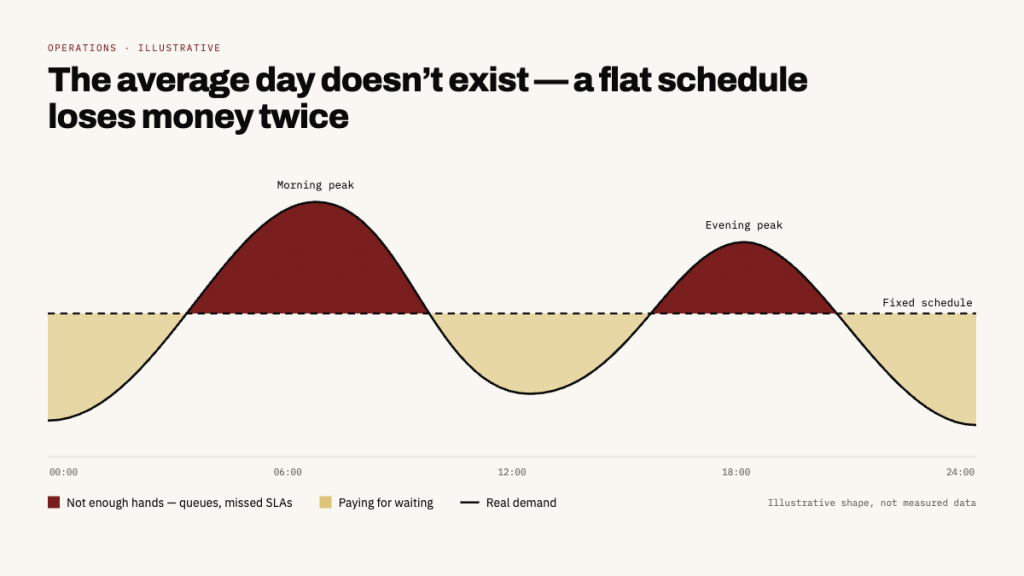
A fixed schedule feels comfortable. Everyone knows who does what, and when. The problem is that it’s built on an average, and nobody ever actually lives the average.
A few examples you’ve probably come across:
- A cleaning team checks the restrooms every hour, even when they’re empty at 10 a.m., but can’t keep up when three flights land at once.
- Buses run at the same frequency at 2 p.m. as at 8 a.m., while half the seats stay empty in the middle of the day.
- A warehouse staffs its shifts for a “standard” volume, then piles up overtime on Monday and waits for orders on Thursday.
In every one of these cases, the schedule does exactly what it was designed to do. It’s reality that doesn’t play along.
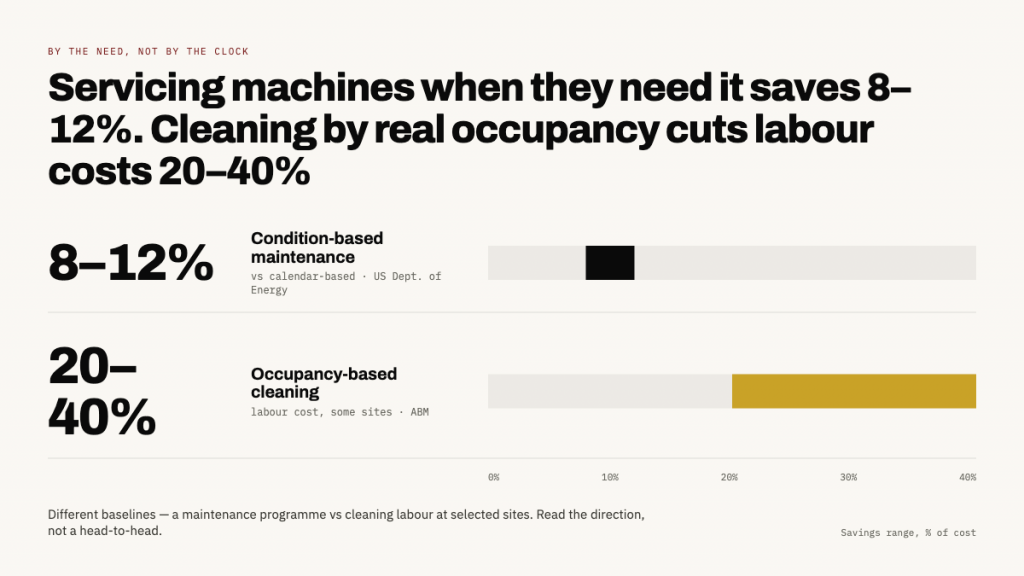
In industry, the classic example is maintenance by the calendar. Machines get serviced every few weeks whether they need it or not, and they still break down between two inspections. The US Department of Energy estimates that maintenance based on the actual condition of equipment saves 8 to 12% compared with a purely calendar-based program
In logistics, the most striking example I know is the Port of Los Angeles in 2021. At the peak of the crisis, around 100 container ships were waiting offshore, compared with about 17 in normal times. The port switched to 24/7 operations, yet a shortage of truck drivers and night-shift warehouse staff kept the rest of the chain on its usual hours, so the backlog barely moved. A schedule only works if the whole chain follows the real flow.
What it really costs
A fixed schedule loses money twice: when there are too many people, and when there aren’t enough.
In quiet hours, you pay for waiting. A study by US researchers on idle time at work estimates that keeping staff on site “just in case” costs American businesses up to $100 billion a year. And there’s a hidden side effect: when people know they’ll be waiting, they naturally slow down. The waste becomes invisible, because everyone looks busy.
At peak times, you pay in service. Queues, missed SLAs, customers who walk away, teams under pressure. This cost is harder to put a number on, but it often hurts the most, because it hits your reputation directly.
And there’s a third, quieter cost. When the schedule never matches what happens on the ground, teams stop believing in it. They improvise. And an operation that improvises all the time can no longer really be managed.
Managing by real demand: two airport examples
The alternative isn’t to get rid of schedules. It’s to make them respond to what’s actually happening.
At ACOREL, we’ve applied this logic in two airport projects, each handling around 10 million passengers a year. Both started from the same problem: decisions based on assumptions rather than real data.
Case 1: queues at the checkpoints
At a French international airport, border control, security screening and check-in are the zones where every minute counts. The airport works with strict waiting-time targets (30 minutes for EU passengers, 45 for non-EU), and peaks arrive suddenly. Staffing was largely fixed, and teams managed queues by feel.
What changed:
- LIDAR, 3D and computer-vision sensors measure passenger flows in real time across more than five critical zones;
- teams follow the situation on dashboards and directly on their phones, with automatic alerts;
- a predictive layer flags congestion before it becomes visible, so an extra lane opens or staff move in time.
Staffing now follows actual passenger flow: fewer people standing idle in quiet hours, enough hands at the peaks, and waiting times that stay stable even on busy days.
Case 2: the restrooms
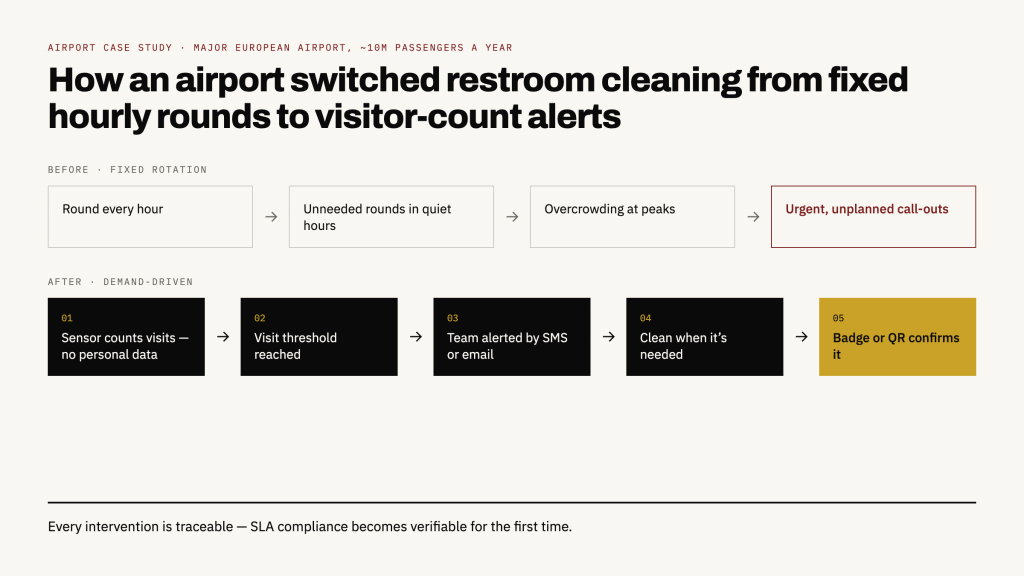
At a major European airport, restrooms were cleaned on fixed rotations. The result was a classic one: unnecessary rounds in quiet hours, and overcrowded facilities at peak times that forced urgent, unplanned interventions. Now:
- sensors at the entrance of each restroom block count visits in real time, without collecting any personal data;
- when a set number of visits is reached, the cleaning team gets an alert by SMS or email;
- each intervention is confirmed with a badge or QR code.
The team cleans when it’s needed, not just when the clock says so. And because every intervention is traceable, SLA compliance becomes verifiable for the first time.
What I like about these projects is that there’s nothing spectacular about it. No technological revolution, just a well-asked question: what if we stepped in at the moment the need actually exists? The same logic works in a warehouse, a bus network or a shopping center. Facility services company ABM, for example, reports cutting labor costs by 20 to 40% at some sites by matching cleaning to real occupancy measured by sensors.
How to move to demand-driven operations: 4 steps
If you run operations and this idea speaks to you, here’s the approach I recommend. It works whatever the sector.
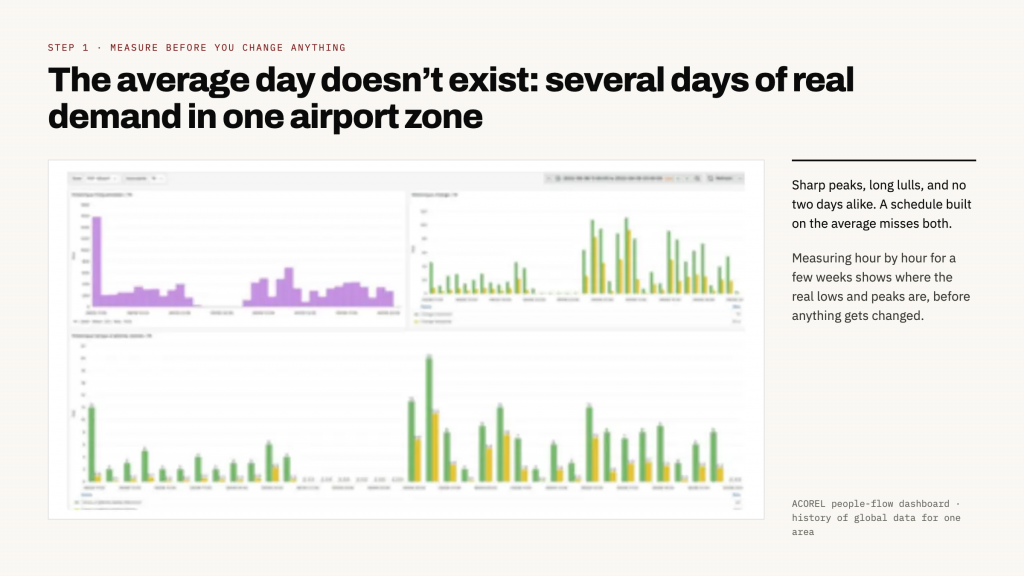
- Measure before you change anything. For a few weeks, measure real demand hour by hour: visits, volumes, queues. Don’t touch the schedule yet. You’ll quickly see where the lows and peaks are, and they probably won’t be where you expected.
- Set thresholds that trigger action. Not “we clean every hour”, but “we step in after X visits”. Not “two counters open”, but “a third one as soon as the wait goes over X minutes”. A threshold is a decision made in advance, calmly, rather than in the heat of the moment.
- Adapt roles, not just tools. This is the step people forget most often. If teams receive alerts but keep the same routines, nothing changes. You need to rethink who gets the alert, who decides, and how the team organizes itself between peaks.
- Track new metrics. Time on site doesn’t tell you much anymore. Look instead at the time between alert and intervention, the real utilization of your teams, and SLA performance at peak hours.
One piece of advice: start small. One site, one process, one willing team. Results will convince people far better than any presentation.
Let’s be honest: it doesn’t work everywhere
I don’t believe in miracle solutions, and this one has its limits.
Safety first. In critical environments, such as rail signaling or security, minimum staffing levels are set by regulation. There, you don’t go below the threshold, whatever the traffic.
Labor rules matter. In many countries, including France, changing someone’s schedule can’t happen overnight: notice periods apply, and they can only be shortened within a negotiated framework. So demand-driven operations don’t mean “calling people in at the last minute”. They mean making better use of the resources you already have: moving a team from a quiet zone to a busy one, adjusting tasks during the day, preparing for predictable peaks in advance.
People need predictability. A schedule that changes all the time wears teams out. The approach that works best, in my view, combines a stable core known in advance with a flexible share to absorb the peaks. The sensor doesn’t replace the manager. It gives them better reasons to decide.
Data must stay anonymous. Measuring people flows in Europe means complying with GDPR. Modern counting sensors process images directly on the device and only send out numbers, never recording faces. It’s a non-negotiable condition for the system to be accepted, by authorities and by the public alike.
In short: react faster rather than plan better
For a long time, operational performance meant building the best possible schedule. Today, it’s mostly about reacting faster when reality drifts away from it.
And the stakes keep growing. Look at Dubai International Airport: 95.2 million passengers in 2025, with close to 99.5 million expected in 2026. At that level of load, no fixed schedule holds up. Only an organization that sees what’s happening in real time can keep pace.
The good news is that this shift doesn’t require a big bang or a huge budget. Mostly, it requires changing the question: no longer “what did we plan?”, but “what’s happening right now?”.
So, in your operations, what’s still running by the clock when it could be running on demand?
Dimitri Rudenko is Business & Operations Director at ACOREL. He turns complex industrial, mobility and IT operations into measurable results, with experience across IoT and embedded systems, SaaS, nuclear and logistics, in France, the EU and the Middle East.