


























Oslo has the capital. Trondheim has the engineering. Bergen has the customers.
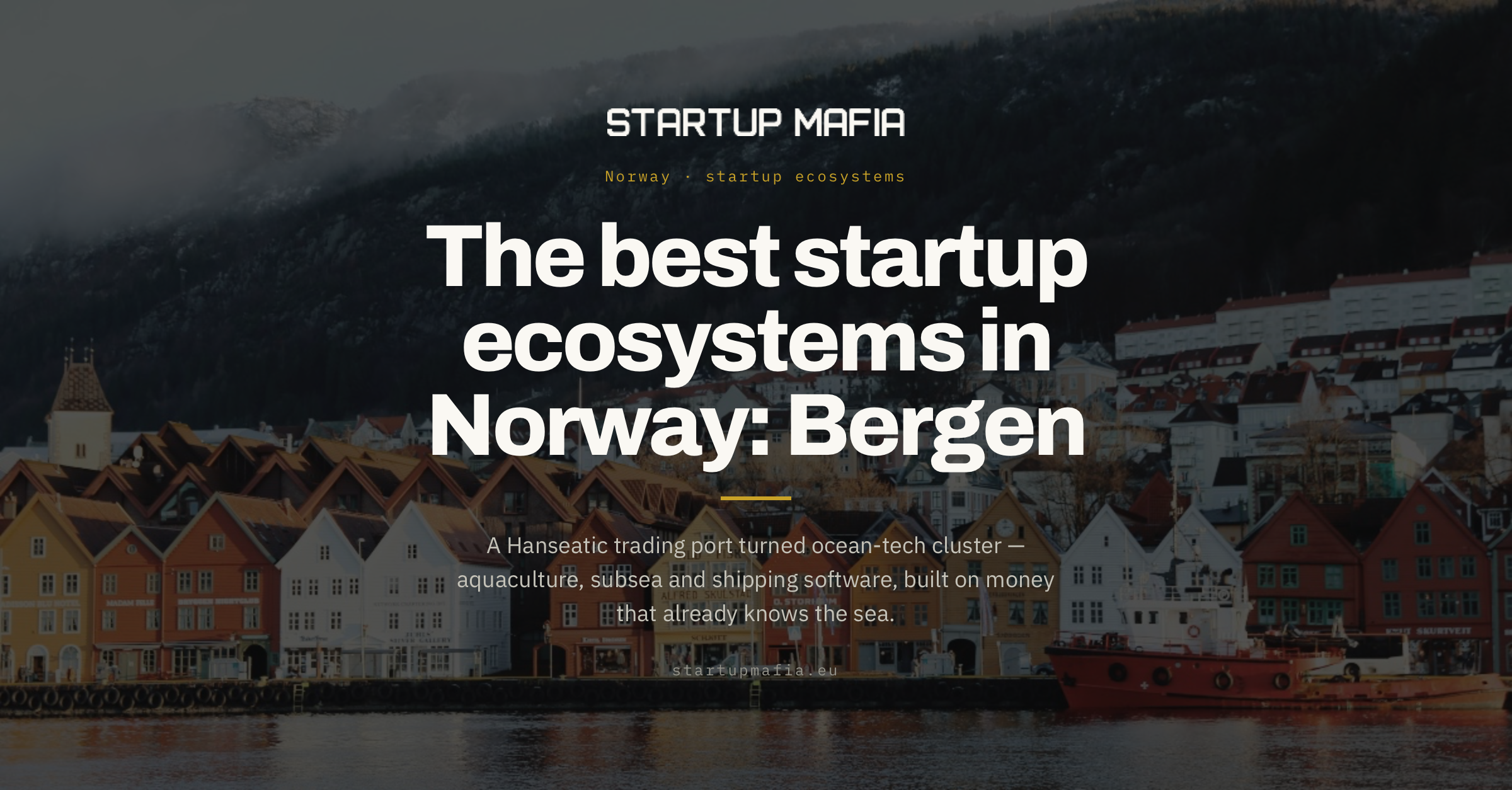
That is the shortest useful summary of Norway’s third ecosystem, and it undersells the place. Bergen is the most sector-specialised startup city in Norway and probably the most pleasant one to build in — a compact, rain-soaked harbour city where the headquarters of the global salmon industry, Norway’s largest commercial broadcaster, and one of Europe’s better marine research clusters all sit within a few kilometres of each other.
It has been described as Norway’s second-largest but arguably most creative startup ecosystem, combining quality of life, maritime heritage and a growing technology focus into distinctive ventures in ocean technology, creative media and sustainability.
It also has a funding problem it has not fixed. More on that.
1. Why Bergen is different
Oslo and Trondheim are generalist ecosystems with specialisms. Bergen is the reverse: three deep, genuinely world-class clusters with comparatively little in between.
Cluster one: seafood and aquaculture. Bergen is, functionally, the capital city of global salmon farming. The headquarters of Mowi (then Marine Harvest), Grieg Seafood, Lerøy Seafood Group, Salmon Group and Cargill Aqua Nutrition are all within walking distance of each other, and all are partners in the NCE Seafood Innovation Cluster.
Cluster two: media technology. The Norwegian Media Cluster is a world leader in augmented reality, graphics, AI, virtual studios, robotics, IP-based video and visual storytelling tools, with around 100 member companies and eight universities and research institutions among them.
Cluster three: marine science and life sciences. Marineholmen has been a driving force in Bergen’s marine science community for more than 130 years — the city’s first biological station was established there in 1892, laying the foundation for work by Michael Sars, Fridtjof Nansen and Vilhelm Bjerknes.
For a founder, that concentration means one thing above all: if your product serves any of these three industries, your first ten customer conversations are a short walk away. That is a rarer advantage than it sounds.
2. The numbers
Bergen’s startup statistics are modest and worth being honest about.
Seedtable tracks 26 funded companies in Bergen, which have raised $301M between them, led by Corvus Energy. Failory’s watchlist runs to 50 companies. Nationally, StartupBlink counts roughly 967 Norwegian startups with Oslo as the clear centre of gravity and Bergen among the sector-specific regional contributors.
That is a much smaller venture footprint than Oslo’s ~2,200 startups and 188 scaleups, or Trondheim’s 50–70 new tech companies a year out of the NTNU/SINTEF orbit.
But the cluster economics tell a different story. The Norwegian Media Cluster alone reported combined member revenue approaching $1bn, with more than 86% of members launching new innovations every year. Bergen’s strength is not startup volume. It is the quality of the industrial base a startup can plug into.
3. Marineholmen: the blue innovation district
If Trondheim has Gløshaugen and Oslo has Forskningsparken, Bergen has Marineholmen — and it is the most physically distinctive of the three.
Built on Bergen’s derelict shipyards across Damsgårdssundet from the University of Bergen’s main campus, Marineholmen brings researchers, students, startups, investors and public actors into close physical proximity. The tenant list reads like a map of Norwegian marine science: the High Technology Centre, UiB, DNV, the NCE Seafood Innovation Cluster, Pharmaq, Hatch, the Ocean Industries Accelerator, the Norwegian Marine Laboratory, ILAB, the Norwegian Food Safety Authority, the Veterinary Institute and VIS.
ILAB (Industrilaboratoriet) is the piece that matters most to aquaculture founders. It operates advanced research facilities at Marineholmen that let scientists and companies test, monitor and optimise biological and technical processes under controlled marine conditions. Wet-lab access at this level is not something you can improvise.
The district is developed by GC Rieber with sustainability built in — seawater cooling for some buildings, growing solar, and plans to add housing by converting existing warehouses.
Through UiB’s collaboration with VIS and StartupLab Bergen, researchers get IP guidance, funding access and tailored business development for science-based startups.
4. Media City Bergen: the cluster nobody outside Norway talks about
Media City Bergen is a 45,000 m² campus in the city centre and the workplace of around 1,200 people in the media industry. It was founded by co-locating TV 2, NRK, Vizrt, the University of Bergen’s Department of Information Science and Media Studies, Bergens Tidende and Bergensavisen under one roof.
The trajectory. The cluster entered Innovation Norway’s cluster programme in 2010 as MediArena, earned NCE (Norwegian Centre of Expertise) status in 2015, and holds the ECEI Gold Label for cluster management excellence. The founding dynamic was TV 2’s entrepreneurial culture, the university’s research collaboration, and Vizrt’s ambition for a large joint project.
Who’s in it. Vizrt, Vimond, Fonn Group, Myreze, Highsoft, Sixty, Mediability, TV 2, NRK, and publishers including Bergens Tidende, Dagens Næringsliv and Stavanger Aftenblad, alongside a range of startups in 3D, animation, games, film, music, mobile, drones and sensor technology.
What’s there for founders. The south tower houses the MCB Media Lab plus a dedicated startup lab for entrepreneurship and business development. NCE Media runs the Media City Bergen Village at IBC, taking smaller members into the global market — a role TV 2 and Vizrt used to play informally.
If you’re building anything in video infrastructure, real-time graphics, AR, virtual production or newsroom tooling, this is the densest concentration of buyers and expertise in the Nordics.
5. Seafood: the most internationally connected part of the ecosystem
NCE Seafood Innovation is a national industry cluster whose members and partners span the entire seafood value chain — aquaculture producers, the supply industry, startups, VCs, research and academia. Members get access to competency programmes, industry-defined innovation projects, and shared meeting infrastructure.
Hatch Blue is the more remarkable story. The world’s first aquaculture-focused accelerator, founded by Carsten Krome, chose Bergen after a lengthy search, launching with NCE Seafood Innovation and Bergen Teknologioverføring (BTO, now VIS) as partners. The logic was blunt: the Bergen environment was perfect because the major producers were all within walking distance of the accelerator venue.
Its structure has been genuinely competitive with anything in Europe — an intensive 16-week programme with around 100 recruited mentors, and cohort terms of roughly $75,000 in cash plus $55,000 in in-kind services. It has 59 investments and two portfolio exits on record.
Two caveats, stated plainly. Hatch is now headquartered in Cork, Ireland, with offices in Bergen, Singapore and Hawaii, and in February 2026 took a strategic minority GP investment from Builders Vision, Lukas Walton’s investment platform, to build out its Blue Revolution Fund. Bergen incubated the world’s leading aquaculture investment platform and then watched its centre of gravity move.
That is a recurring Norwegian theme, and Bergen is not immune to it.
Current programmes worth tracking include Hatch’s CREST accelerator for aquaculture, climate resilience and ocean innovation, and AquaScale, run with Ireland’s Bord Iascaigh Mhara.
6. VIS: the operating system of Western Norway’s ecosystem
Almost everything institutional in Bergen routes through VIS – Vestlandets Innovasjonsselskap, the region’s technology transfer office and incubator, founded in December 2004 and based at Thormøhlens gate 51 on Marineholmen with around 38 employees.
What VIS actually provides:
- Physical space at three locations — Marineholmen, Media City Bergen and Haukeland University Hospital — which neatly maps to the ocean, media and health verticals.
- Business development advisory from experienced developers, one-to-one.
- Network into the leading research, investor and industry environments in Bergen and Vestland, with more than 100 events a year across ocean, health and technology.
- Investor access through a close partnership with the Connect network, running exclusive Springbrett sessions, plus Demo Day Vestlandet, where selected Western Norway startups pitch to a full room of investors. Demo Day has drawn over 200 local and national financiers.
- Discounted partner agreements for legal, IP, patent, accounting, finance and marketing services.
- Early-stage community programmes — TILT Student for students across Vestland exploring entrepreneurship, and TILT Komet, a low-threshold community for researchers, students and makers with or without an idea yet.
- Licensing, as a real TTO. VIS signed an exclusive licence agreement with vaccine company Valneva SE covering ETEC technology.
VIS also co-built Catalyst Map, an interactive digital map of Western Norway’s innovation ecosystem, together with Framdrift, Link Utvikling, Atlas Accelerator and StartupLab. If you are new to Bergen, start there.
StartupLab Bergen is the other anchor — the Oslo incubator’s second location, part of a network with around 110 active member companies across both cities, running the same 3-month accelerator with NOK 2–4M for roughly 10%.
7. The companies
Ocean and energy
- Corvus Energy — large-scale battery and hydrogen fuel cell systems for the maritime industry, powering vessels and port applications. Bergen’s biggest venture-funded name.
- Wattif EV — EV charging infrastructure, around $58M raised.
- SeaSmart — fish farm drone technology; an early Marineholmen success that found its angel investor after moving into the park, and later exited.
- Bergen Carbon Solutions — carbon nanofiber produced from CO₂, listed on Oslo Børs.
Climate and data
- 7Analytics — precision analytics for climate adaptation, helping clients model surface water flooding, sea-level rise and geohazards.
Life sciences
- Cytovation — CyPep-1, a first-in-class synthetic peptide immunotherapy that kills tumour cells by creating pores in their membranes, triggering a systemic anti-tumour immune response.
- BerGenBio and Nykode Therapeutics — both Sarsia Seed portfolio companies that reached IPO.
Media and software
- Vizrt, Vimond, Highsoft (Highcharts), Fonn Group, Myreze, Sixty, Mediability.
Edtech and health tech
- Eduplaytion (Numetry, the maths game) and Motitech.
8. The capital
This is Bergen’s weakest link, and it is worth being specific rather than vague.
Sarsia Seed is the anchor. Founded in 2006 in Bergen, it invests in science-based technology companies and has backed 30 to date. Sarsia Seed I was NOK 390M across 22 companies; Sarsia Seed II closed at €33M (NOK 300M) as a 50/50 partnership between Innovation Norway and private capital, targeting NOK 5–20M deals across life science, cleantech and renewable energy. Its portfolio has produced three IPOs and an acquisition — BerGenBio, Nykode Therapeutics and SeaSmart.
Grieg Kapital, the Grieg Group’s investment company, specialises in aquaculture, renewables and technology at seed and early-stage VC.
NCE Media Invest focuses on creative technologies.
Connect Vest runs the investor matchmaking layer alongside VIS.
Beyond that, Bergen relies on connections to Oslo-based venture capital, growing corporate venture activity out of the maritime and energy industries, and public funding instruments.
The honest read. Bergen has good sector-specialist seed capital in life sciences and cleantech, credible corporate and family-office money in seafood and shipping, and very little generalist venture capital. A Series A in Bergen usually means an Oslo or Nordic lead. A Series B almost always means international.
Public money works the same as everywhere in Norway: SkatteFUNN pays back 19% of eligible R&D costs, in cash if you are pre-profit, capped at NOK 25M of project expenses a year. Innovation Norway’s grant ladder and the Research Council’s schemes sit alongside it, and Bergen’s cluster organisations are unusually good at helping members assemble applications.
9. Talent, cost and the rain
Universities. The University of Bergen is a founding partner of the Media Cluster, with its Department of Information Science and Media Studies physically co-located in Media City Bergen and 220 of its students based there. NHH (the Norwegian School of Economics) supplies the commercial side — genuinely useful, given that this is the layer Trondheim struggles with. HVL (Western Norway University of Applied Sciences) rounds it out.
Cost. Cheaper than Oslo, more expensive than Trondheim. One-bedroom rents run roughly 10,000–15,000 NOK a month, against Oslo’s 12,000–18,000. Bergen has a notably tight-knit, collaborative community with a lower cost profile than the capital.
Culture. The collaborative quality is real and repeatedly noted. In a city this size the ecosystem is small enough that reputations travel fast, which cuts both ways but mostly helps founders who deliver.
The rain. It rains heavily on roughly 240 days a year. Everyone jokes about it. Factor it into your international recruiting pitch.
10. The honest problems
Incumbent gravity. Bergen’s two strongest clusters are both organised around very large companies — the salmon majors and TV 2/NRK/Vizrt. That gives you customers, mentors, pilot budgets and credibility. It also means procurement cycles measured in quarters, innovation agendas set by incumbents, and a real risk that your startup becomes a well-paid supplier rather than an independent company. Both outcomes are viable. Know which one you are choosing.
Thin venture depth. 26 funded companies and $301M in aggregate is not an ecosystem that will fund your Series A locally in most sectors. Build the Oslo and international investor relationships from day one.
The centre-of-gravity drift. Hatch Blue was founded in Bergen and is now headquartered in Cork. Bergen has a pattern, milder than Trondheim’s, of incubating things that scale somewhere else.
Cluster silos. Marineholmen, Media City Bergen and Haukeland are three good ecosystems in one city rather than one large one. VIS operating across all three helps, and Catalyst Map exists precisely because navigation was a problem — but cross-pollination between the seafood and media worlds is weaker than it should be given how close they are.
11. The verdict
Bergen is the right choice if:
- Your customers are fish farms, feed companies, vessels, ports or seafood supply chains. No other city in the world puts this many decision-makers within walking distance.
- You’re building media technology — real-time graphics, AR, virtual production, video infrastructure, newsroom AI. Media City Bergen has no European equivalent at this density.
- You need marine wet-lab and controlled-condition testing. ILAB and the Marineholmen infrastructure are hard to replicate.
- You’re a UiB or Haukeland researcher. VIS is a capable, well-resourced TTO with real licensing experience.
- You want a lower burn rate than Oslo without sacrificing customer proximity in your sector.
Bergen is the wrong choice if:
- You’re building horizontal software with no sector anchor. Oslo’s investor and customer density will beat it.
- You need to raise a generalist Series A locally.
- Your bottleneck is pure hard engineering volume — Trondheim’s NTNU pipeline is deeper.
12. A practical first 90 days in Bergen
- Open Catalyst Map and work out which of the three clusters you actually belong to. Getting this wrong wastes months.
- Book a meeting with VIS. They are the switchboard — advisory, space at Marineholmen, Media City Bergen or Haukeland, and the route into Connect and Demo Day Vestlandet.
- Join the relevant cluster as a member. NCE Seafood Innovation if you touch aquaculture; NCE Media if you touch video or visualisation. Membership is the access mechanism, not a badge.
- File SkatteFUNN. Same logic as everywhere in Norway, and the cluster organisations will help you write it.
- Get one paid pilot with an incumbent. A signed contract with Mowi, Lerøy, Grieg or TV 2 is worth more internationally than any amount of Norwegian seed funding.
- Book lab or test capacity early if you need ILAB or marine testing conditions.
- Apply to Hatch or StartupLab Bergen depending on sector — Hatch for aquaculture and blue food specifically, StartupLab for general tech.
- Start the Oslo investor conversation immediately. Sarsia Seed and Grieg Kapital are excellent within their mandates. Outside those mandates, plan to travel.
Bergen will not give you a deep venture market or a large local generalist talent pool. It will give you the world’s most concentrated set of aquaculture buyers, a media technology cluster punching far above a city of 290,000, wet-lab infrastructure with 130 years of institutional memory behind it, and a founder community small enough that people actually help each other.
Pick a cluster, get a paying incumbent, then go raise the money somewhere else.