

























































A fractional CMO for ProcureTech or supply chain software is a senior marketing leader who owns GTM strategy and execution without a full-time salary commitment. For vendors navigating multi-stakeholder procurement cycles, ERP incumbent objections, and international expansion, a specialist fractional CMO compresses time-to-pipeline significantly.
Why ProcureTech GTM is fundamentally different
Most B2B SaaS marketing playbooks were written for products that a single buyer can evaluate, approve, and implement. ProcureTech and supply chain software do not work that way. Your deal involves the CPO who owns the procurement function, the CIO who owns the integration architecture, the CFO who controls the budget, and the Operations leader who will actually use the platform. Getting any one of them to say no is enough to kill a deal that took six months to build.
That multi-stakeholder reality shapes everything: how you position the product, how you write the website, how you structure a sales deck, how you build the ROI case, and how you run outbound. Generic B2B SaaS marketing frameworks — the kind that optimize a single free-trial funnel or a one-persona demand gen campaign — do not transfer. They produce activity without pipeline.
Add the ERP incumbent problem on top. “We already have this in SAP” or “Oracle covers that” ends more ProcureTech deals than any competitor does. Unless your GTM is built around a crisp, defensible answer to that objection — grounded in category design, not feature comparison — your sales team is relitigating the same conversation on every call.
The ProcureTech market is growing at 11% annually toward $7B+ — but most of that spend flows to vendors with clearer category stories, not better products. Eight in ten procurement leaders say vendor messaging fails to explain differentiation clearly enough to act on. The market opportunity is real. The messaging gap is real too.
Signs your supply chain software company needs a fractional CMO
Most ProcureTech founders recognize these patterns once they’re named. The harder part is admitting that a content agency, a part-time marketing manager, or a performance marketing retainer will not solve them.
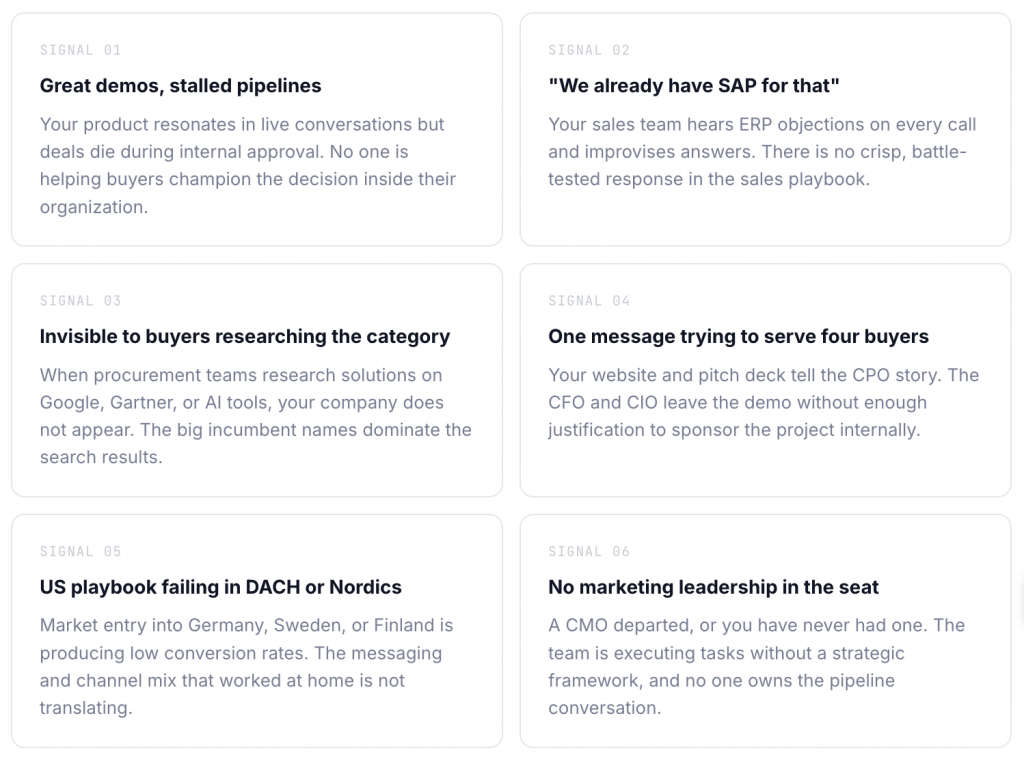
If two or more of these sound familiar, you are not facing a content problem or a channel problem. You are facing a positioning and leadership problem — and that is exactly what a fractional CMO solves.
What a fractional CMO owns in ProcureTech
A generalist CMO description covers strategy, brand, demand generation, and team management. For supply chain software specifically, the scope looks different in practice. Here is what effective fractional CMO ownership looks like in this market.
Category positioning and narrative design
Before any campaign runs, the fractional CMO defines where your product fits in the procurement and supply chain stack — and why a best-of-breed solution wins over the ERP module. This is not a tagline exercise. It is the foundation that makes every other piece of marketing coherent and defensible.
Coupa built an $8B business not by outbuilding SAP, but by naming a category — Business Spend Management — that gave every CFO a clear reason to act. That kind of category clarity is a strategic output, not a copywriting output. It requires someone senior enough to make the call and experienced enough to back it with market evidence.
Multi-stakeholder message architecture
The fractional CMO designs separate messaging tracks for each buying stakeholder — CPO, CIO, CFO, Operations — each making a different case for the same decision. This work sits above what any content writer or agency can produce without deep strategic context. It feeds the website, the sales deck, the outbound sequences, and the ROI tools.
ROI and business case infrastructure
In ProcureTech, deals stall at internal approval more often than at the demo stage. The fractional CMO builds the assets that give buyers something to take to their CFO: ROI calculators, case studies benchmarked to their industry, business case templates, and competitive displacement frameworks. This is sales enablement at the strategic level, not the content production level.
Sales and ERP objection playbook
A fractional CMO with ProcureTech experience writes the scripted responses to “SAP already has this,” “Oracle covers that,” and “we can build it ourselves.” These battle cards, competitive positioning decks, and discovery frameworks reduce the time your sales team spends reinventing answers on every call.
Demand generation and LLM/AI visibility
In 2026, procurement teams research solutions using AI tools — ChatGPT, Perplexity, Google’s AI Overviews — alongside traditional search. A fractional CMO with current GTM knowledge builds the content architecture that surfaces your company in both. AI visibility is increasingly a first-page-of-research problem, not a last-mile SEO problem.
International expansion GTM
DACH, Nordics, EU, and US markets each require a localized version of your GTM: different ICP parameters, different channel weighting, different regulatory context, different procurement culture. A fractional CMO who has executed these expansions before does not learn on your budget.
The generalist trap: why most CMOs get this market wrong
The fractional CMO market has grown rapidly, and so has the supply of generalists who claim broad B2B SaaS experience. For most tech categories, that experience transfers reasonably well. ProcureTech is an exception.
“Most B2B SaaS CMOs have built their playbooks around a single buyer persona and a relatively short decision cycle. ProcureTech inverts both assumptions. The deals that move fastest are the ones where someone has already done the internal selling work before the vendor even shows up — and that only happens when your messaging gives buyers the right language to champion you.”
— Natali Trubnikova, Co-founder, Go Global
A generalist fractional CMO joining a supply chain planning or eProcurement vendor will typically default to frameworks built for SaaS with a single economic buyer. They will optimize for top-of-funnel lead volume, run content programs aimed at a single persona, and build a demand gen motion that looks productive on a dashboard while deals continue to stall at the CFO approval stage.
The problems that actually block pipeline in ProcureTech — category confusion, multi-stakeholder misalignment, ERP incumbent positioning, change management anxiety — require domain-specific GTM patterns, not generic B2B templates. The right fractional CMO has already solved these problems for other vendors in the same space and comes with tested frameworks, not hypotheses.
What to look for when hiring a fractional CMO for ProcureTech
Use these criteria as a filter before you engage anyone for a strategy conversation. The goal is to distinguish operators from strategists, and domain specialists from generalists.
- Procurement or supply chain software track record. They should be able to name specific vendors they have worked with, the stage those companies were at when they engaged, and what the GTM problem was. Vague references to “enterprise software” or “complex B2B” are not the same thing.
- Multi-stakeholder messaging experience. Ask them to describe how they have handled a deal where CPO, CFO, and CIO each needed a different version of the value proposition. If they have not solved this before, they will solve it slowly on your account.
- ERP objection playbook.Have they built competitive displacement frameworks for SAP, Oracle, or Microsoft? If not, your sales team will continue improvising.
- International expansion exposure. If you are entering European markets, they should have direct DACH, Nordics, or broader EU experience — not aspirational familiarity.
- Execution ownership, not advisory delivery. The most important question is whether they will own the work or brief other people to do it. A senior strategy memo is not the same as a working GTM motion. Ask for a specific example of something they personally built, not commissioned.
- PR and analyst relations capacity. Gartner Magic Quadrant and Forrester Wave inclusion shortens sales cycles in ProcureTech materially. A fractional CMO who can build toward analyst recognition — and pursue coverage in Spend Matters, CPO Strategy, and Supply Chain Digital — creates a compounding visibility asset, not just a campaign.
Pricing and engagement models in 2026
Fractional CMO pricing for B2B technology companies has stabilized into three primary models in 2026, with meaningful variation by seniority, scope, and market focus.
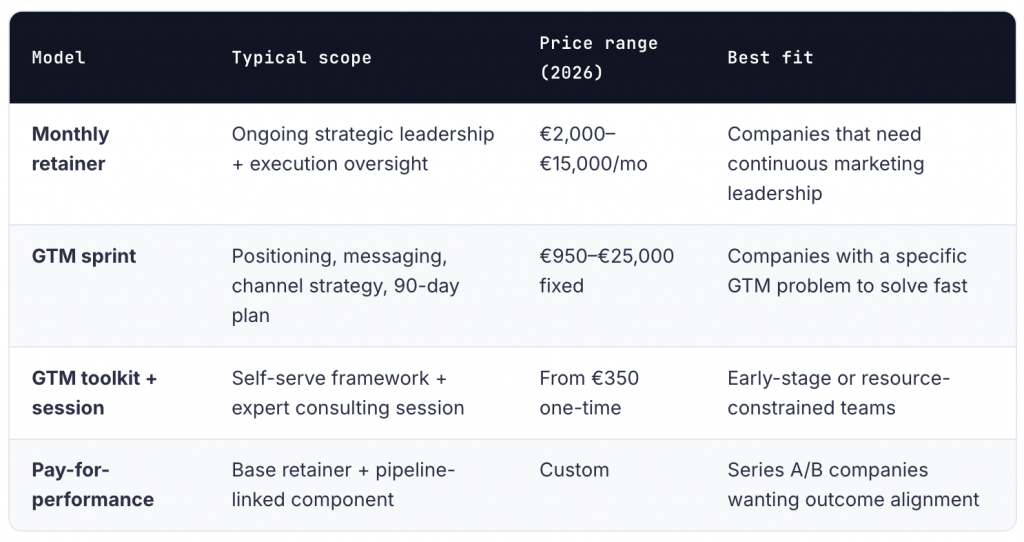
Full-time CMO compensation for a qualified senior hire in B2B enterprise software now typically exceeds €200,000–€300,000 in total annual cost including benefits and equity. A fractional CMO engagement at €2,000–€8,000 per month provides senior-level strategic leadership at 30–50% of that cost — with faster ramp time, because a domain-experienced operator does not need six months to understand the market.
The more important cost consideration is opportunity cost. Every month your pipeline stalls while the GTM motion is being figured out is a month of revenue you cannot recover. The right fractional CMO engagement pays back in compressed time-to-pipeline, not just in salary savings.
How Go Global approaches fractional CMO for supply chain tech
Go Global’s fractional CMO service for ProcureTech and supply chain software companies is built around one principle: execution, not advisory. Every engagement starts with a diagnosis of what is actually blocking pipeline — not a framework presentation — and moves to implementation in the same engagement.
Co-founder Natali Trubnikova brings direct experience with supply chain planning and ProcureTech GTM alongside 10+ years in B2B marketing and international expansion. This is not applied general knowledge — it is direct domain pattern recognition from working inside the same buying environments your customers navigate.
A typical Go Global fractional CMO engagement for a ProcureTech vendor covers:
- Category positioning and competitive narrative — including the ERP incumbent objection framework
- Multi-stakeholder message architecture for CPO, CIO, CFO, and Operations buyers
- ROI and business case content that survives the internal approval stage
- Website copy and conversion structure built for the procurement buyer journey
- Sales playbook with battle cards and discovery frameworks for long-cycle enterprise deals
- PR and analyst relations roadmap toward Gartner, Forrester, and trade press coverage
- International expansion GTM for DACH, Nordics, EU, or US market entry
- AI/LLM visibility content architecture so your company appears when procurement teams research solutions
If you are trying to decide whether a fractional CMO engagement is the right next step, a 30-minute strategy call will give you a clear diagnosis of what is blocking your pipeline and what to fix first — with no obligation to proceed.
Frequently asked questions
What is a fractional CMO for ProcureTech companies?
A fractional CMO for ProcureTech is a senior marketing executive who works with your company on a part-time or project basis — owning go-to-market strategy and execution without the cost of a full-time hire. In the procurement and supply chain software market specifically, a good fractional CMO understands multi-stakeholder buying dynamics, category design, ERP incumbent displacement, and the long-cycle enterprise sales motion that defines deals in this space.
How is ProcureTech marketing different from regular B2B SaaS marketing?
Most B2B SaaS GTM is designed around a single buyer and a relatively short sales cycle. ProcureTech deals involve four or five stakeholders — CPO, CFO, CIO, Operations — each with different priorities and veto power. The ERP incumbent objection (“SAP already does this”) is a constant, and deals frequently stall during internal approval rather than at the demo stage. These dynamics require fundamentally different messaging architecture, sales enablement, and ROI content than standard SaaS GTM frameworks produce.
When should a supply chain software company hire a fractional CMO?
The right time is typically when you have product-market fit — at least some customers who value the product — but pipeline is stalling before deals close, messaging is inconsistent across stakeholders, or you are preparing to enter a new market. A fractional CMO is also the right call when your existing CMO has departed and you need senior marketing leadership during the gap rather than running the function with a junior team.
How much does a fractional CMO cost for a B2B tech company in 2026?
Fractional CMO retainers for B2B technology companies typically range from €2,000 to €15,000 per month depending on seniority, scope, and market focus. Project-based GTM sprint engagements — covering positioning, messaging, and a 90-day plan — generally run €950 to €25,000. This compares favorably to a full-time senior CMO hire, which typically costs €200,000–€300,000+ per year in total compensation. The more relevant comparison is time-to-pipeline: a domain-experienced fractional CMO compresses the ramp time significantly versus an internal hire building context from scratch.
Can a fractional CMO help with ERP objection handling?
Yes — and this is one of the most specific value-adds a domain-experienced fractional CMO brings to ProcureTech. A good fractional CMO builds competitive displacement frameworks, battle cards, and scripted responses to the “we already have SAP/Oracle for that” conversation. This is not generic objection handling — it requires understanding why best-of-breed solutions win over ERP modules and giving your sales team the specific language to make that case on every call, not improvise it.
What does multi-stakeholder messaging mean in practice?
Multi-stakeholder messaging means creating distinct value propositions for each buying influence in a procurement software deal — the CPO who cares about savings and supplier relationships, the CIO who cares about integration complexity and IT governance, the CFO who cares about payback period and risk, and the Operations team who cares about usability and implementation disruption. A fractional CMO designs these as separate messaging tracks — separate website pages, separate sections of a sales deck, separate outbound sequences — each making a different case for the same decision. Without this architecture, any one stakeholder can kill a deal the others were ready to sign.
How does AI search (LLM visibility) affect ProcureTech marketing in 2026?
In 2026, procurement and supply chain decision-makers increasingly use AI tools — ChatGPT, Perplexity, Google’s AI Overviews — to research vendor categories before shortlisting. When a CPO asks an AI “what are the best supply chain planning tools for a mid-market manufacturer?”, the AI aggregates from structured category content, analyst mentions, review platforms, and authoritative trade sources. Companies that appear in those aggregated answers get on shortlists before competitors know a search was happening. A fractional CMO with current GTM expertise builds the content and authority architecture needed to show up in AI-generated research results — which is now a genuine top-of-funnel acquisition channel for B2B software companies.