




















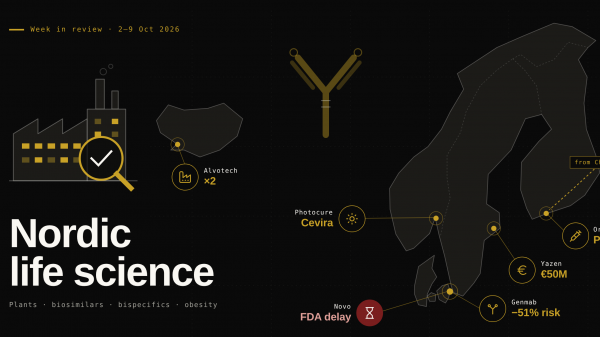
























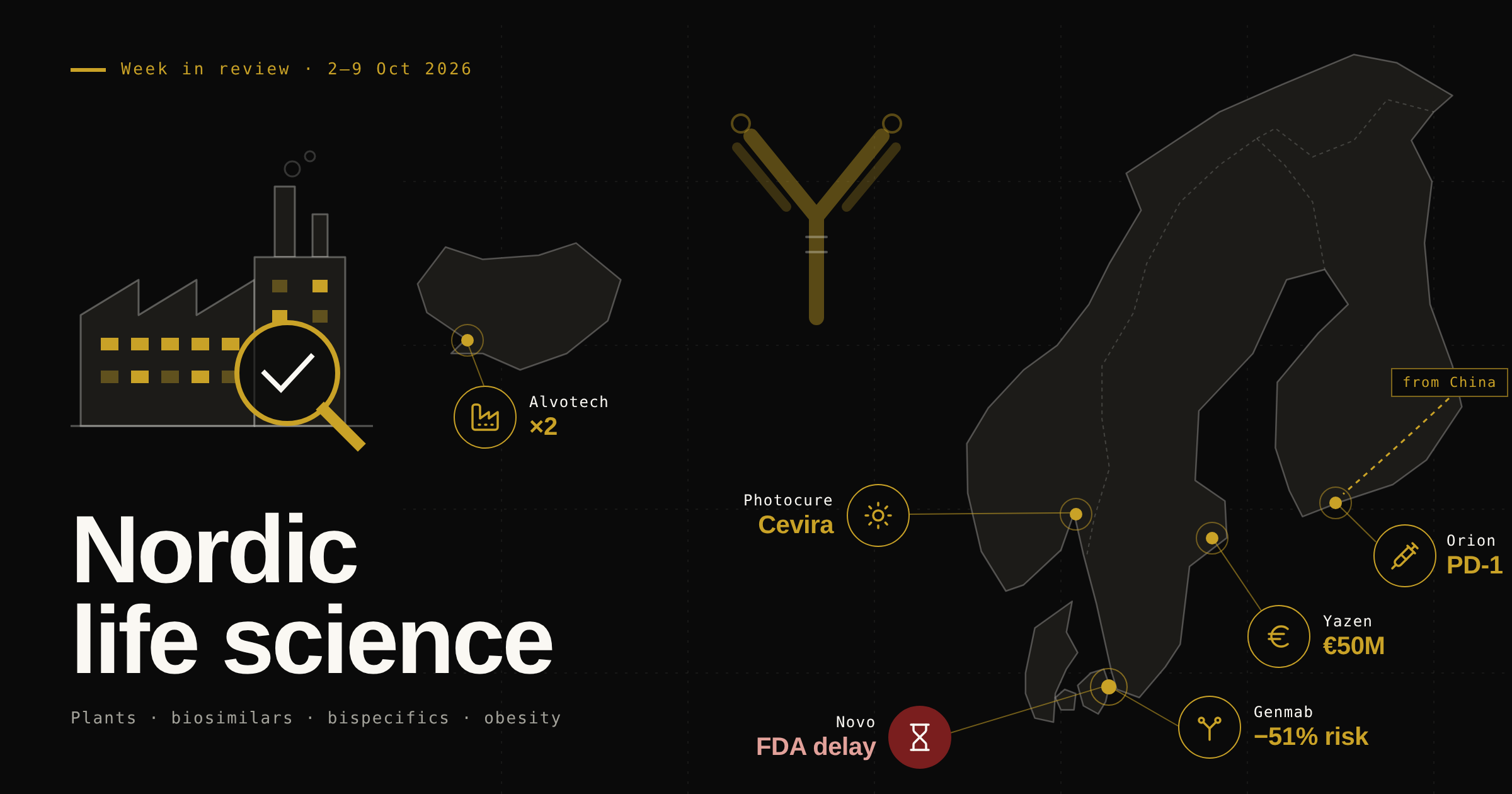
The week in Nordic life science was shaped by two opposing storylines. On one side, manufacturing and regulatory inspections proved to be a bottleneck even for the largest players: the FDA extended its review of Novo’s haemophilia drug because of issues at a production site. On the other, Iceland’s Alvotech got confirmation that its own factory problems are behind it. In between came strong clinical data from Genmab, a wave of biosimilar deals (Orion) and €50 million for Swedish digital obesity clinic Yazen.
The week at a glance
- Novo — the FDA extended its review of denecimig (haemophilia A) due to remediation at a manufacturing site; no new date yet, and Novo still targets a US launch in H1 2027.
- Genmab / AbbVie — Epkinly + R-CHOP cut the risk of progression or death by 51% in first-line DLBCL. These are Phase 3 results, not an approval.
- Orion — exclusive European rights to sell Qilu’s pembrolizumab (Keytruda) biosimilar.
- Alvotech — the FDA approved a second production suite for its Humira biosimilar, doubling US capacity; shares rose ~13%.
- Yazen — €50 million led by Verdane to scale medical obesity care across Europe.
- Asieris / Theramex — licence for Cevira (a drug of Norwegian origin) in Europe, Australia, New Zealand and Turkey.
Novo: manufacturing and job cuts
Denecimig: delayed by the plant, not the data
On 2 October Novo said the FDA is extending its review of the biologics licence application (BLA) for denecimig (Mim8), a subcutaneous FVIIIa-mimetic bispecific antibody for prophylaxis of haemophilia A in adults and children, with or without inhibitors. The application was filed in September 2025, with a decision expected in Q3 2026.
The cause is not clinical. After a pre-licence inspection, the FDA gave feedback on the manufacturing site, and ongoing remediation there is the reason for the extension. According to Novo, the regulator found no deficiencies in the efficacy and safety data from the FRONTIER programme, and the findings do not affect Novo’s marketed products. The FDA has not set a new date. Novo keeps its target of a US launch in H1 2027 and says its 2026 financial outlook is unaffected.
Why it matters. Haemophilia A is a market dominated by Roche’s Hemlibra, and every quarter of delay pushes back a new competitor. The broader signal: the FDA is scrutinising manufacturing sites hard, and for many Nordic companies that risk is now more real than clinical risk (see Alvotech below).
Job cuts: correcting the “15,000” figure
The digest carried a report that Novo is laying off 15,000 people. That is inaccurate: the Patch headline refers to total pharma layoffs across New Jersey, not Novo alone. What is actually known:
- Novo filed a notice with New Jersey’s labour department for 108 job cuts at its US headquarters in Plainsboro, effective 31 December.
- At its Capital Markets Day on 21 September, CEO Mike Doustdar said the company has about 13,000 fewer employees than a year ago. That combines the ~9,000 cuts announced in September 2025 with ~4,000 further departures, some of them attrition and unfilled roles rather than layoffs.
- Headcount now stands at roughly 66,000.
Why it matters. The restructuring is a year old and has moved into a phase of targeted waves. The impact on Denmark’s labour market is visible: by The Local’s estimate, more than 7,000 Novo jobs have disappeared in the country.
Oral obesity candidate from China
Novo also licensed an oral obesity candidate from a Chinese partner. The digest gives no deal details and we have not verified them separately. The move fits a wider trend: large Western companies are increasingly buying early-stage assets in China, especially in metabolic disease.
Genmab: a breakthrough in first-line DLBCL
The digest called this an approval; it is actually positive top-line results from the Phase 3 EPCORE DLBCL-2 trial. Epkinly (epcoritamab) combined with R-CHOP reduced the risk of progression or death by 51% versus R-CHOP alone in patients with newly diagnosed diffuse large B-cell lymphoma. According to the companies, it is the first Phase 3 trial of a bispecific antibody to show a significant progression-free survival benefit in the first-line setting. The data will be submitted to a medical meeting, followed by discussions with regulators.
In the US, Epkinly currently holds only an accelerated approval in the third-line setting. First line means roughly 25,000 new cases a year in the US and a head-on fight with Roche’s Polivy (approved in first line with R-CHP in 2023). TD Cowen analysts had said a first-line win would support expectations of $3 billion in peak Epkinly sales. Genmab shares rose as much as 14% on the news.
Why it matters. For Genmab, Denmark’s largest biotech, Epkinly is key to diversifying away from Darzalex royalties. After the monotherapy miss in EPCORE DLBCL-1, these data restore confidence in the programme.
Biosimilars: Orion and Alvotech
Orion moves into pembrolizumab
On 6 October Finland’s Orion signed an agreement with Qilu Pharma Europe giving Orion the exclusive right to distribute, market and sell an intravenous pembrolizumab biosimilar (reference product: MSD’s Keytruda) in Europe. Qilu is developing the product and will supply it, receiving a profit share and milestone payments in return. Financial terms were not disclosed.
The digest listed this event five times (Yahoo, Manila Times, GlobeNewswire, etc.) — it is a single deal.
Context: this is not a one-off. In July Orion expanded its partnership with Shilpa Biologicals on a nivolumab (Opdivo) biosimilar for Europe, so the company is steadily building a portfolio of checkpoint-inhibitor biosimilars. Qilu, for its part, licensed US rights to the same product to India’s Cipla in early September. Almost simultaneously (5 October), Orion dosed the first patient in a Phase 1/2 trial of ODM-216, its first biologic candidate to enter the clinic.
Why it matters. Keytruda is the world’s best-selling drug, and as its patents expire the biosimilar market will be huge. Orion is betting on a “Chinese manufacturer + European distributor” model.
Alvotech: the Reykjavik plant is rehabilitated
On 5 October the FDA approved a supplement to the Simlandi (Humira biosimilar) licence, allowing drug substance for the US to be made in a second suite (DSM2) at the Reykjavik plant. This doubles capacity for the US market, where Teva sells the product. Alvotech shares rose about 13%.
The more important subtext: between November 2025 and January 2026, the FDA rejected Alvotech’s biosimilars to Simponi, Eylea and Prolia/Xgeva because of deficiencies at this same plant. In July 2026 the FDA closed its latest inspection with a VAI classification, the three applications were resubmitted in June, and the company expects decisions this quarter.
(The digest wrongly filed this item under “Novo Nordisk operations”.)
Deals and funding
Yazen — €50 million. The Swedish digital clinic for medical obesity treatment raised €50 million in a round led by European growth investor Verdane, with participation from previous lead investor Evli Growth Partners. The money will scale its evidence-based care model across Europe. It is one of the largest Nordic digital health rounds this year and further proof that obesity attracts capital not only in drug development but also in care-delivery models.
Asieris → Theramex: Cevira. On 7 October China’s Asieris granted women’s health specialist Theramex exclusive rights to Cevira — a non-surgical treatment for cervical precancerous lesions — in Europe, Australia, New Zealand and Turkey. The deal is conditional: the upfront payment depends on a supply agreement, audits of manufacturing sites, alignment with the upstream licence and clarification from the European Commission on the device’s clinical value assessment. The Nordic link: Cevira was developed by Norway’s Photocure, which licensed it to Asieris in 2019 for up to $250 million plus 10–20% royalties, so this is a route to future income for Photocure.
ALK-Abelló expands its Catalent contract. The Danish (the digest wrongly says Swedish) allergy immunotherapy leader expanded its deal with CDMO Catalent. Volumes were not disclosed; against that backdrop, Simply Wall St is debating a 32% undervaluation thesis for the shares.
AstraZeneca completed a $2 billion equity investment in Summit Therapeutics to accelerate development of the bispecific antibody ivonescimab, and entered a clinical collaboration on combinations. For Anglo-Swedish AZ it is one of the year’s biggest oncology bets.
Repligen completed its acquisition of BioLife Solutions — a US bioprocessing deal for cell and gene therapy. There is no direct Nordic link; it matters only as a signal of consolidation among CGT suppliers.
Trends of the week
- Manufacturing is the new main regulatory risk. Novo (delayed by a plant) and Alvotech (back after plant problems) are two sides of the same coin. For companies entering the US, site quality is now as critical as clinical data.
- China as a source of assets. Orion takes a biosimilar from Qilu, Novo an oral obesity candidate, and Asieris brings Cevira to Europe through Theramex. Nordic companies increasingly act as commercial partners for Chinese developers.
- Oncology biosimilars of PD-1 inhibitors. Pembrolizumab and nivolumab are becoming the next big wave after adalimumab, and Orion is positioning early.
- Obesity beyond GLP-1. Capital is flowing not only into molecules but into service models (Yazen), while Novo looks to diversify its pipeline.
- Bispecific antibodies in oncology. Genmab (Epkinly) and AstraZeneca (ivonescimab) are two different bets on the same class.
What to watch next
- FDA decisions on Alvotech’s three resubmitted biosimilars — expected in Q4.
- A new FDA date for denecimig and whether the H1 2027 launch target holds.
- Full EPCORE DLBCL-2 data and first-line filings.
- Fulfilment of the Asieris–Theramex conditions (plant audit, European Commission position).
- Novo and Genmab quarterly results in early November.
Note: corrections to the source digest
- Novo is not laying off 15,000 people — that is the total for pharma in New Jersey; Novo is cutting 108 roles in Plainsboro, and its overall headcount has fallen by about 13,000 over the year.
- Epkinly is not yet approved in first-line DLBCL — these are Phase 3 results.
- ALK-Abelló is a Danish company, not Swedish.
- The Alvotech item was wrongly filed under Novo.
- The five Orion/Qilu entries are one and the same deal.
- Repligen/BioLife has no direct Nordic link.
Sources
- Novo provides update on the denecimig BLA in the US
- Medical Dialogues / Reuters: FDA extends review of Novo Nordisk’s hemophilia drug
- Fierce Pharma: Novo trims 108 jobs at US headquarters
- Metaintro: 13,000 fewer people now work at Novo Nordisk
- CURE: Epkinly plus R-CHOP cuts lymphoma progression risk by 51%
- Fierce Pharma: AbbVie, Genmab score first-line DLBCL win for Epkinly
- BioPharma Dive: Epkinly EPCORE study results
- Inderes: Orion Pharma announces agreement with Qilu Pharma Europe
- Goodwin: Cipla and Qilu pembrolizumab biosimilar US deal
- BioPharm International: Alvotech wins FDA nod for 2nd Simlandi suite
- TIKR: Alvotech soars 13% on FDA nod
- Cision: Yazen secures €50 million led by Verdane
- Asieris–Theramex Cevira licensing agreement
- Photocure: global licensing deal for Cevira with Asieris (2019)
- Cision: AstraZeneca completes equity investment in Summit