











































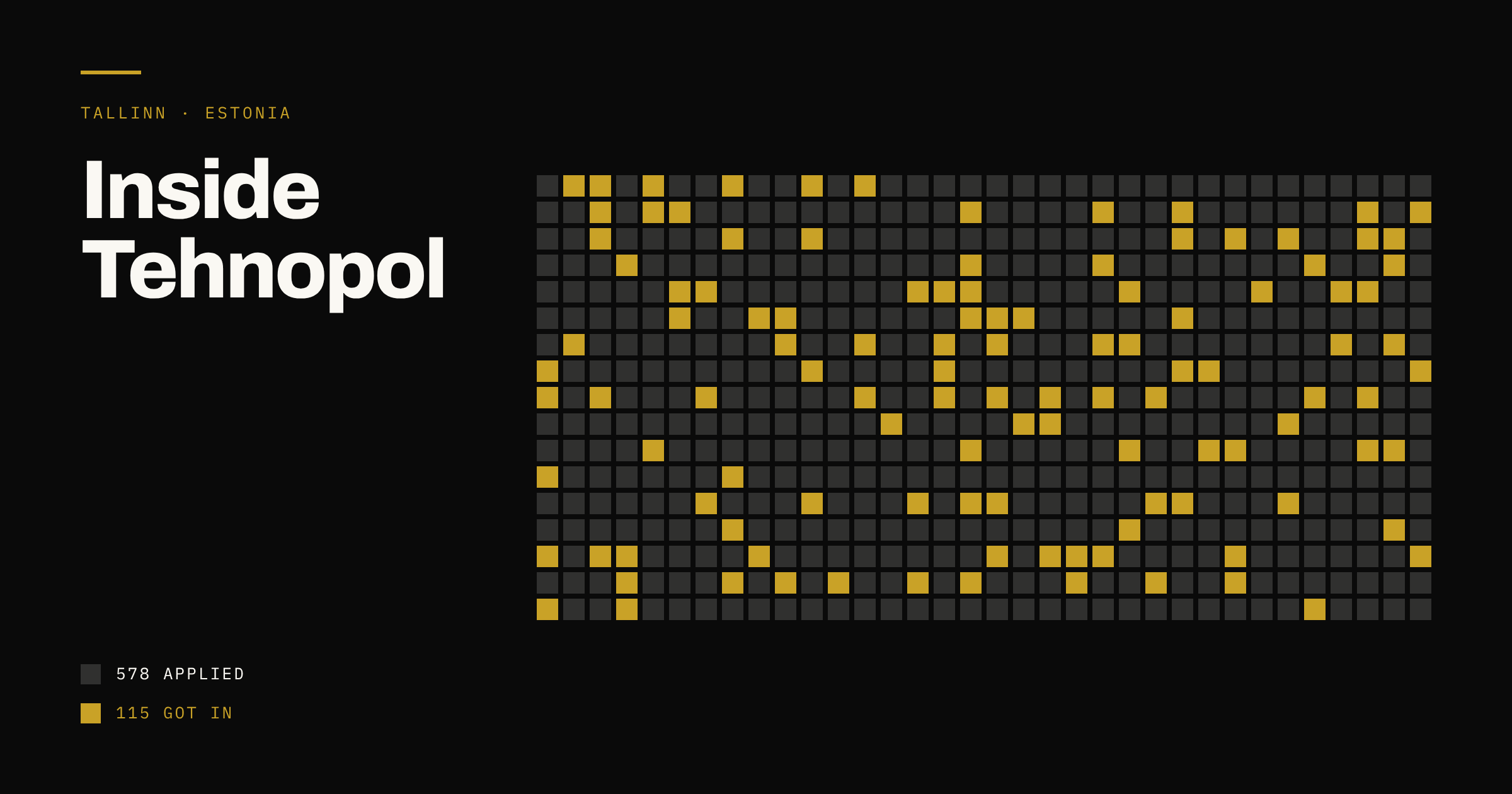
Last year 578 teams knocked on the door of a science park in Tallinn’s Mustamäe district. Around 115 got in. Between them, they raised €12.8 million — and some of them are now selling to navies.
If you picture Estonian tech, you probably picture Skype, Wise and Bolt: consumer brands, Old Town coffee shops, a nation of e-residents. Tehnopol doesn’t fit that picture. It sits next to the Tallinn University of Technology (TalTech) campus, it’s run as a public foundation rather than a VC fund, and lately its most talked-about alumni build things like underwater robots and battlefield communications.
That is exactly why it is worth a closer look. Over two decades, Tehnopol has quietly turned into one of the Baltics’ most productive startup machines — and, in the past few years, into one of the region’s main on-ramps for defence and dual-use founders. Here’s how it got there, how its model actually works, and what founders should know before applying.
From a protocol to a playground (2001–2012)
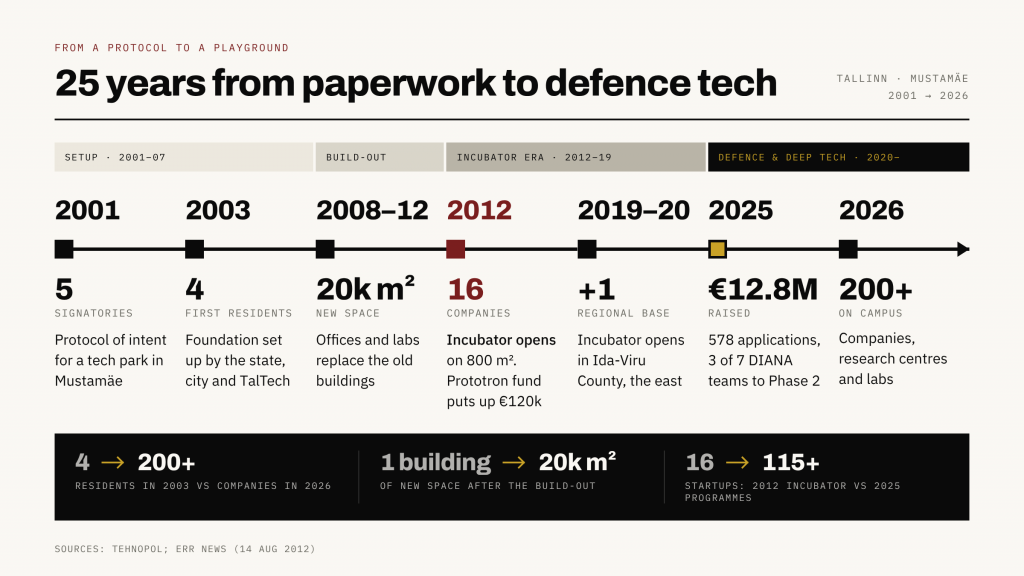
Tehnopol began as paperwork. In 2001, Enterprise Estonia, TalTech, the Ministry of Economic Affairs, the Ministry of Education and the City of Tallinn signed a protocol of intent to build a technology park in Mustamäe. The goal was simple to say and hard to do: get the university’s research out of the lab and into companies.
In 2003 the state, the city and TalTech set up the foundation that still runs the park today, Sihtasutus Tallinna Teaduspark Tehnopol. Startup support started the same year — with four residents in a single innovation centre building.
The real physical leap came between 2008 and 2012, when old buildings were torn down and more than 20,000 m² of new office and lab space went up. The capstone was a dedicated startup incubator: on 14 August 2012, Tehnopol opened 800 m² of offices, meeting rooms and demo rooms built for 16 young companies and around 60 people (ERR News). Board member Pirko Kontsa pitched the logic as density — put founders in one space and the ideas start to compound.
The same day, Tehnopol, Swedbank and TalTech announced Prototron, a prototype fund that put €120,000 on the table for its first three winners. Prototron would become the incubator’s feeder lane for the next decade.
Today the campus hosts 200+ companies, research centres and labs, and the incubator has a permanent foothold in Ida-Viru County in the east, opened around 2019–2020.
The deal: no rent, no fee, 2%
Many accelerators take 6–10% of your company on day one. Tehnopol’s flagship programme asks for far less. The Tehnopol Startup Accelerator charges no monthly fee and takes a 2% equity option in return for the full package: a lead mentor, specialist legal and marketing advisers, a six-module training track, desk space on campus and partner cloud credits.
The logic is simple. Tehnopol only gets paid if you do. For a founder burning savings on an MVP, that’s a very different conversation from a rent invoice.
What it takes to get in. Each round takes about ten teams. You need a tech product at MVP or prototype stage, a company registered in Estonia (e-Residency makes this doable from abroad) and a team willing to show up in person — most workshops run on site, in English. The core programme lasts six months, with an optional 3–6 month extension after an interim review.
What it won’t accept. A solo founder. Speaking on a panel at Latitude59 in May 2026, incubator head Anne-Liisa Elbrecht said Tehnopol screens for at least two people on a founding team — even as applicants start listing AI agents as “co-founders” (ComplexDiscovery). Her point was about risk, not prejudice: when one person is the company, investors carry all of it. She was equally blunt about AI-written applications. Using the tools is fine; an application where the founder’s own voice has disappeared is not.
The event organisers summed up what accelerators still sell in the age of AI as “pressure, rhythm and clarity”. That is a decent one-line description of Tehnopol’s whole pitch.
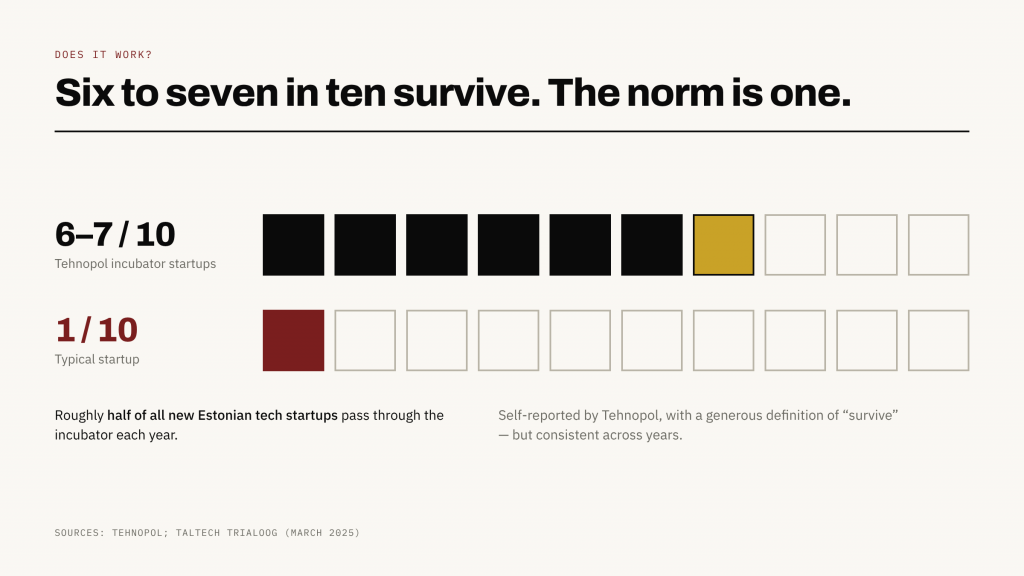
Does it work? By Tehnopol’s own count, roughly half of all new Estonian tech startups pass through the incubator each year, and six to seven out of ten survive, against a typical one in ten (Tehnopol). Those are self-reported numbers with a generous definition of “survive”, but they’re consistent across years.
One incubator, many doors
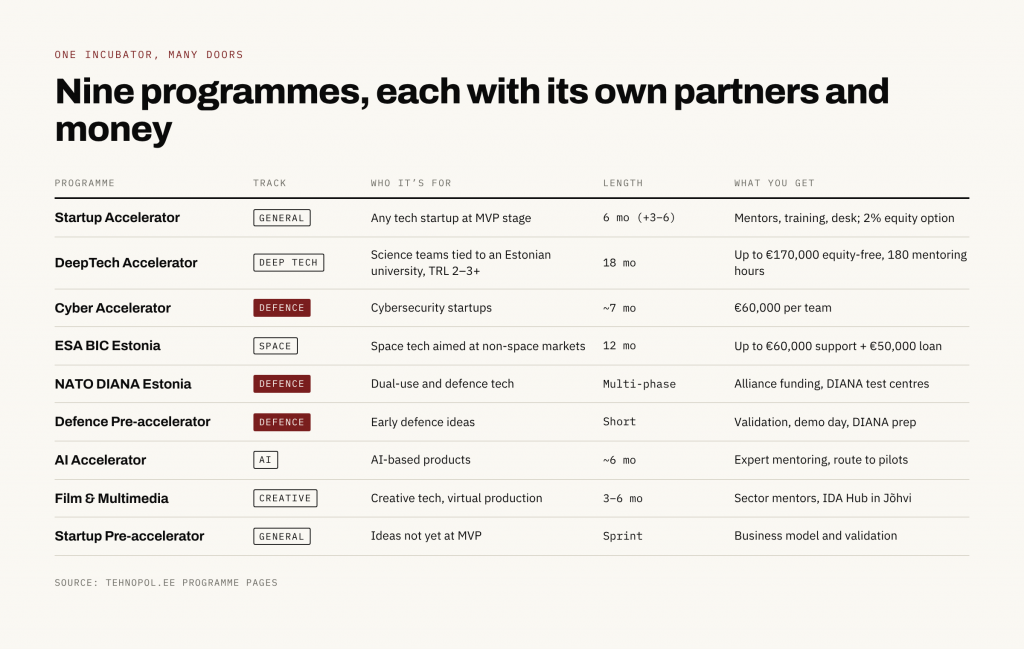
Somewhere along the way, Tehnopol stopped being a general-purpose incubator. It now runs a family of themed programmes, each with its own partners, money and test infrastructure. The point is access: a cyber founder needs the state’s information systems authority in the room, not a generic pitch coach.
| Programme | Who it’s for | Length | What you get |
|---|---|---|---|
| Startup Accelerator | Any tech startup at MVP stage | 6 months (+3–6) | Mentors, training, desk; 2% equity option |
| DeepTech Accelerator | Science-based teams tied to an Estonian university, TRL 2–3+ | 18 months | Up to €170,000 equity-free, up to 180 mentoring hours |
| Cyber Accelerator | Cybersecurity startups | ~7 months | €60,000 per team to develop the idea |
| ESA BIC Estonia | Space tech aimed at non-space markets | 12 months | Up to €60,000 support + €50,000 loan |
| NATO DIANA Estonian Accelerator | Dual-use and defence tech | Multi-phase | Alliance funding, access to DIANA’s test centres |
| Defence Pre-accelerator (Defence Business Lab) | Early defence ideas | Short format | Validation, demo day, prep for DIANA |
| AI Accelerator | AI-based products | ~6 months | Expert mentoring, route to pilots |
| Film & Multimedia Accelerator | Creative tech, virtual production | 3–6 months | Sector mentors, IDA Hub in Jõhvi |
| Startup Pre-accelerator | Ideas not yet at MVP | Short sprint | Business model and validation |
Three of these deserve a closer look.
Defence. The NATO DIANA Estonian site is run by Tehnopol with Sparkup Tartu Science Park, and it’s where the incubator’s centre of gravity has shifted. In 2025, three Estonian companies — Spacedrip, C2Grid and LSMedical — were picked for the DIANA accelerator, and 3 of 7 local companies made it to Phase 2, up from a third the year before (Tehnopol). C2Grid, a TalTech spin-off building digital twins of terrain from drone video, went through the defence pre-accelerator first.
Deep tech. The DeepTech Accelerator is part of a state network putting more than €12 million into science-based companies. It is unusually strict: you need a live link to an Estonian research institution, a shareholders’ agreement and clear IP ownership before you start. Training alternates monthly between Tallinn and Tartu.
Creative tech. The least expected vertical lives in Ida-Viru County. The Film & Multimedia Accelerator works around IDA Hub, a film and media innovation centre in Jõhvi, with partners like PÖFF and the Baltic Film, Media and Arts School. Its first hackathon in 2025 drew 90+ people.
2025 by the numbers
Tehnopol’s 2025 wrap-up reads like a scoreboard (Tehnopol):
| Metric | 2025 |
|---|---|
| Applications across all programmes | 578 |
| Companies joining programmes | 115+ |
| Capital raised by participating companies | €12.8M |
| — private funding | €5.4M |
| — public funding | €7.4M |
| Incubator team | 11 people |
| Net Promoter Score | 97.1 |
| NATO DIANA Estonia: companies reaching Phase 2 | 3 of 7 (42.86%) |
| NATO DIANA Estonia: overall satisfaction | 9.57 / 10 |
That €12.8M is up from “over €11 million” in 2023, when RAIKU (€8.8M) led the pack.
The more interesting number is the split. Public money (€7.4M) outweighed private money (€5.4M). That isn’t a sign of weakness so much as a sign of what Tehnopol now works on. Defence, cyber and deep tech companies at TRL 2–4 are exactly where European VCs hesitate, because payback takes years. Grants and alliance programmes act as a bridge that makes those companies investable later.
The same document also notes that cohorts are arriving more mature — sharper focus, more realistic validation — which is what you’d expect when a pre-accelerator layer starts doing its job.
And 11 people run all of this. That’s a small team for 115 companies a year, which partly explains the heavy reliance on external mentors.
The alumni: from a €20k prototype to navies
Wayren: the whole pipeline in one company. If you want to see the Tehnopol machine end to end, look at Wayren. It was founded in 2020 by former staff of Estonia’s Cyber Command to keep troops talking when normal networks fail. In December 2022 it was one of three winners of Prototron’s 29th round, taking €20,000 of equity-free money to build a crisis-communications prototype (Äripäev/AM). Next came the Tehnopol Startup Incubator, then the NATO DIANA accelerator in Estonia. In 2025 Greek defence group EFA Group, with its subsidiary SCYTALYS, put €7.9 million into the company to develop a battlefield platform linking soldiers, drones, vehicles and weapons (Seedtable). Its first target markets: Estonia and Ukraine. The company’s own pitch line is short: “Our systems function when others fail.”
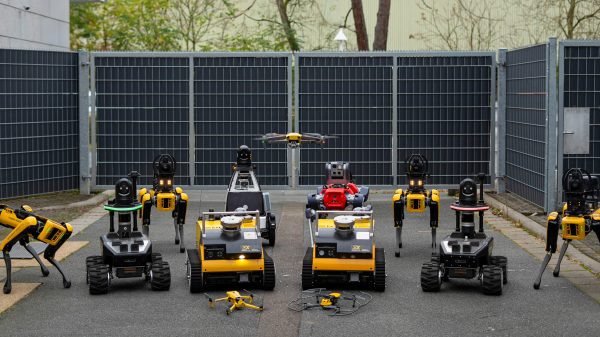
Lobster Robotics. Builds autonomous underwater robots that map the seabed. After testing with the Estonian Navy, its robots were adopted by the Royal Netherlands Navy in 2025.
Askara AI Solutions. A Cyber Accelerator graduate using AI to detect security threats. In 2025 it started working with defence prime Thales.
C2Grid. A TalTech spin-off that turns drone video into digital twins for crisis drills and operations planning. It did the defence pre-accelerator, then got into NATO DIANA, and raised its first investment within a year of founding (TalTech Trialoog).
Neocortex. Builds AI-driven characters for games and virtual worlds. It finished in the top three of its AI Accelerator cohort, and founder Sercan Altundas now argues on stage for what accelerators add that a chatbot can’t: a room full of people who’ve made real decisions.
RAIKU. The 2023 headliner, raising €8.8 million — the biggest round among that year’s incubator companies.
You’ll also see bigger Estonian names — Skeleton Technologies, Defendec, Bikeep — linked to Tehnopol in overviews of the ecosystem. Skeleton, founded in 2009, has since raised around €392 million and is eyeing a US IPO in 2027 (Ascendants). Its exact path through Tehnopol is less documented than Wayren’s, so treat it as part of the wider campus story rather than a clean incubator case study.
What Tehnopol gets right — and what to watch
It glued the triple helix together physically. University, state and business are usually three separate buildings with three separate calendars. In Mustamäe they share a campus, a foundation and a pipeline: Prototron money for the prototype, the incubator for the business, specialised programmes for the scale-up. Wayren walked that path in about three years.
It aligned its incentives with founders. A 2% option is cheap enough that teams get picked for potential rather than for ability to pay rent. Tehnopol wins only when they do.
It moved early on defence. Long before “dual-use” was a pitch-deck buzzword, Tehnopol had cyber and defence tracks with the right state partners. Elbrecht said in March 2025 that interest in defence was climbing among founders, and the 2025 results back that up (TalTech Trialoog). In the same interview she put the survival rate plainly:
“Around 60% of our startups survive, which is an excellent result in this field.”
Now the caveats, because a good profile needs them.
- Public money does a lot of the lifting. €7.4M of last year’s €12.8M was public. That’s rational for deep tech, but it makes the model sensitive to budgets and policy cycles.
- Most metrics are self-reported. Survival rates, NPS and raise totals come from Tehnopol itself. They’re consistent over time, but nobody audits them independently.
- The ecosystem’s mood has cooled. In a September 2025 op-ed, Elbrecht herself argued that Estonia’s startup scene needs to rediscover the risk appetite that built its first wave (TalTech Trialoog). An incubator can’t manufacture that alone.
- You have to be there. Estonian registration and on-site workshops are non-negotiable. Great for density, less great for a team that can’t relocate.
Should you apply? If you’re a two-plus founder team with an MVP, a technical edge and a reason to be in the Baltics — especially in defence, cyber, deep tech or space — Tehnopol is one of the cheapest, best-connected doors in Europe. The general Startup Accelerator opens its next call in spring 2027; the DeepTech and Film & Multimedia programmes take applications on their own calendars.