






































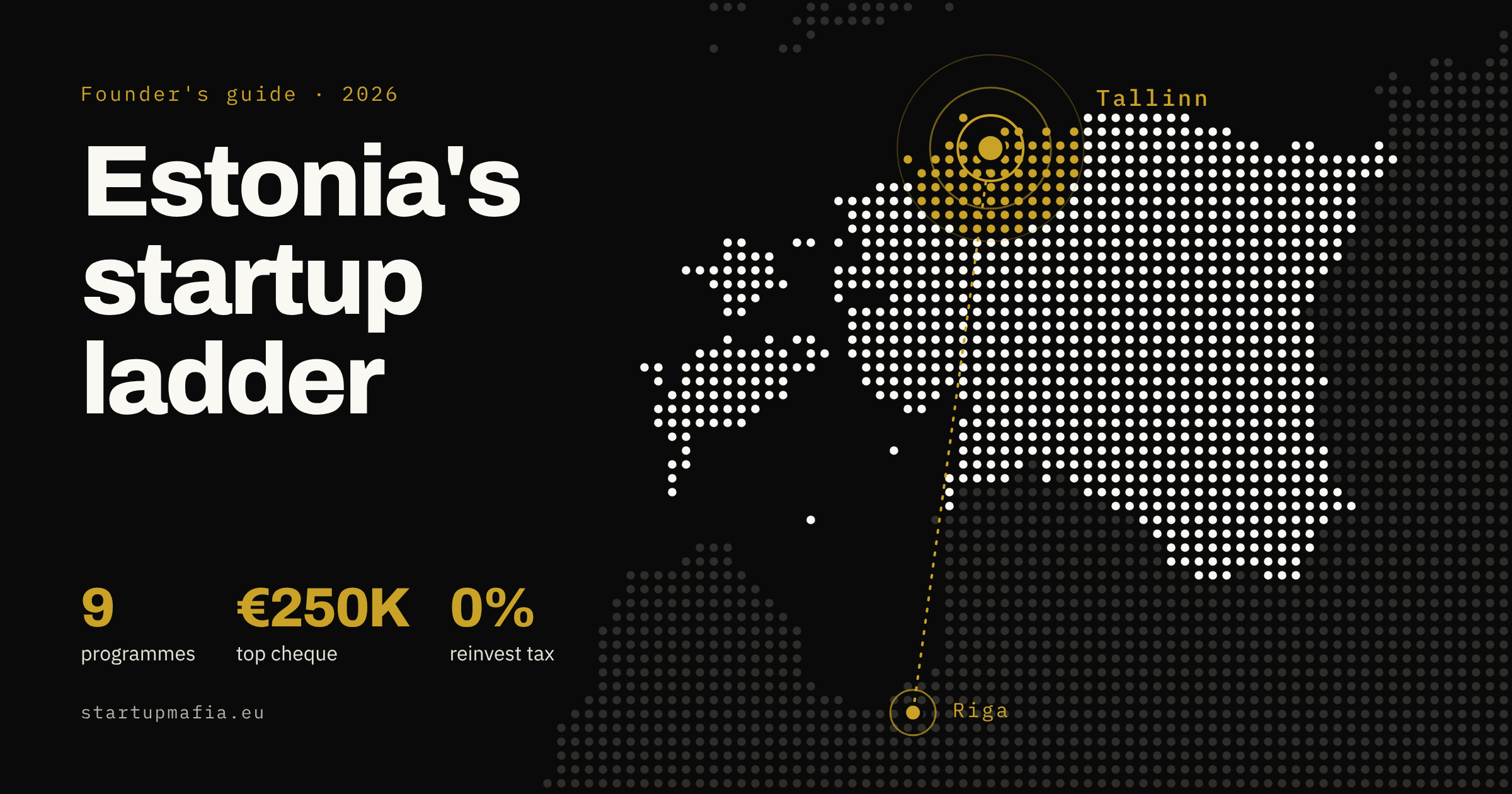
Estonia has 1.4 million people and Europe’s highest number of startups and unicorns per capita. Skype, Wise, Bolt, Pipedrive and Glia all grew out of the Tallinn ecosystem. The country’s edge is not only its digital state and simple taxes, but a dense network of accelerators and incubators that carries a founder from a weekend hackathon to a seed round.
This guide maps that network: which programmes fit each stage, how much money they put in, what equity they take, and how a non-EU founder — including the many Ukrainian teams now building in the Baltics — can legally plug in through the Startup Visa and e-Residency.
How the ecosystem is built
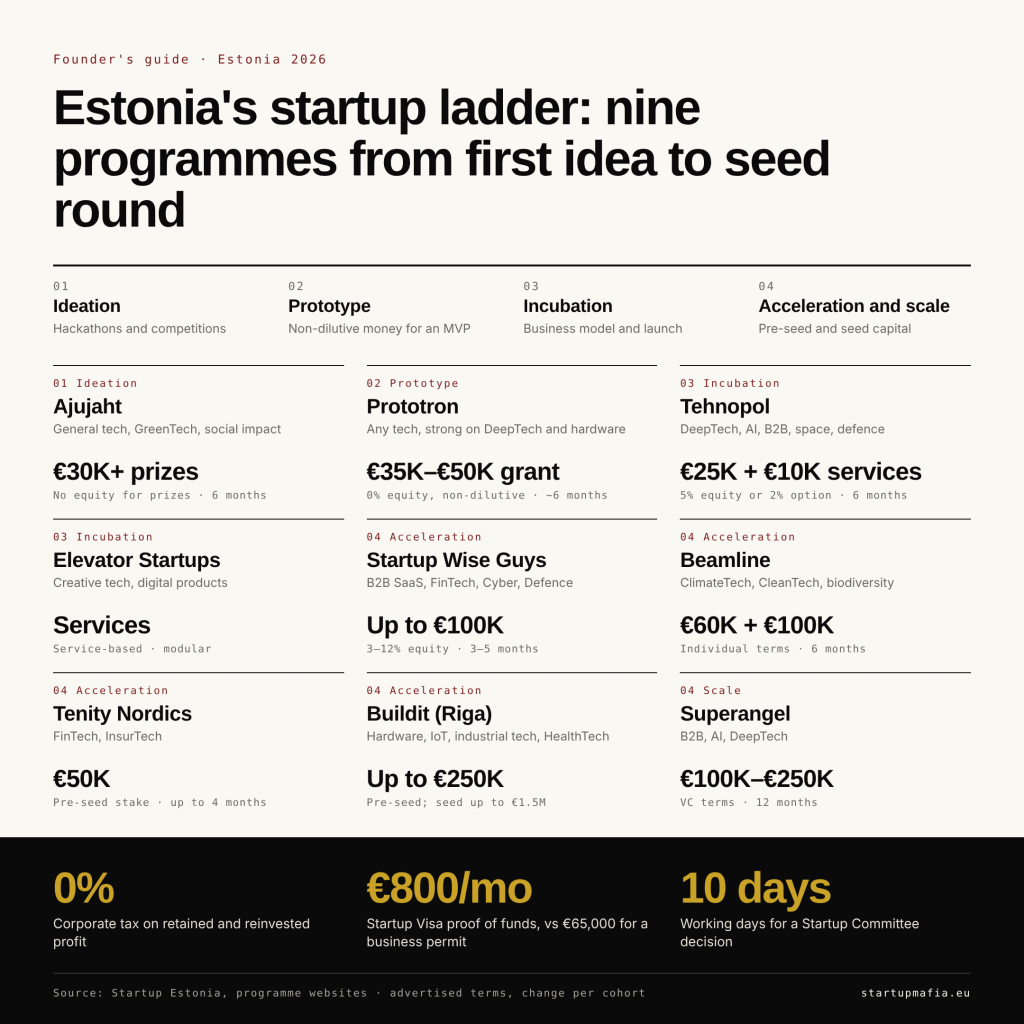
Estonia’s support system works as one connected pipeline in which public initiatives and private capital hand founders on from stage to stage. Its coordinator is Startup Estonia, a government initiative that does not invest directly. Instead it builds infrastructure, publishes market data, maintains standard legal templates for investment deals, and runs the Startup Visa programme.
A typical path through the system looks like this:
- Ideation. Hackathons such as Garage48 let founders validate a concept over a weekend and assemble an international team.
- First prototype. Prototron gives non-dilutive grants to build a working MVP.
- Incubation. Tehnopol Startup Incubator or the national Ajujaht competition help shape the business model and prepare a market launch.
- Acceleration and scale. Commercial accelerators such as Startup Wise Guys, Beamline and Superangel provide pre-seed and seed capital for international expansion.
The tax system reinforces every step. Estonia levies 0% corporate income tax on retained and reinvested profit; tax is due only when profit is distributed. A growing startup can therefore put all of its operating income back into product and hiring without an early tax drag.
The programmes at a glance
Nine programmes cover almost every stage and sector a tech founder in Estonia will meet; the table compares their focus, money, equity terms and length.
| Programme | Sector focus | Funding | Equity | Length |
|---|---|---|---|---|
| Startup Wise Guys | B2B SaaS, FinTech, Cyber, Defence, Sustainability, PropTech, Web3 | Up to €100,000 convertible (incl. €35,000 programme cost); up to €250,000 follow-on | Negotiated, typically 3–12% | 3–5 months |
| Tehnopol Startup Incubator | DeepTech, GreenTech, Smart City, AI, B2B | Up to €25,000 investment + services worth up to €10,000 | 5% equity or 2% option; services-only track takes none | 6 months |
| Prototron | Any tech, strong on DeepTech and hardware | €35,000–€50,000 prototype grant | 0% (non-dilutive) | ~6 months incl. incubation |
| Beamline Accelerator | ClimateTech, CleanTech, biodiversity | €60,000 initial + up to €100,000 follow-on | Individual deal terms | 6 months |
| Superangel (Alpine House) | B2B, AI, DeepTech | €100,000–€250,000 | Institutional VC terms | 12 months |
| Ajujaht | General tech, GreenTech, social impact | €30,000+ prize pool + direct investment offers | None for prizes | 6 months |
| Buildit (Riga, open to Baltic teams) | Hardware, IoT, industrial tech, HealthTech | Up to €250,000 pre-seed; up to €1.5M seed | Individual terms | 3–4 months |
| Tenity Nordics (regional) | FinTech, InsurTech | €50,000 initial investment | Standard pre-seed stake | Up to 4 months |
| Elevator Startups | Creative tech, digital products | Validation, development and scaling services | Service-based | Modular |
Figures are the programmes’ advertised terms and change between cohorts; confirm the current offer before you apply.
Inside the key programmes
Startup Wise Guys: the B2B sales machine
Founded in Tallinn in 2012, Startup Wise Guys is one of the most active early-stage accelerator funds in Central and Eastern Europe and the Nordics, with 700+ investments in founders from 60+ countries. The programme is built around three things: an aggressive B2B sales system, proof of product–market fit, and readiness for the next round.
The flagship deal is a convertible investment of up to €100,000, of which €35,000 covers the programme cost, plus a possible €250,000 follow-on. Vertical tracks cover SaaS, fintech, cybersecurity (CyberNorth), defence, sustainability, proptech and Web3. Alumni include Katana, Ondato, Montonio, StepShot and CallPage. The fund also runs programmes in Ukraine, which makes it a natural first contact for Ukrainian B2B teams.
Tehnopol: the deep-tech campus
The Tehnopol science and technology park runs a six-month incubator with training, international mentors and services worth up to €10,000. Selected teams can take €25,000 in exchange for 5% equity or a 2% option. Tehnopol also hosts three specialist hubs:
- ESA BIC Estonia supports startups that bring space technology down to Earth or build for the space sector.
- NATO DIANA develops dual-use and defence technology, with access to NATO test centres and grant funding.
- Cyber Accelerator focuses on information-security projects.
Prototron: money for the first prototype
Prototron is backed by Swedbank, Tallinn University of Technology (TalTech), Tehnopol and the City of Tallinn. It exists to close the funding gap between an idea and a working prototype. Winners receive €35,000–€50,000 in non-dilutive grants, six months of incubation at Tehnopol, legal support and a chance to pitch leading Baltic investors.
Beamline: climate-focused acceleration
Beamline backs ClimateTech, CleanTech, sustainability and biodiversity startups over six months. It invests €60,000 up front, with up to €100,000 in direct follow-on for the strongest teams. As InnoEnergy’s official partner in Estonia, it connects founders to Europe’s energy-transition network and corporate partners. Alumni include S.Lab, HelioRec, Naco Technologies and Renewcast.
Superangel, Ajujaht and the specialists
Superangel combines a VC fund with a year-long acceleration track and writes €100,000–€250,000 cheques into B2B, AI and deep-tech companies; it co-organises the BaseCamp hackathons with Garage48. Ajujaht (“Brain Hunt”) is Estonia’s best-known accelerator competition, run partly as a TV show, with a €30,000+ prize pool and no equity taken for prizes.
Three regional and niche programmes round out the map. Buildit, based in Riga, was the first dedicated hardware accelerator in the Baltics and Nordics; its €20M fund writes up to €250,000 at pre-seed and €1.5M at seed, backed by a network of European manufacturing partners. Tenity Nordics invests €50,000 in fintech and insurtech startups and ends with a pitch at Slush. Elevator Startups, a unit of digital agency ADM supported by Enterprise Estonia, helps up to eight creative-tech teams a year with validation and product development.
Getting in: Startup Visa and e-Residency
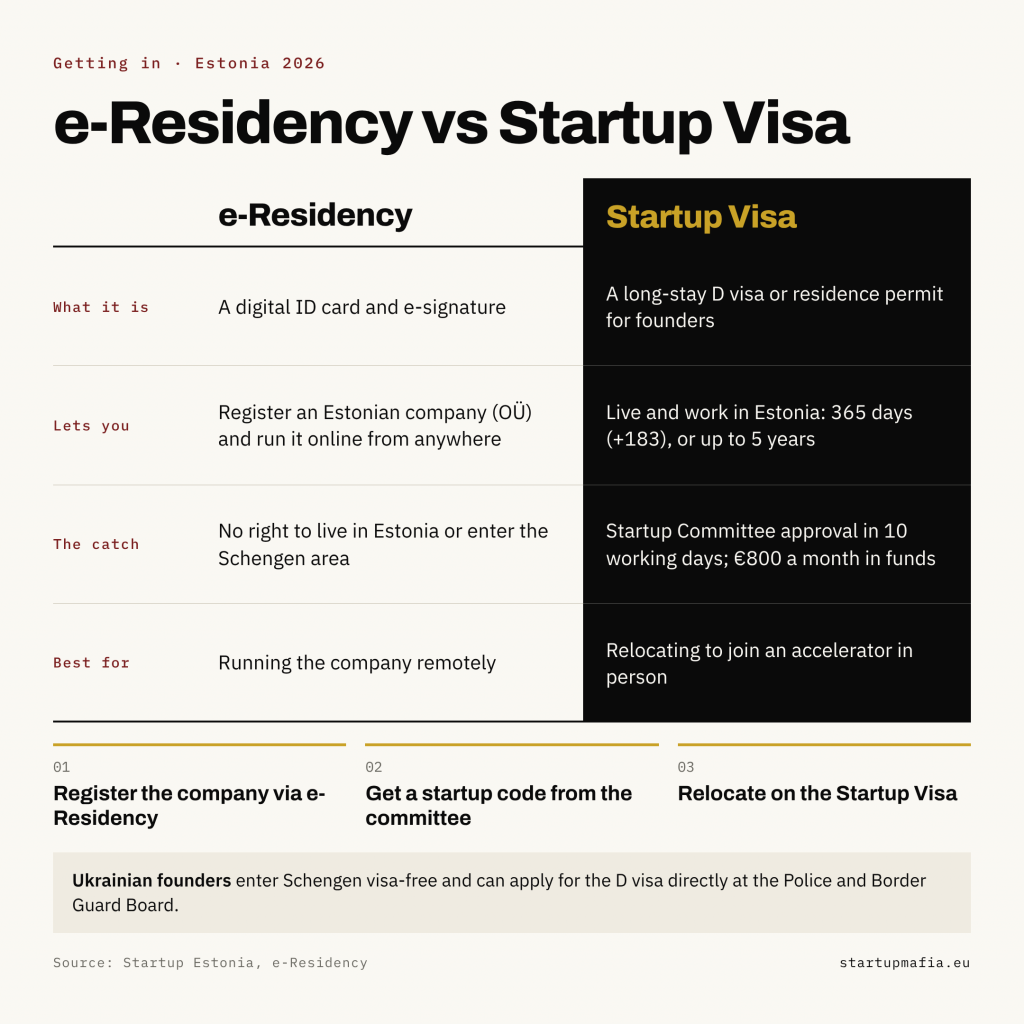
Non-EU founders reach Estonian accelerators through two tools that are often confused: e-Residency lets you run a company remotely, while the Startup Visa lets you live and work in the country.
The Startup Visa route
The process starts with the Startup Committee, a panel of people from the Estonian startup community. It assesses whether your company is a technology-based, innovative business with global growth potential. Retail, consultancies and restaurants do not qualify, and the company must be under 10 years old. The committee decides within 10 working days.
A positive decision gives you a unique startup code. With it you can apply for:
- a long-stay D visa for up to 365 days, extendable by 183 days; or
- a temporary residence permit for business, for up to five years, once the company is registered in Estonia.
The financial bar is low. Unlike the standard business residence permit, which requires at least €65,000 invested in an Estonian company, the Startup Visa asks for proof of at least €800 per month of your planned stay. Visa applicants also need health insurance with at least €30,000 of coverage. Spouses and minor children can receive visas and permits on the same terms, and committee-approved startups can hire foreign specialists without the usual quotas and salary thresholds.
For Ukrainian founders, the path is shorter than for most non-EU applicants. Because Ukrainian citizens enter the Schengen area visa-free, they can arrive in Estonia and apply for the D visa directly at the Police and Border Guard Board, rather than through an embassy.
e-Residency is not a visa
e-Residency gives you a digital ID card and e-signature to register an Estonian company (OÜ) and run it online from anywhere. It does not grant the right to live in Estonia or to enter the Schengen area.
The common sequence for international founders is: register the company through e-Residency, apply to the Startup Committee, then use the Startup Visa to relocate and join a local accelerator in person.
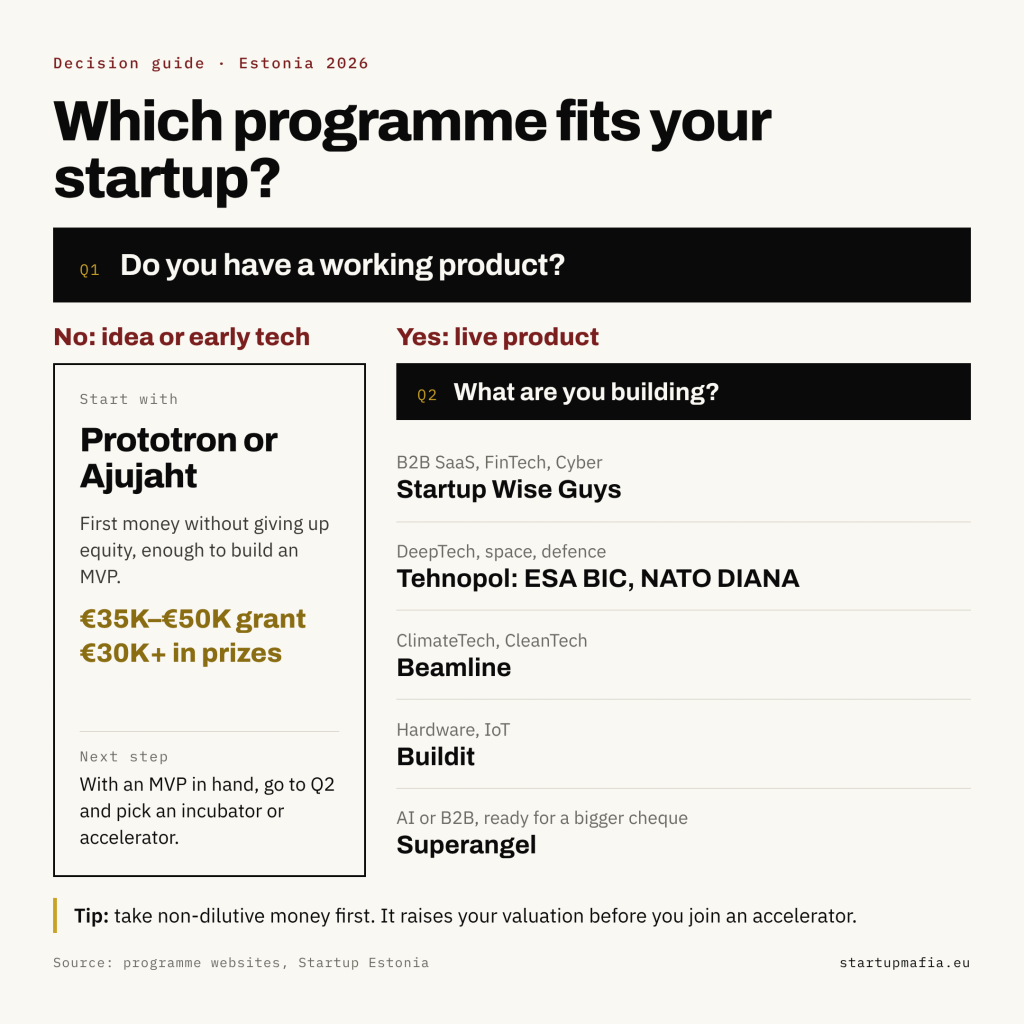
Which programme fits your startup
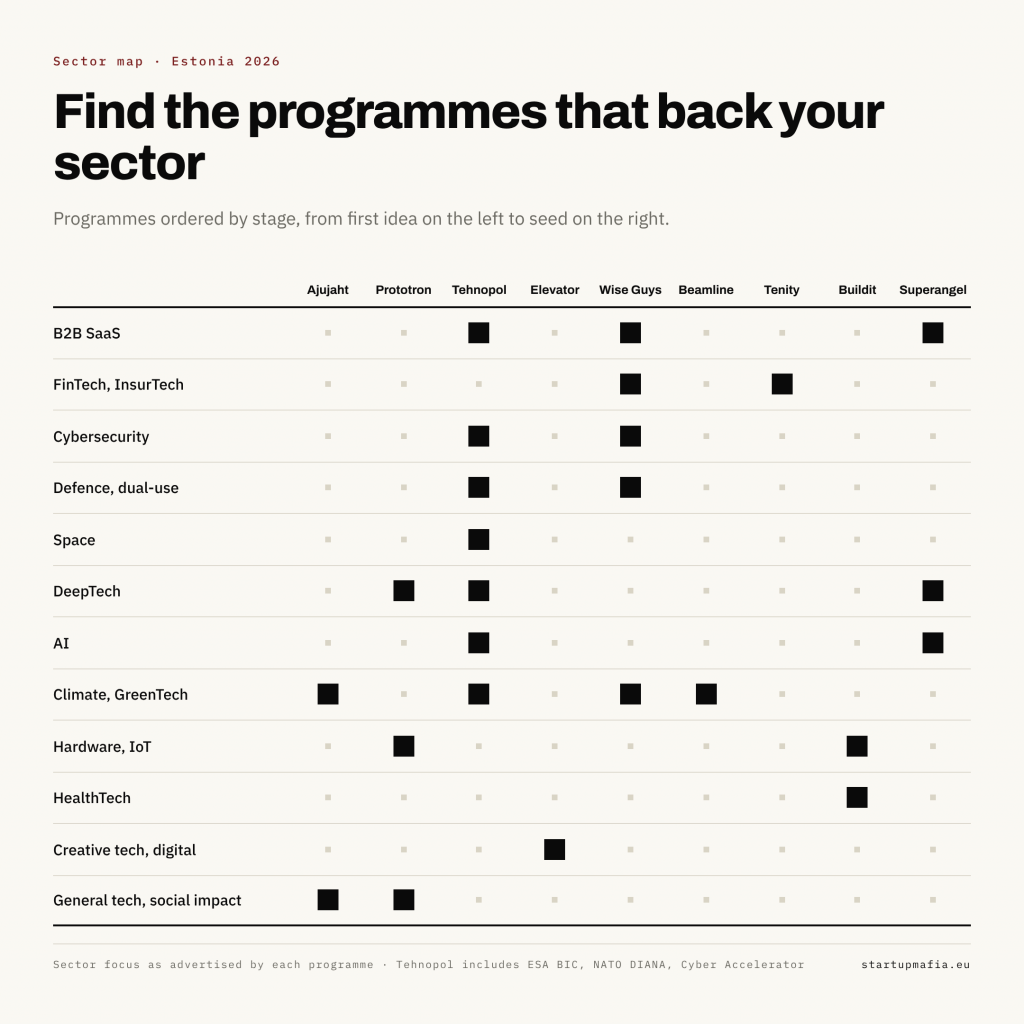
The right choice depends on two things: how far along you are, and how capital-intensive your technology is.
| Your situation | Best first stop | Why |
|---|---|---|
| Idea or early technology, no MVP | Prototron, Ajujaht | First capital without giving up equity; enough to build an MVP for the next round |
| B2B SaaS, FinTech or Cyber with a live product and first users | Startup Wise Guys | Strong B2B sales training, high survival rates, direct access to international VCs |
| DeepTech, space or defence | Tehnopol (ESA BIC, NATO DIANA) | Labs, test centres and European programme access for long R&D cycles |
| ClimateTech or CleanTech | Beamline | InnoEnergy network and energy-transition corporate partners |
| Hardware or IoT | Buildit | Manufacturing partners that shorten the path from design to production |
| AI or B2B, ready for a larger cheque | Superangel | €100,000–€250,000 plus a year of support |
A few practical rules apply across all of them:
- Read the equity terms closely. Startup Wise Guys’ €100,000 includes a €35,000 programme fee, so the cash you actually receive is closer to €65,000.
- Stack non-dilutive money first. A Prototron grant before an accelerator raises your valuation and cuts dilution later.
- Sort out residency early. The Startup Committee takes 10 working days, but visa and permit processing adds weeks; start before the cohort does.
- Use the tax rule. With 0% tax on reinvested profit, keep early revenue inside the company rather than paying it out.
The bottom line
Estonia offers one of Europe’s most complete support ladders for tech founders: grants for the first prototype, incubators for deep tech, specialist accelerators for climate and hardware, and B2B-focused funds for scaling. Combined with 0% tax on reinvested profit and a Startup Visa that asks for €800 a month rather than €65,000 in capital, it is one of the lowest-friction places in the EU to build a company from outside the EU. The founders who get the most from it are the ones who know their stage and pick the programme that matches it.