
























































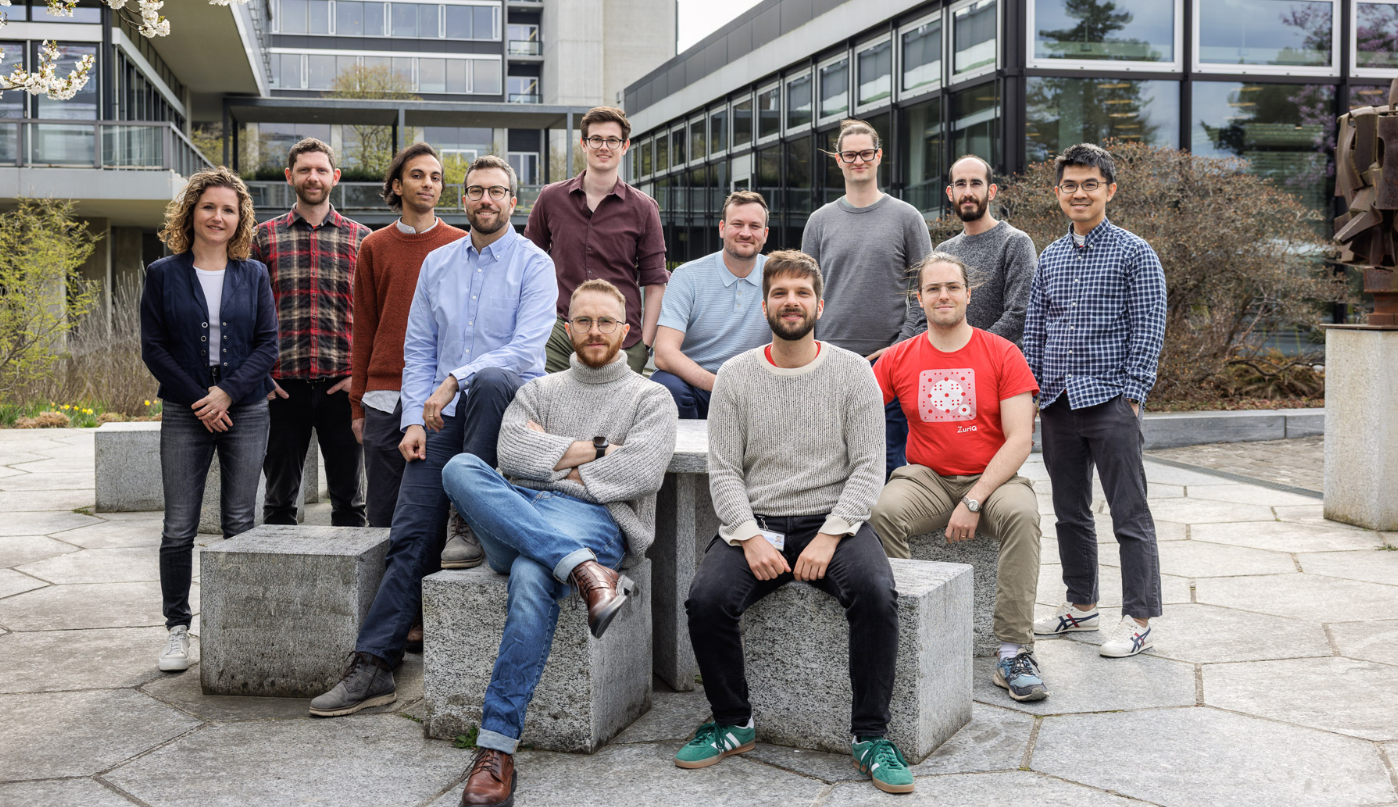
ZURICH, Switzerland — ZuriQ, a Swiss quantum computing startup developing a new generation of trapped-ion quantum processors, has raised €22.4 million ($25.5 million) in Seed funding to accelerate research, expand its engineering team, and scale its chip technology toward utility-scale quantum computers.
The round was led by Quantonation, with participation from Forward.one, Extantia, Firgun Ventures, and existing investors. The financing follows a previously undisclosed $4.2 million pre-seed round completed after the company spun out of ETH Zürich in 2025.
Rethinking Quantum Computer Architecture
Founded by researchers from ETH Zürich, ZuriQ is tackling one of quantum computing’s biggest technical challenges: building machines with enough stable qubits to solve commercially valuable problems.
While many trapped-ion quantum computers rely on one-dimensional ion chains, ZuriQ has developed a native two-dimensional trapped-ion architecture designed to scale far more efficiently.
Instead of arranging qubits in a single line, the company’s processors organize ions across the entire surface of a semiconductor chip, allowing significantly higher qubit density and greater flexibility as systems grow.
Solving the Quantum Scaling Challenge
Quantum computers promise exponential improvements in solving certain computational problems, but building large, reliable systems remains one of the industry’s greatest engineering obstacles.
Qubits—the quantum equivalent of classical computing bits—are extremely sensitive to environmental interference, making them difficult to scale without introducing errors.
According to CEO and co-founder Dr. Pavel Hrmo, many existing trapped-ion companies continue to build on architectures originally developed more than two decades ago.
ZuriQ believes its two-dimensional design removes one of the key bottlenecks limiting today’s quantum hardware by allowing qubits to expand across an entire chip rather than growing sequentially.
Prototype Already Demonstrated
The company has already built an early working prototype featuring a 3×3 array of nine individually controlled trapped ions.
The chip was manufactured in collaboration with semiconductor company Infineon using established chip fabrication processes, demonstrating that the technology can be produced using existing industrial manufacturing techniques.
ZuriQ now plans to increase the number of controllable ions dramatically, with the goal of developing processors containing hundreds—and eventually thousands—of qubits.
Funding to Accelerate Research and Manufacturing
The newly raised capital will support expansion across several areas, including:
- Growing the company’s research and engineering teams.
- Scaling semiconductor chip fabrication.
- Advancing quantum processor development.
- Recruiting additional quantum computing specialists.
The company believes these investments will help move its technology closer to commercially viable utility-scale quantum computers.
A New Generation of Quantum Computing
Scientific advisor Professor Jonathan Home of ETH Zürich explains that the company’s innovation lies in its geometry.
By arranging ions in two dimensions instead of one, the architecture allows the number of qubits to grow with the surface area of the chip rather than linearly, potentially enabling thousands of interconnected qubits on a single processor.
The design also allows ions to move more freely, creating greater connectivity between qubits—a critical factor for building more powerful quantum systems.
Growing Momentum in Europe’s Quantum Ecosystem
The funding reflects continued investor confidence in Europe’s rapidly expanding quantum technology sector.
Although significant technical challenges remain before fault-tolerant quantum computers become commercially available, investors increasingly view scalable hardware platforms as one of the industry’s most promising opportunities.
With fresh funding, proprietary two-dimensional architecture, and strong academic roots at ETH Zürich, ZuriQ is positioning itself among a new generation of European DeepTech companies seeking to build practical quantum computers capable of solving real-world scientific and industrial problems.