
































A country of 1.3 million people has produced more unicorns per capita than almost anywhere on earth, and the pattern behind most of them is boringly consistent: someone in their late teens or twenties got annoyed by a broken process and built the fix before anyone told them they were too young to try. Markus Villig was 19 when he started what became Bolt. Kaarel Kotkas was 20 when he founded Veriff. Estonia doesn’t treat that as a fluke — it treats it as the default setting.
What’s less written about is who’s carrying that pattern forward right now, in 2026. Not the founders everyone already name-drops at conferences, but the ones a few years and a few funding rounds behind them — still building, still young enough that “watch this person” is a genuine prediction rather than a victory lap.
Kaarel Kotkas — Founder & CEO, Veriff
Kotkas grew up on a small island in Estonia, and his origin story has become part of startup folklore in the country: at 14, he photoshopped his own ID to get around eBay’s age restrictions so he could buy biodegradable rope for hay bales on his family’s farm. Years later, running into the same broken identity-verification systems, he founded Veriff in Tallinn in 2015 at age 20. The company took its first outside money — €60,000 from an early banking partner — that same year, and went live with three paying customers within seven months, staying profitable for its first three years. Y Combinator selected Veriff for its accelerator in 2016, giving it its first institutional validation; Accel came in for the Series B in 2021 alongside IVP; and Tiger Global and Alkeon Capital co-led a $100 million Series C in January 2022 at a $1.5 billion valuation, making Veriff one of Estonia’s unicorns. Total funding now sits close to $200 million. Kotkas was named EY Estonia’s Entrepreneur of the Year in 2020, and Veriff won “Overall Fraud Prevention Solution Provider of the Year” at the 2025 CyberSecurity Breakthrough Awards. The company now serves 3,000+ business customers across fintech, crypto, gaming, mobility, and digital marketplaces, and opened a tech hub in Brazil in 2025 as it pushes further into Latin America.
Robin Saluoks — Co-founder & CEO, eAgronom
Saluoks comes from a family of farmers in Tartu County and started his first company at 17, before co-founding eAgronom in 2016 with Stenver Jerkku, a University of Tartu software engineering graduate. The company began with a €1 million seed round in 2018 that included a €500,000 farmer-crowdfunding campaign — 50 of eAgronom’s own customers investing directly — before scaling into a broader climate-tech platform. eAgronom now works with more than 3,000 paying farmers across 14 countries, running a Carbon Program built on Verra’s greenhouse gas crediting standards that has helped partner farms sequester roughly 525,000 tonnes of CO2 annually. Funding to date is upward of $25 million, with backers including Mondelez International’s Sustainable Futures arm, which invested in 2025 specifically to accelerate regenerative-agriculture adoption across Europe. Saluoks won Estonia’s Young Entrepreneur of the Year award in 2018, the EU Youth Entrepreneurship Award in 2019, and made Forbes’ 30 Under 30 Europe list at 27.
Markus Villig — Founder, Bolt
The historical icon of this list, included deliberately even though he’s long past the “Under 30” cutoff — every young Estonian founder on this page is, in some way, working in his shadow. Villig founded Taxify (rebranded Bolt in 2019) at 19, turning it into one of the largest ride-hailing and micromobility platforms in Europe and Africa, operating in dozens of countries. He was named Estonia’s Entrepreneur of the Year for 2022, and Bolt has continued expanding aggressively — including its first-ever acquisition, Danish ride-hailing company Viggo, and a partnership with Stellantis aimed at deploying autonomous vehicles at scale. If there’s a founding myth for Estonia’s current generation of twenty-something entrepreneurs, it starts here.
Avery Schrader — Founder & CEO, Modash
Schrader is Canadian, originally from Nova Scotia, and moved to Europe as a teenager — first to Germany, then to Estonia after reading about its reputation as “the Silicon Valley of Europe.” Before founding his own company, he worked as VP of International Founders at the Estonian Founders Society and mentored at Startup Wise Guys, which is how he met Modash co-founder and CTO Hendry Sadrak. He launched Modash in January 2020 to help brands find and manage the “long tail” of influencers — creators without huge followings — rather than competing for the same handful of mega-influencers everyone else chases. The company generated $3.5 million in revenue in 2023 and projected over $10.8 million for 2024. It closed a $12 million Series A led by Dutch VC henQ in October 2024, bringing total funding to roughly $13.6 million, and now serves 1,500+ clients including Victoria’s Secret, Birkenstock, Canon, and Farfetch. In early 2025, Modash acquired fellow Estonian startup Promoty to add CRM-style relationship tools, and opened a second office near Shopify’s Ottawa headquarters to serve North American customers. Schrader was 26 as of late 2024 — putting him at roughly 28 today, one of the very few founders on this list whose current age is actually on record.
Arman Kayhan & Mert Menekşe — Co-One
Kayhan finished a master’s in artificial intelligence at Istanbul Technical University and walked away with one clear lesson: data labeling was a bottleneck every AI startup ran into. In 2021, he and college friend Mert Menekşe built Co-One to fix it, basing the company in Tallinn as e-residents. The startup now coordinates a network of more than 9,000 freelance data labellers who sift and categorize photos and video for AI, e-commerce, and healthcare clients. It raised a $700,000 seed round in January 2023 from Turkish VCs Leap Investments and Lima Ventures, and Kayhan made Forbes’ 30 Under 30 Europe list in the Technology category in 2024 — one of the few Estonia-based founders to do so in recent years.
Almog Koren — DogBase
DogBase is the kind of founder-market fit story that doesn’t need embellishing: Koren is an active search-and-rescue K9 handler with a Special Forces background who bootstrapped the company through serious personal health challenges, building the tool he needed for his own job. DogBase replaces the paper logs and spreadsheets that working-dog trainers — police K9, search-and-rescue, military, and service programs — have relied on for decades, with mobile-friendly tools to track training progress, certifications, and health data. Founded in 2022, the company shipped a working product to pilot users within weeks of incorporating, and was one of just seven teams — chosen from a record 465 applicants across 53 countries — to reach the Latitude59 2026 pitch competition final in Tallinn, where it won up to €100,000 in syndicated angel investment from EstBAN, LatBAN, and FiBAN. Investors specifically cited strong conversion from free users to paying customers as the deciding factor.
Madis Alesmaa — Alpha3D
Alpha3D is building a production engine for 3D content — not the visual-prototype generators that flood the space, but assets with clean topology and structured geometry that plug directly into gaming, e-commerce, and simulation pipelines without needing a rebuild. Founder Madis Alesmaa, an Estonian Business School graduate now splitting time between Tallinn and San Francisco, took the company to the Latitude59 2026 Top 15, one of only a handful of Estonian teams to make that cut this year — a genuinely technical wedge in a category most competitors are still faking with generative flash.
Jekaterina Mazina-Šinkar, Jelena Gorbatsova, Evelin Halling & Ivo Kuldmäe — SafePAS
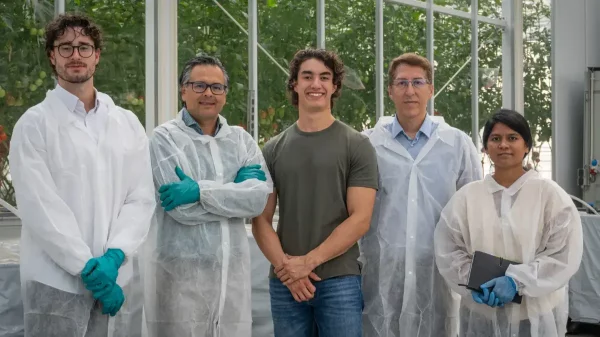
SafePAS makes lab-grade analytics affordable for public safety and agri-food use cases. Its two flagship products are DrugHunter, an on-site saliva-based drug-impairment test aimed at making roads and workplaces safer, and SMAGRY, a data-driven farming analytics tool. The four-person founding team took the company from lab science to roughly €3.25 million raised in about two years — a €700,000 pre-seed round, a €2.5 million grant tied to the EIC’s Seal of Excellence, and €50,000 in scale-up support — while winning sTARTUp Pitching 2025 and growing the team to 15 employees by the fourth quarter. SafePAS was also a nominee at the 2025 Estonian Startup Awards.
None of these eight stories look alike — a fintech unicorn, a carbon-credit platform, a ride-hailing giant’s founder, a K9 trainer’s side project that became a company. But run them side by side and the throughline is the same one Estonia has been running on for a decade: a founder who lived the problem before they tried to sell the solution, a company that got to a funded pilot fast, and almost no patience anywhere in the pipeline for pitch-deck theater. That’s not a coincidence of geography. It’s what happens when a country makes starting a company roughly as easy as registering for a library card, and then gets out of the way.