




































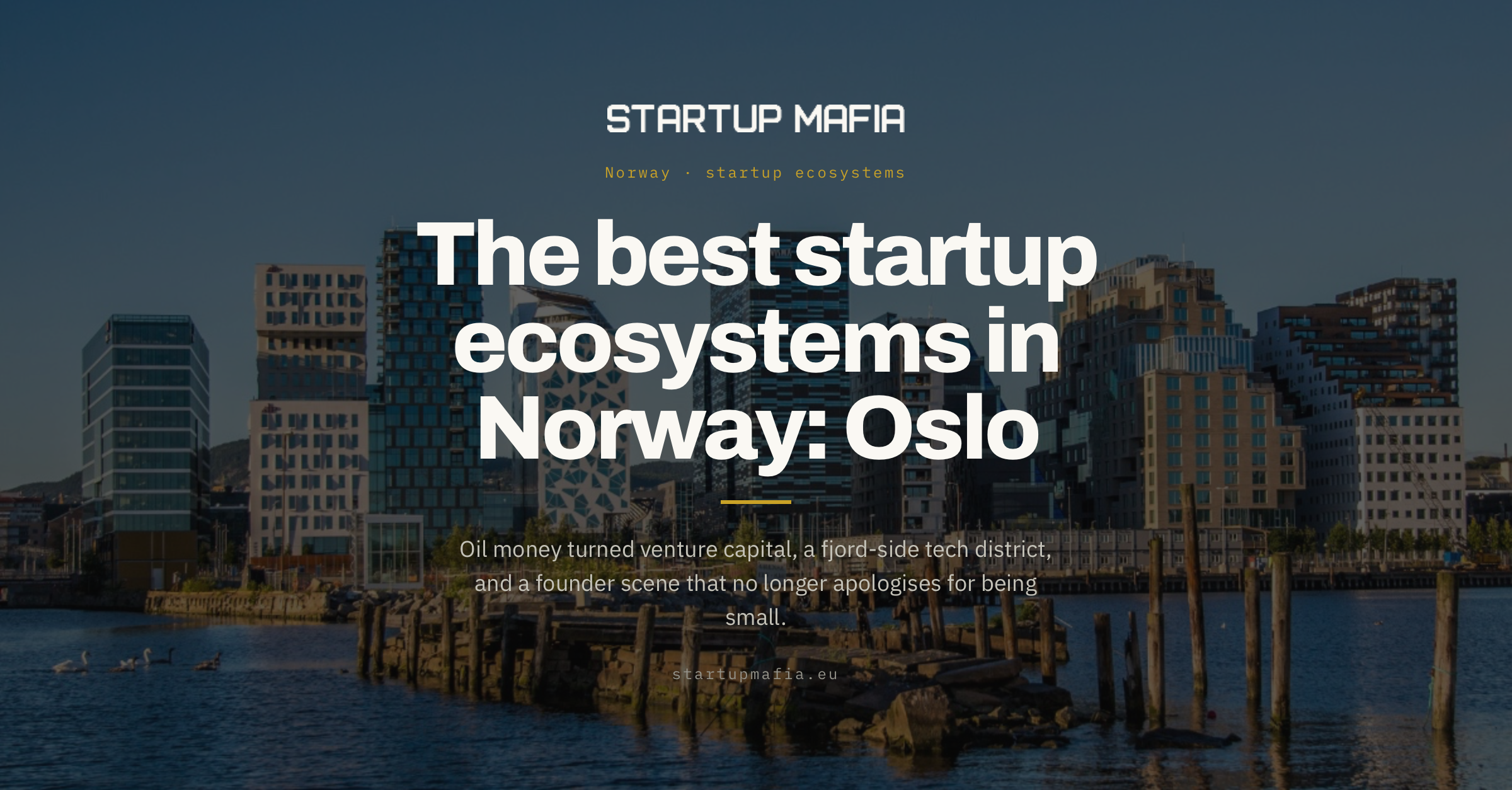
If you only look at one Norwegian city, look at Oslo. It holds the investors, the exits, the accelerators, the public buyers and roughly 70% of the country’s scaleups. It is also, on paper, a strange place to build a company: costly, small, outside the EU, and carrying a tax regime that has pushed several of its own most successful founders abroad.
Both things are true at once. This is a detailed look at what Oslo actually offers a founder in 2026 — the numbers, the sectors, the money, the talent, and the parts nobody puts in the tourism brochure.
1. The numbers, and why they never agree
Start here, because Oslo statistics vary by an order of magnitude depending on the source.
The narrow count. StartupBlink lists 562–583 startups in Oslo, ranking the city #77 globally and #1 in Norway, with total tracked startup funding around $183M. Four Oslo companies have crossed $1B in valuation, and the top three between them have raised over $3.5B.
The broad count. Oslo Business Region, drawing on Menon Economics data, puts the city at roughly 2,200 startups and 188 scaleups. Oslo Innovation Week markets the region as home to over 3,000 startups and scaleups with hundreds of investors. StartUs Insights tracks 570+ Oslo startups averaging 14 employees each.
The gap is definitional, not factual. Oslo Business Region draws the line clearly: a startup is a company with 1–10 employees and a business model forecasting rapid market expansion, while a scaleup has 10+ employees, grows at least 20% annually, qualifies for SkatteFUNN, and has either raised NOK 1M+ in share capital or taken venture money.
That scaleup definition is the number worth watching. Under 200 companies in the whole capital have cleared it. Oslo is a real ecosystem, but it is a small one — closer in scale to Copenhagen or Helsinki than to Stockholm, and nowhere near Berlin or London.
Funding direction is less ambiguous. Nationally, StartupBlink reports funding down 38.4% from 2024 to 2025 with deal count down 48.7%. Oslo-specific commentary describes a seed-stage funding gap and a shortage of risk-willing capital for startups aiming at fast international scaling, with overall funding falling in 2024 versus 2023 even as the ecosystem matures.
2. What Oslo is actually good at
Oslo’s sector mix is not a matter of fashion. It follows the customers who are physically there: energy majors, shipping groups, banks, insurers, the public sector, and a population with unusually high purchasing power and digital literacy.
Industrial and enterprise software. This is the real Oslo specialism. Cognite, spun out of Aker, built an industrial data platform that contextualises sensor and equipment data to improve operational efficiency and safety — and hit a $1.6B valuation on a $150M Series B led by TCV in 2021, since reported around $2B. Ardoq does enterprise architecture, having raised roughly $164M. EcoOnline does workplace risk and compliance. The pattern repeats: expensive operational problem, enterprise buyer, global market.
Fintech. Banks, insurers and a highly cashless population. DNB runs its own accelerator with StartupLab. The FinTech Factory and Nordea Accelerator sit in the same space.
Consumer hardware and design. reMarkable is the standout, raising around $104M and reaching unicorn status in 2022, backed by Spark Capital — proof that Scandinavian design culture still attracts global venture interest.
Marketplaces and consumer. Oda (online grocery, backed by Kinnevik and Kreos), Tise (second-hand fashion), Gelato (on-demand production, $240M Series D led by Insight Partners in 2021, backed by Greylock, Google Ventures and BlackRock).
Edtech. Kahoot!, Norway’s first unicorn, and Attensi, which moved into StartupLab in 2012 and became one of its best-known alumni.
Climate, energy and mobility. Otovo (residential solar, operating across nine European cities), Morrow Batteries, Aker Horizons at Fornebu as a corporate climate incubator.
Crypto and data. Dune Analytics, the on-chain analytics platform founded by Fredrik Haga and Mats Olsen in 2018, reached $1B. More on Haga later — his story is central to understanding Oslo’s biggest structural problem.
Health and life sciences. Concentrated around Oslo Science Park: Aleap is the largest health startup incubator in the Nordics, ShareLab runs Scandinavia’s leading biotech incubator with fully equipped labs across two floors of the Science Park, and Oslo Cancer Cluster runs its own incubator.
What Oslo is not good for: generic consumer apps, anything that needs cheap engineering, and anything that depends on a large domestic market. Norway’s 5.5 million people will not carry a consumer business.
3. The physical map
Unlike sprawling ecosystems, Oslo’s is walkable and clustered in four places.
Forskningsparken / Oslo Science Park (Blindern). The gravitational centre. Adjacent to the University of Oslo, it houses StartupLab, Aleap, ShareLab, and the tech transfer offices. It sits inside Oslo Science City, alongside Inven2 and SINTEF TTO, which move research into commercial use, and the University of Oslo’s Veksthuset innovation unit, which gives students and researchers tools and incentives to push ideas forward.
Vulkan / Grünerløkka. MESH is the best-known startup coworking community. It co-founded NAST (the Norwegian Alliance for Startups and Tech) with StartupLab to shape political debate around startups.
Fornebu / Lysaker. Corporate innovation and hardware. Aker Horizons is here, and Tracxn records one Norwegian unicorn headquartered in Lysaker rather than Oslo proper.
Central Oslo. 657 Oslo, Oslo International Hub (Norway’s largest permanent gathering place for international knowledge workers, with 4,000+ people through it, many of whom went on to found companies), and the bank and corporate accelerators.
4. The capital stack
Oslo’s funding ladder is unusually generous at the bottom and unusually thin at the top. Work it in that order.
Non-dilutive money first
SkatteFUNN is the single most important instrument for a pre-revenue Oslo startup. Administered by the Research Council of Norway with the Tax Administration, it is rights-based — meet the criteria and you are entitled to it. It gives a 19% tax deduction on eligible R&D project costs, capped at NOK 25M of expenses per project per year. Critically, if your company has no taxable income, the credit is paid out in cash. Eligible costs include internal hours, purchased services, instruments and equipment, and the project must involve genuine technical or scientific uncertainty. Apply in the first half of the year — guidance is better and processing faster.
Innovation Norway runs a grant ladder from early validation to internationalisation. The later-stage grants target companies that have already validated a business model domestically and received other public funding, typically requiring some professionalisation — an advisory board, external expertise, a clear international network. Innovation Norway prioritises innovation, scalability, and high value creation with export revenue and new jobs.
Also in the mix: the Research Council’s IP-N innovation projects, Enova for energy and climate technology, and the City of Oslo’s Regional Research Fund.
Accelerators and incubators
| Programme | Investment | Structure |
|---|---|---|
| StartupLab | NOK 2–4M, typically ~10% (convertible loan) | 3-month accelerator, two cohorts a year; 100+ mentors, office space, angel syndicate, corporate partners |
| Antler | ~€100K for ~10–11% | Founder residency, 6–12 weeks, two cohorts a year; phase one is cofounder matching, phase two is traction |
| Katapult Accelerator | €150K–500K for 8–12% | 90-day impact programme, 100+ global mentors, investor demo day |
| Katapult Ocean | ~€150K | Blue economy focus, follow-on capacity up to €4M |
| DNB NXT Accelerator | NOK 2–4M via StartupLab | 3-month programme, free space, DNB executive sponsor; annual, ~September deadline |
| TheFactory | Up to NOK 500K | 12-week fintech/proptech/retailtech programme, 120+ mentors, corporate pilots, two cohorts a year |
| Founder Institute Oslo | None | 4-month part-time curriculum and mentor pool |
StartupLab deserves separate attention. Launched in 2012 by Alexander Woxen with Oslotech, built on entrepreneurial activity at Oslo Science Park, it has become Norway’s largest tech incubator: now in Oslo and Bergen, around 110 active member companies at any time, and investments in more than 130 companies since inception, with industry networks in mobility, data science, hardware and energy. Its own criteria are worth reading as a proxy for what Oslo funds: Norwegian startups with a global vision, with a product launched or launching within six months.
Venture capital
The active Oslo-based and Oslo-facing names: Alliance Venture (seed and early stage), Skyfall Ventures, Sandwater, SNÖ Ventures (B2B software, 1bn+ NOK under management), Idekapital, Arkwright X (€100K–2M into B2B tech), Norselab, and StartupLab’s own fund at pre-seed. Investinor, the state-owned evergreen investor, manages around NOK 4.2bn across internet, software, semiconductors, energy, cleantech, marine and life sciences. Hadean Ventures covers life sciences from Oslo. Verdane comes in at growth stage with over €8bn AUM across digitalisation and decarbonisation themes.
Angel Challenge connects individual investors to startups and is the most structured route into Oslo’s angel base.
The structural problem: OECD data shows Norwegian venture capital investment as a share of GDP is among the lowest in Europe — less than half of Sweden’s and far behind the US. That is the number that should shape your fundraising plan.
5. Talent: excellent, expensive, and hard to incentivise
Oslo draws on a professional talent pool of over 350,000, fed by the University of Oslo, BI Norwegian Business School, OsloMet, and inflows from NTNU in Trondheim.
The engineering quality is high. The price is too. Levels.fyi puts the average total compensation for a software engineer in Oslo at NOK 930,013, with a typical range of NOK 779,458 to NOK 1,108,947, and entry level between NOK 634,865 and NOK 697,294 — with reMarkable topping the list at around NOK 997,510. Broader survey data puts the Oslo software developer average near NOK 986,596. On contract rates, Norway sits 27% above the Europe and UK baseline for senior rates but 12% below North America, with senior contract rates at $51–58/hr and lead-tier stretching past $69/hr where architecture ownership is involved.
Two complications:
Remote US competition. Oslo employers now compete with remote US contracts for the same senior talent, which has pushed the senior tier upward specifically. Demand for Swift, Rust and MLOps specialists has moved from niche to premium inside two years.
Language. English works fine in business, but Norwegian matters for full social integration and for advancing into senior leadership. If you are hiring internationally, plan for it.
The equity problem — and the fix
Oslo’s tax-favoured share option scheme is the tool most foreign founders miss. Under it, taxation is deferred until the employee sells the shares rather than triggering at exercise, and gains are taxed as capital income rather than salary — roughly 38% instead of up to 47.6%, with a recent regulatory update significantly widening eligibility.
Use it. Without it, Norwegian option grants are close to useless as an incentive.
6. The elephant in the room: wealth tax and exit tax
You cannot write honestly about Oslo without this section.
Norway levies an annual wealth tax (formuesskatt) on net wealth above roughly NOK 1.76M for a single person, at 1.0% above the threshold and 1.1% above NOK 20M. The decisive change for founders came when working capital in private companies, previously discounted to 65%, was raised to 80% and then to 100% of market value.
The consequence for startup founders is direct: they are often taxed on capital long before their companies are profitable. The wealth tax bill is payable in cash, which for a founder holding illiquid shares in a loss-making company means forcing a taxable dividend out of the business simply to pay it — with net leakage above 60%.
This is not theoretical. Fredrik Haga, co-founder of Dune Analytics, relocated to Switzerland after facing substantial wealth tax liabilities on the paper valuation of a loss-making business that could not distribute dividends.
Layered on top is the exit tax, tightened in the 2024 budget round. Leaving Norway now triggers a deemed disposal of your shares the day before departure, taxed at 37.84% on unrealised gains above a NOK 3M allowance, payable immediately or over a 12-year instalment plan — and the old five-year lapse window is gone.
The startup community has pushed back. MESH and StartupLab founded NAST specifically to shape the political debate. Johan Brand of Kahoot! has argued the tech sector is collateral damage in a rule aimed primarily at wealthy individuals, noting that the Netherlands and the US have exit taxes too — the issue is how it lands on employees and founders paid in equity who later relocate. One Norwegian founder went as far as saying they would stop hiring international talent because of it.
What this means practically. Take tax advice before you incorporate, not after you raise. Structure early. Understand that a paper valuation in Oslo creates a real cash liability, and that this is the most common reason Norwegian founders redomicile.
7. Oslo’s underrated advantage: the city itself is a customer
This is the part most guides miss.
Oslo ranked #1 of 50 medium-sized cities globally for government appetite to adopt new technology. Oslo Business Region actively facilitates collaboration between startups and the City of Oslo to test, pilot and scale solutions through public procurement and partnerships.
The national framing behind this is explicit: to maintain the welfare state, Norwegian exports need to double by 2040, and that will not happen without expanding the growth-company ecosystem. Public money and public procurement in Oslo are pointed at the same goal you are.
If your product touches mobility, energy, waste, health services or the built environment, a municipal pilot is a realistic and reference-worthy first contract — and easier to get in Oslo than in most European capitals.
8. The calendar
Oslo Innovation Week is the single event worth planning around. It runs 80+ events across climate tech, health tech, deeptech, ocean tech, fintech, industrial tech and circular economy, with 500+ investment firms participating, digital and in-person investor matchmaking, and 100 Pitches — Norway’s largest investor-ready pitching competition, run by StartupLab, DNB NXT and OIW.
Also on the circuit: DNB NXT, Oslo Startup Day, Norway Health Tech Demo Day, and TheFactory Demo Day.
9. The honest verdict
Oslo is the right choice if:
- You are selling enterprise or industrial software and want energy, shipping or financial customers in the same city.
- You need to raise — this is where Norwegian investors are.
- You want a municipal or public-sector reference customer.
- Your company is research-adjacent and benefits from the Science Park cluster.
- You need commercial and go-to-market hires more than raw engineering volume.
Oslo is the wrong choice if:
- Your burn is tight and you don’t need the investor proximity. Trondheim and Bergen are materially cheaper, with Oslo rents at 12,000–18,000 NOK a month for a one-bedroom against 8,000–12,000 in Trondheim.
- Your customers are ships, fish farms or offshore platforms — go to Bergen or Stavanger.
- You expect to be worth a lot on paper before you are profitable, and you haven’t planned for the wealth tax.
And regardless: treat Oslo as a launchpad, not a market. Local validation is not global product-market fit, and Norway’s home market sets the ceiling. The Oslo companies that worked — Cognite, Gelato, reMarkable, Kahoot, Dune — all sold abroad early.
10. A practical first 90 days in Oslo
- Incorporate an AS and get advice on founder share structure and the wealth tax exposure before your first priced round.
- File SkatteFUNN in the first half of the year. It is rights-based, and the cash refund for loss-making companies is the closest thing to free money in the ecosystem.
- Set up the tax-favoured option scheme from your first hire. Retrofitting it is painful.
- Apply to StartupLab or Antler — not primarily for the money, but for the network density. NOK 2–4M for ~10% is not cheap capital; the mentor base, angel syndicate and corporate partners are the actual product.
- Go after one paid pilot, ideally with a large Norwegian industrial or the municipality. A signed budget beats a letter of intent, and Oslo’s public sector is unusually willing.
- Build your international investor list in year one. Given how thin late-stage Norwegian capital is, the Series B conversation needs to start eighteen months before you need it.
- Book Oslo Innovation Week and apply to 100 Pitches.
Oslo will not give you cheap talent or a big home market. It will give you sophisticated industrial customers, generous public R&D funding, a dense and genuinely helpful ecosystem inside a two-kilometre radius, and a government that actively wants to buy from you. For the right kind of company — B2B, technical, export-minded — that is a better deal than it looks from the outside.
Just do the tax planning first.